
By Associated Press staff
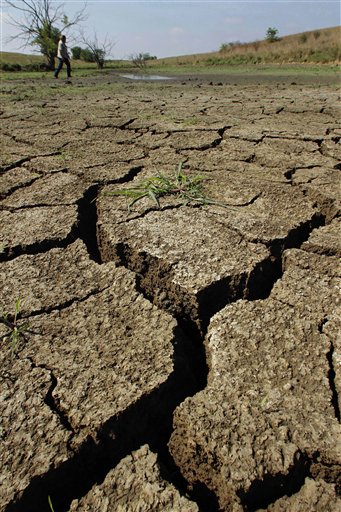
CHAMPAIGN, Ill. — The United States is in the midst of the worst drought in decades, and the dry weather and soaring temperatures are taking a toll on people living and working in Ohio west to California and Texas north to the Dakotas.
Farmers have watched their corn wither and their cattle go hungry.
Homeowners have seen their lawns turn brown and gardens wilt.
Communities in the Midwest that rarely experience water shortages have enacted restrictions, and businesses are looking for ways to stay afloat as sales fall off.
Here are a few of their stories:
WATER FOR QUARTERS
The creeks and ponds that Cimeron Frost’s 300 cows and calves drink from in central Illinois are almost dry.
So each day, he takes rolls of quarters to what amounts to water vending machines in nearby towns.
He drops in the coins, collects the water in metal and plastic tanks and tows it on trailers to his pastures around the town of Tallula.
He hauls 4,000 gallons a day in four separate trips, dumping or piping the water into big, galvanized-steel troughs for his herd to drink.
Even at 40 to 50 gallons per quarter, it adds up.
“It takes a little over two rolls of quarters a day, plus probably $40 in gasoline a day, to water all our cows in all our locations,”
Frost, 65, said.
At $10 a roll, that’s about 60 bucks a day, or $420 a week, and he’s been hauling every day since mid-June.
He estimates he has spent about $2,700 so far. But he worries more about what could lie ahead.
“If we don’t have a wet fall and a wet spring, we could be in trouble for another year,” Frost said.
BUY NOW, PLANT LATER
Jeff Gatewood has never seen a summer this bad in 36 years at Allisonville Nursery in the Indianapolis suburb of Fishers.
Indianapolis had its hottest July on record, with temperatures topping 90 degrees on 28 days, and less than an inch of rain fell in June and July.
“We’ve now gone where nobody’s gone before. Hot, dry, hot, dry, record-setting all the time,” Gatewood said.
With business down 20 percent to 30 percent because of the weather, he quit ordering new plants in June and cut hours and staff.
Then he decided to get creative.
The nursery held a “heat stroke” sale in late July, offering customers a chance to buy plants and pick them up later, once cooler temperatures arrive and local watering bans are lifted.
That brought people in and helped business some, he said.
“We’re seeing a pent-up demand like a dam wanting to break. I think once we see cooler temperatures in the lower 80s, get a little rain shower — that’s going to help,” he said.
The nursery has clustered plants in shaded areas to protect them. Gatewood said hydrangeas are especially vulnerable.
“Even in the shade, when it’s 95 or 100, they hate it,” he said.
CREATIVE FORECASTING
Facing three minutes to fill on the nightly newscast, a TV station blog to update and a forecast reading something like “sunny and 102” for the umpteenth day in a row, meteorologist Todd Yakoubian doesn’t sweat.
He pulls out a meat thermometer.
“I try to keep it as interesting as possible,” said Yakoubian, a meteorologist with KATV in Little Rock, Ark. “You can’t do the same thing day in and day out.”
To illustrate just how hot it has been in Arkansas, and for how long, Yakoubian recently filled a sink in his home with water from the “cold” tap and measured it at a not-very-refreshing 84 degrees.
He also has fried eggs on a sidewalk and baked cookies in a car, but admits everybody does that.
He’s on a quest to find other ways to show just how doggone hot the dog days are.
“I put a wireless thermometer in the attic and hooked up a webcam and streamed it for “How Hot Is It In Todd’s Attic?”
The answer: 138.6 degrees.
He also took temperature readings in his wife’s car to show viewers how dangerous it was to leave children or animals in vehicles that can reach 130 degrees.
“I used a meat thermometer because it was the only one I had that would go that high,” Yakoubian said.
A SILVER LINING
There may be a silver lining to the drought: The so-called “dead zone” in the Gulf of Mexico is shrinking and the summer has seen fewer tornadoes.
The dead zone is an area of low oxygen in the waters that is a long-standing environmental problem, which experts say is caused by farm pollution running into the Mississippi River and then the Gulf of Mexico.
But with less rain, there is less runoff.
Nancy Rabalais, a dead zone expert with the Louisiana Universities Marine Consortium, found the dead zone was the fourth smallest in 80 years of records.
It measured only 2,889 square miles in July, compared to a five-year average of 5,695 square miles.
Tornado Alley also has been quiet this summer. In mid-April, the U.S. looked like it was on pace to set a record with the number of tornadoes this year. Then the storms stopped coming.
In June, there were about 100 tornadoes, the second fewest in more than 60 years of recordkeeping.
Then in July it got even slower, with a preliminary count of 24. Before this year, the fewest tornadoes the U.S. had in July was 73.
The heat wave and drought are the primary reason for fewer twisters, said Harold Brooks, a research meteorologist at the National Severe Storm Laboratory in Norman, Okla.
In a drought, there are fewer thunderstorms from which tornadoes can form.
But there’s also less wind shear, which storms need to get rotation for tornadoes, said Jeff Masters, meteorology director at Weather Underground.
But exchanging tornadoes for drought and extreme heat is not a good trade. Tornadoes typically kill one or two people each July, but the heat waves are killing dozens.
“I think heat waves are the most dangerous weather phenomena out there,” Masters said.
DROUGHT-RESISTENT CORN
A deepening drought in the nation’s farm states has cut further into this fall’s harvest, with farmers now expected to pull from their fields the lowest corn yield in more than a decade.
But American farmers are still expected to produce their eighth-largest harvest ever, 10.8 billion bushels, and while there’s sure to be a rise in prices at the grocery stores — corn is used in everything from cosmetics to cereal, colas and candy bars — there’s little risk of a failed harvest that would lead to shortages on the shelves.
It is also enough to meet the world’s needs.
The drought stretching across the U.S. from Ohio west to California is deepest in the middle of the country, and major farm states like Iowa and Illinois are seeing conditions get worse each week.
Farmers credit advances in seed technology that have produced hardier, more drought-tolerant corn for any harvest at all.
WEEPING WILLOWS
The limbs of the weeping willows gracing banks of a lake at the Chicago Botanic Gardens drooped more than usual, and the leaves — normally plush and green — wilted and began to fall after several weeks of unusual heat.
Weeping willows are water-loving trees, said Tim Johnson, horticulture director for the botanic gardens: “When things dried down, they responded. The leaves yellowed up and some dropped.”
Many of the gardens’ 2.5 million plants have required extra watering during the summer’s triple-digit heat, but the willows were a special case.
Groundskeepers have been excessively watering the willows about once a week for about a month, drawing water
from several lakes on the property to deluge the roots for about 30 minutes.
One tree that was in particularly bad shape required 850 gallons of water, an amount that usually hydrates several miles on the 385-acre reserve, during one watering alone.
Still, the foliage wilts.
“The damage has been done,” Johnson said.
RESOURCE RATIONING
Randy Pettinghill buys water from the city of Morrilton for his farm in the Arkansas River Valley, but this year, the city put a cap on what he could have. It turns on the spigot every third night from 7 p.m. to 7 a.m., and Pettinghill collects as much as he can in lagoons on his property in Arkansas’ Conway County.
He tries to ration the water, but with the temperature regularly over 100 degrees, he’s losing a lot to evaporation.
He has wells on his property too.
He spent $25,000 to have the second one drilled in July because the first was producing half its normal amount of water.
He connected the two, and they still aren’t producing enough to keep his corn and soybeans irrigated. He left about two-fifths of his 1,700 acres unplanted this year, and he’s been pumping water onto the rest, spending $22,000 a month for fuel.
“If I run out of water, they’ll be dead in two weeks,” he said.
CASHING IN
For some, the drought will likely be a money-maker — especially those who fall outside the dry-weather zone.
One of those farmers is Harlan Anderson.
The rainfall on his 800-acre farm near Cokato in southern Minnesota has been normal, maybe a bit more. That means he’ll have alfalfa, corn and soybeans to sell when others don’t, and he’ll benefit from rising prices.
But demonstrating what he described as his Scandinavian sense of reserve, Anderson said he feels a little guilty when talking about how he expects to profit from the misfortune of other farmers in the Upper Midwest.
“My projection is that our gross profits for the year will double,” Anderson said. “The drought has certainly been good to me. Don’t say that too loud.”
He’s started getting frequent calls in recent weeks from livestock farmers around the country. Some usually grow their own feed, while others buy it from farmers like Anderson. All are starting to worry about their supply.
“Looking ahead, they’re trying to decide if there’s a sufficient supply of feed, can they afford it and are they going to keep feeding their dairy cow or their horse — or are they going to shoot them?” Anderson said.
