
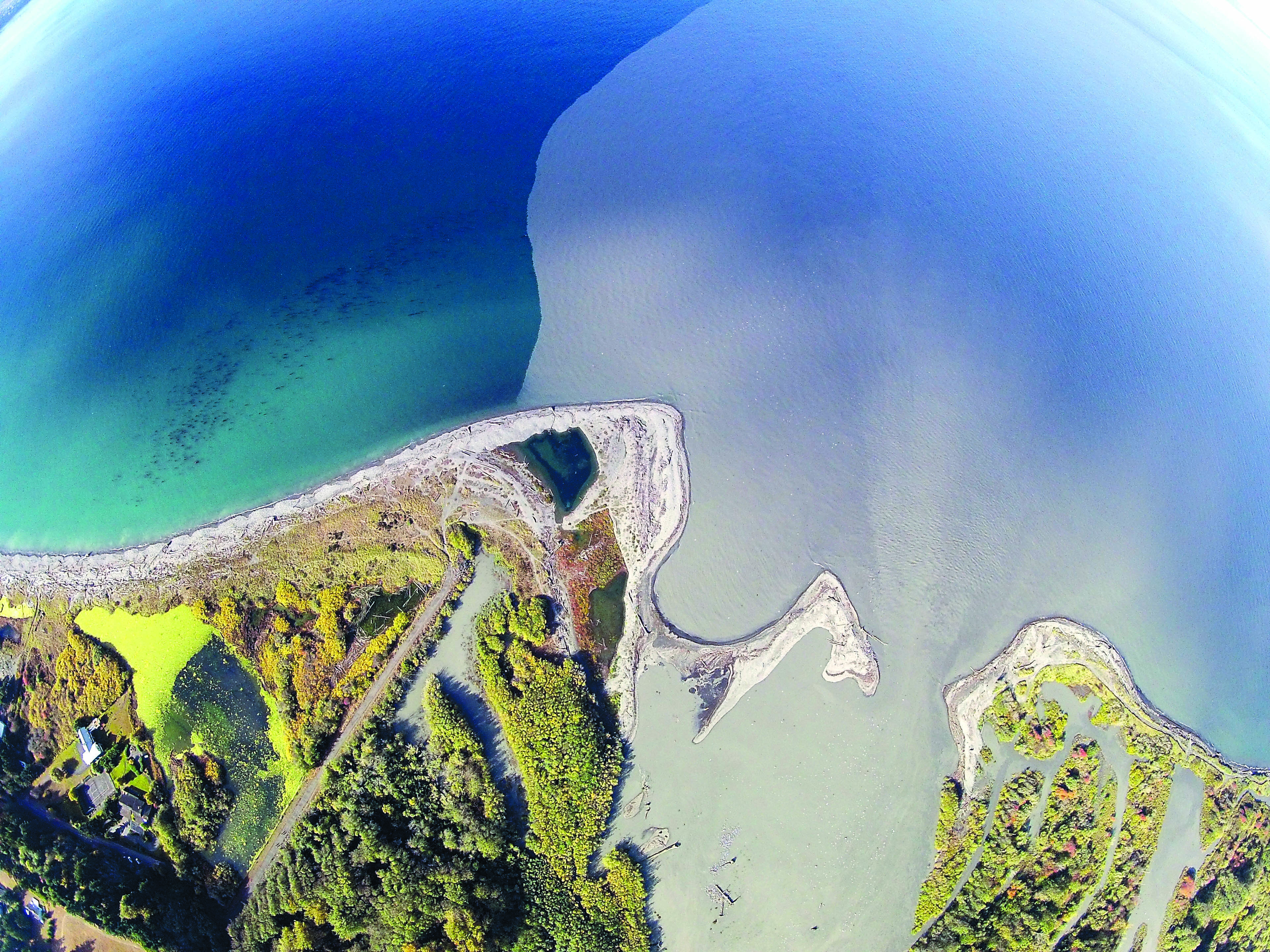
OLYMPIC NATIONAL PARK — A rain-swollen Elwha River is now flowing freely for the first time in a century, triggering the first big release of some of the 20 million cubic yards of sediment stuck behind what’s left of Glines Canyon Dam.
While scientists are giddy over the long-anticipated and well-planned flush of Lake Mills sediment, coho and chum salmon are ducking for cover since the river’s turbidity has spiked seven-fold since summer.
“They’re headed to the closest clean water they can get to,” said Robert Elofson, river restoration director for the Lower Elwha Klallam tribe.
“They’re having trouble, but that was expected to happen. That’s why we have the hatchery and rearing channel.”
Elofson said the water is still too murky to tell whether the sediment is killing fish.
Olympic National Park spokeswoman Rainey McKenna said the river’s turbidity — the water cloudiness caused by suspended particles which is measured in formazin nephelometric units — peaked at 3,500 fnu last week compared with readings that stayed below 500 fnu in the summer.
“This is something that we’ve planned for,” McKenna said.
“It’s going to be a short-term impact [on fish].”
Crews halted blasting at Glines Canyon Dam on Thursday for a two-month “fish window” intended to keep sediment from reaching toxic levels for migrating fish.
Lake Mills, the man-made reservoir formed by the 210-foot Glines Canyon Dam when it was built in 1927, now is gone.
The river flows freely through the former lake bed and over the top of the remaining 60 feet of the broken-down edifice.
Scientists knew that once the dam was below the bottom of the lake bed the major release of sediment would commence.
“We did expect high sediment levels for a couple of years,” Elofson said.
“I think we were predicting two to three years after dam removal. I’m hoping it goes a little bit quicker.”
Removal of the Glines Canyon and Elwha dams were the cornerstones of a $325 million federal project to restore the Elwha River and its legendary salmon runs.
The Elwha Dam, which was built without fish ladders five miles from the river mouth, was knocked out in less than six months from September 2011 to early March.
Plants are sprouting up in what used to be Lake Aldwell, the reservoir formed by the Elwha Dam when it was completed in 1913.
Nine miles upstream, removal of Glines Canyon Dam is more than a year ahead of schedule. Barnard Construction of Bozeman, Mont., will be finished by summer, at which time 70 miles of pristine habitat within the national park will be available for migrating salmon.
Meanwhile, nearly half of the 24 million cubic yards of sand, silt, cobble and gravel that was trapped behind the dams will make its way to the Strait of Juan de Fuca over the next three to six years.
“We have a lot more sediment coming downstream because the higher water is moving a higher volume,” McKenna said Friday.
“We’re seeing sand deposits throughout the middle stretch of the river [between the dam sites], and we’re also seeing sand deposits at the mouth of the river.”
Elwha River flows peaked at about 5,000 cubic feet per second on Wednesday night, according to the U.S. Geological Survey.
Flows had receded to 2,000 cfs by Saturday, still double the seasonal average of 1,000 cfs.
To deal with the murky water, spawning coho and chum have taken sanctuary in the tribal fish hatchery, state rearing channel or tributaries such as Little River or Indian Creek.
“The fish are moving, but not many of them,” Elofson said.
“The sediment levels are too high. We’ve spotted a few new redds (nests) upstream, but not a lot like the chinook we saw earlier.”
More than 300 coho have found their way into the tribe’s $16.4 million fish hatchery on the lower reaches of the river, enough fish to sustain the population, McKenna said.
A lesser number of chum have taken cover at the nearby rearing channel.
“Both of these locations provide clean water,” McKenna said.
Scientists have been conducting fish surveys on the Elwha River every seven to 10 days.
Olympic National Park is posting regular updates on the dam-removal project at http://tinyurl.com/8st2klp.
________
Reporter Rob Ollikainen can be reached at 360-452-2345, ext. 5072, or at rollikainen@peninsuladailynews.com.