
PORT ANGELES — The beach at the Elwha River mouth and the sea life that has taken up residence in the newly expanded delta seem to be settling into a new normal, according to scientists studying the Elwha River restoration project.
“The nearshore appears to be settling down,” said Anne Shaffer, executive director and lead scientist of the Coastal Watershed Institute, which is studying the changes to the land forms and aquatic life in and around the mouth of the Elwha River and the estuary after two dams on the river were demolished, Elwha Dam in 2012 and Glines Canyon Dam in 2014.
Debris from behind the two Elwha River dams initially created 80 to 100 acres of new sandy beach where, in 2011, the mouth of the river consisted mostly of plate-size cobbles that dropped steeply into the surf.
Those sandy beaches are now making way for some areas of cobble and gravel, along with swaths of sand, Shaffer said.
Rapid growth slows
Shaffer said scientists aren’t sure whether, or when, the mix might change again but said the area’s rapid growth has slowed.
“We’re not seeing those huge pulses of sediment we have seen in the past. Those big, catastrophic deluges of silt seem to be over,” she said.
She said there may still be large sediment flows with major rainstorms, but nothing like the rivers of fine silt and sand that flowed down the waterway in the first years after the dams were removed.
Instead of the continuous, almost explosive growth of beach that happened between 2012 and 2015, it has changed to a more natural seasonal pattern.
The sediment is transferred down the shoreline beach during high surf action and is replaced with new beach sand and gravel when winter storms bring down new silt from the river, Shaffer said.
Some reaches of the sandy beaches of the new lower river initially created are now alternating with areas of cobbles and gravel, as each storm and each flooding episode on the Elwha River changes its size and configuration, she said.
Sand spit
Shaffer said the current configuration is a sandy hook, or sand spit, jutting into the Strait of Juan de Fuca from the eastern side of the river’s mouth, creating a protected estuary.
“We’re still very much in the restoration phase of this shoreline evolution,” she said.
“We don’t know the final form of the delta.”
She noted that the details are likely to change as the river mouth shifts in its channels.
Surveys
The first fish surveys began in 2001, with long-term scientific surveys beginning in 2005 — years before the removal of the two dams that once blocked the flow of the river — to establish a baseline of what was normal with the dams in place, to compare later surveys of the river, estuary and beaches.
The Institute has sampled standard sites at the Elwha and Salt Creek — the study comparative site — monthly for more than a decade.
Surveys are funded through donations to the Institute.
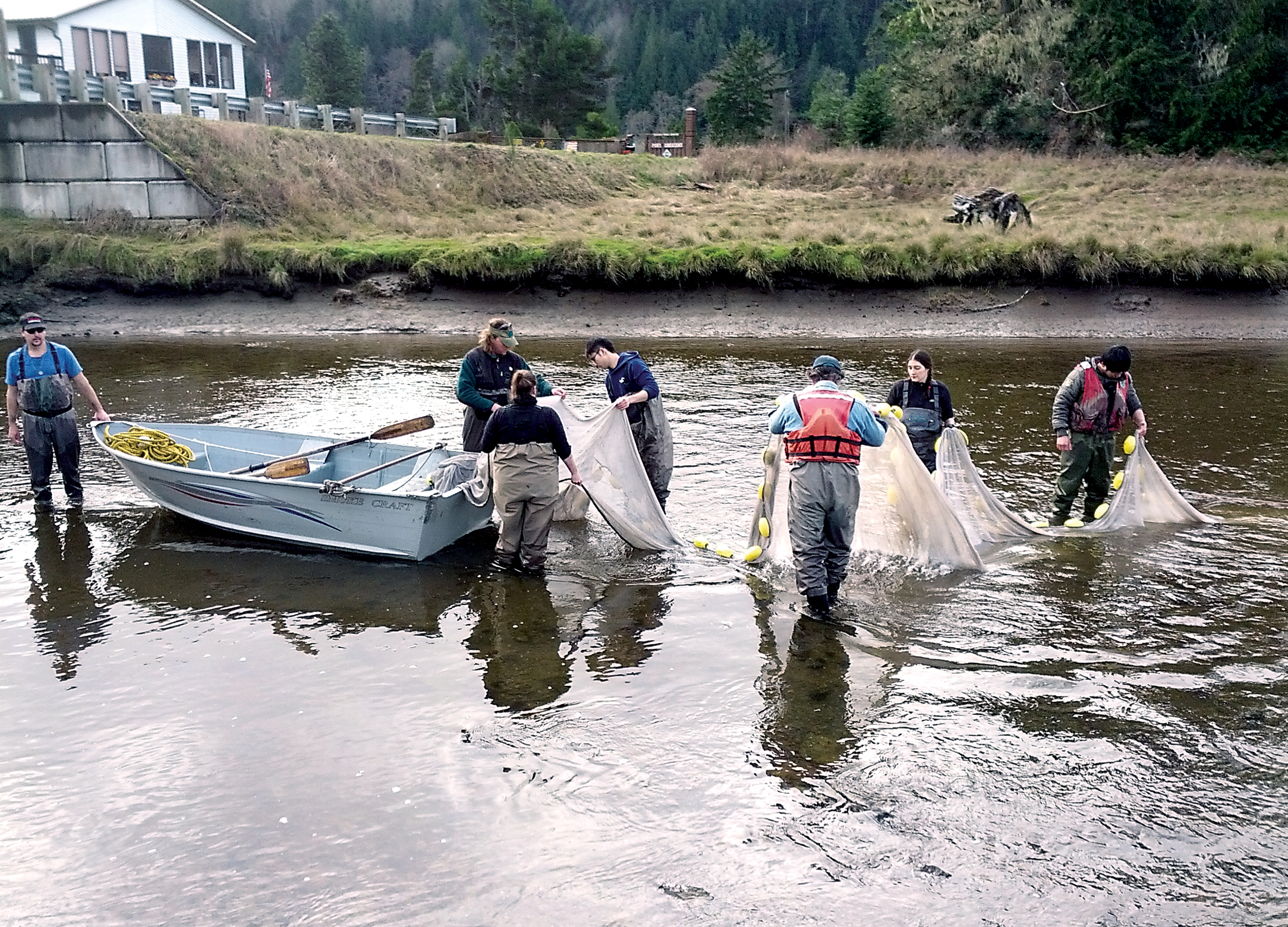
So far in 2016, Shaffer, with a crew of biologists and student interns, surveyed the mouth Jan. 15 and Feb. 1.
They found juvenile chinook, steelhead, chum and coho, and both adult and juvenile surf smelt.
“The juvenile wild steelhead are very encouraging,” she said of the recovery of the fish that was nearly eliminated from the river.
“The fat adult and juvenile smelt foraging in the Elwha lower river are also encouraging.
“This is not the freshwater smelt. They are not gravid (spawning). So it’s really interesting that they are in the lower river,” she said.
She noted that the adult surf smelt have been found in the lower river each January for many years.
Baby chum salmon — once the second largest run of the system, and the ecological backbone of the Elwha system — are just beginning to emerge from nests in the river bed to migrate out of the river and into the ocean, she said, one of the earlier migrations of their kind.
Beavers are longtime residents of the Elwha shoreline and are doing very well, she said.
Migrating sea gulls use the estuary as a rest area and bald eagles have become common visitors to feed on the fish and other animals attracted by the site.
New forage fish
The reappearance of salmon in the Elwha River high above the former dam sites began as soon as the dams were removed, and there has also been a return of several small forage fish species that had not been seen in the Elwha River estuary system.
The brand-new estuary and sandy beaches attracted eulachon and long-fin smelt, both of which are anadromous smelt that return to fresh water to spawn.
These are small fish that salmon, marine birds and whales depend upon as a food source, Shaffer said.
Elwha Dam, once located 5 miles south of the river mouth, was built in 1912. In 1927, Glines Canyon Dam was added 13 miles south of the river mouth, blocking silt working its way toward the mouth.
The electricity generated by the dams was a major factor in the development of the North Olympic Peninsula, but since the dams were built without fish ladders, they halted the annual migration of what once were legendary salmon runs on the Elwha River.
Destruction of both dams and replanting of the river’s bare banks in a $325 million restoration effort released it back to its wild state.
Once the dams were gone, much of the sediment trapped behind them in Lake Mills and Lake Aldwell was carried downstream by the river to form sandy beaches and push the estuary further into the Strait.
Dam removal formally ended August 2014. Estimates are that most of the sediment will arrive to the nearshore within five years of the conclusion of dam removal.
“Nearshore changes associated with this sediment delivery will likely occur for decades,” Shaffer said.
“These seasonal deliveries of sediment and resulting habitat changes are a product of the restored, beach building, nearshore hydrodynamic engine.
“These changes will become our new normal for the Elwha.”
________
Reporter Arwyn Rice can be reached at 360-452-2345, ext. 5070, or at arice@peninsuladailynews.com.
