
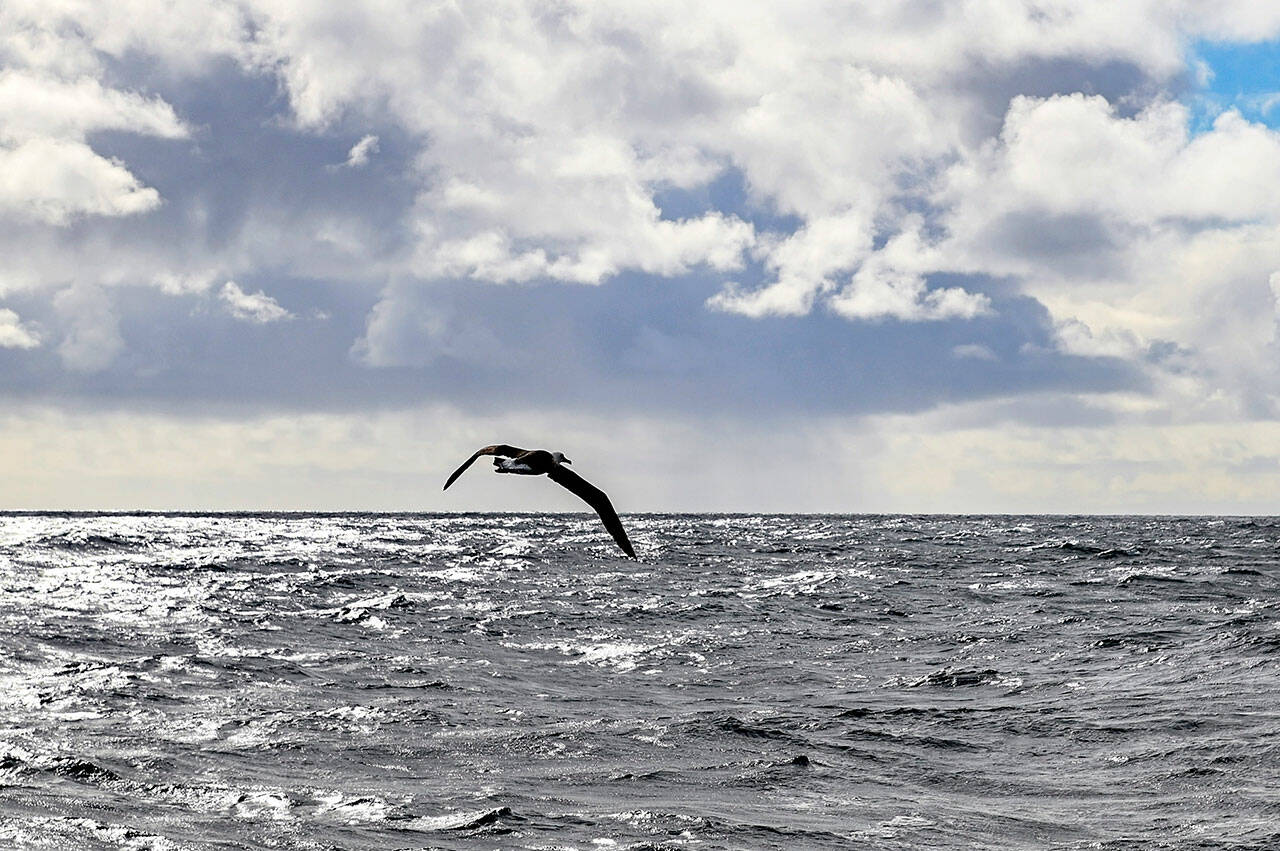
NEAH BAY — Wildlife rescuers released a Laysan Albatross off the coast of Cape Flattery after the bird was found up the Columbia River near Longview last month.
The albatross — one of the largest flying seabirds — was released into the wild on Wednesday though a joint effort by the state Department of Fish and Game, the U.S. Coast Guard and the Progressive Animal Welfare Society in Lynwood.
It was found by a harbormaster in Cowlitz County on Feb. 13. No one knows how or why it got there as the birds spend most of their life at sea, according to Jen Mannas, a wildlife biologist with Fish and Game.
“We don’t typically see them inland, so it’s odd that he was found on the Columbia River,” Mannas said.
The bird was turned over to the Cowlitz County Humane Society who called Fish and Game, and Mannas arranged to have the bird taken to the Progressive Animal Welfare Society, or PAWS, in Lynwood, which has the facilities to take care of sea birds.
Once at the center, the bird underwent surgery to repair a lacerated throat with exposed bone. After the bird was rehabilitated, Fish and Wildlife wanted to release the bird at sea but didn’t have boats large enough to get far enough off the coast to do so.
Fortunately, a U.S. Coast Guard crew was able to make the journey out to sea to release the bird, Mannas said, and on Wednesday a cutter left from Port Angeles with the bird on board.
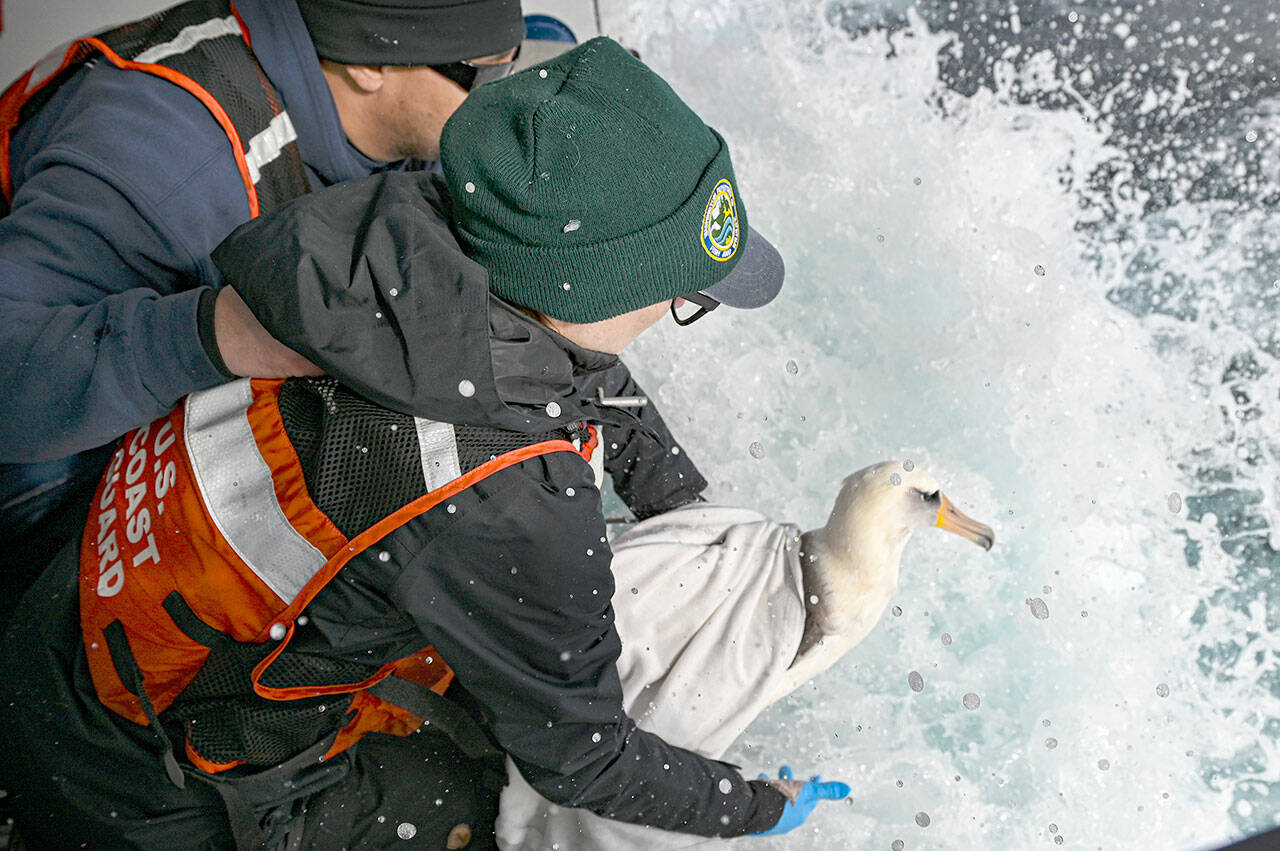
Washington Department of Fish and Wildlife biologist Jen Mannas helps to release a Laysan Albatross from the back of a U.S. Coast Guard cutter off the coast of Cape Flattery on Wednesday. The bird was found on the Columbia River in February and spent almost a month at an animal rehabilitation center in Lynnwood before being released. (Courtesy photo / USCG Petty Officer Steve Strohmaier)
“Albatross need two things to get airborne, one of those is water and the other is really dynamic winds,” Denice said. “They can’t just flap their way into the air. That’s how they stay airborne for so long, you really need them to be offshore and close to their habitat.”
Rescuers also wanted to get the bird close to its natural habitat in case it wasn’t ready to fly yet, Denice said. Albatross spend a lot of time floating on the water looking for food and the crew wanted to give the bird an opportunity to recharge if needed.
But as it turned out, this bird was ready to fly.
“As soon as he got in the water he started flapping his wings, and within 20 seconds he took off,” Mannas said. “It was beautiful.”
Mannas referred to the bird as a “he” but said there’s no way to tell what gender the bird actually was, as male and female albatrosses are practically identical. This particular bird’s weight was right in the overlap zone between males and females so there was no way to distinguish the sex, Mannas said.
Albatrosses can live up to 65 years, Mannas said, but there’s no way to tell how old this bird was other than it was an adult, though she suspected the bird was a young one.
Laysan Albatross only come to land to breed, but their breeding grounds are in the middle of the Pacific Ocean, around the Hawaiian Islands and the Midway Atoll. How this bird arrived on the Columbia River is a mystery, Mannas said.
“Albatross like to follow fishing boats, they know that fishing vessels will provide food opportunities,” Mannas said. “Maybe he hitched a ride.”
It isn’t known how the bird was injured.
Laysan Albatross aren’t endangered, Mannas said, but it’s rare to see them so close to shore. Denice said this bird was the fourth albatross PAWS had treated in 20 years.
Albatross travel around the Pacific as far north as Alaska and can be found off the coast of Japan as they follow food. With a wingspan of up to six feet, albatross are able to ride wind streams with almost no effort Mannas said.
According to the bird-watching group the National Audubon Society, while typically found farther out to sea, the birds have been seen nesting off the west coast of Mexico, and stray birds have been found in the inland Southwestern U.S.
________
Reporter Peter Segall can be reached at peter.segall@peninsuladailynews.com.
