
I APPLAUD PROFESSIONAL trainers who regularly take in abandoned, neglected and/or rescued horses to properly train and prepare for a hopefully long-term and good home. A good home to me means owners who properly care for the horse while it’s theirs; then if or when they need to sell it, they take the time to find it another good home.
I thoroughly love the program Shelby Vaughan, owner of Fox-Bell Farm and Training, in Agnew has. All Vaughan’s dogs and horses, including those used in lessons, are rescues, even her own Grand Prix event horse. A Grand Prix is the highest level of show jumping under the International Federation for Equestrian Sports.
Vaughan is a professional horse trainer and instructs riding students of all ages and levels. Occasionally, she leases a lesson horse or pony from an owner who does not want to sell their animal but hates to see it unused.
Success stories
One such rescue success for Vaughan is Canela. As a baby, Canela had been starved and lived in a horse trailer. After years of abuse, Vaughan adopted him, and after training, he is now one of her best lesson horses in her program.
Vaughan feels that most of her rescue horses originally came from homes with a well-meaning person who lacked the experience needed to take on a horse, especially one that turned out to have behavioral issues. Instead of taking the time, resources and energy needed to work through those problems, people gave up and returned the horse.
To her, the majority of those horses has manmade problems and just need a confident, competent trainer to help them overcome those issues.
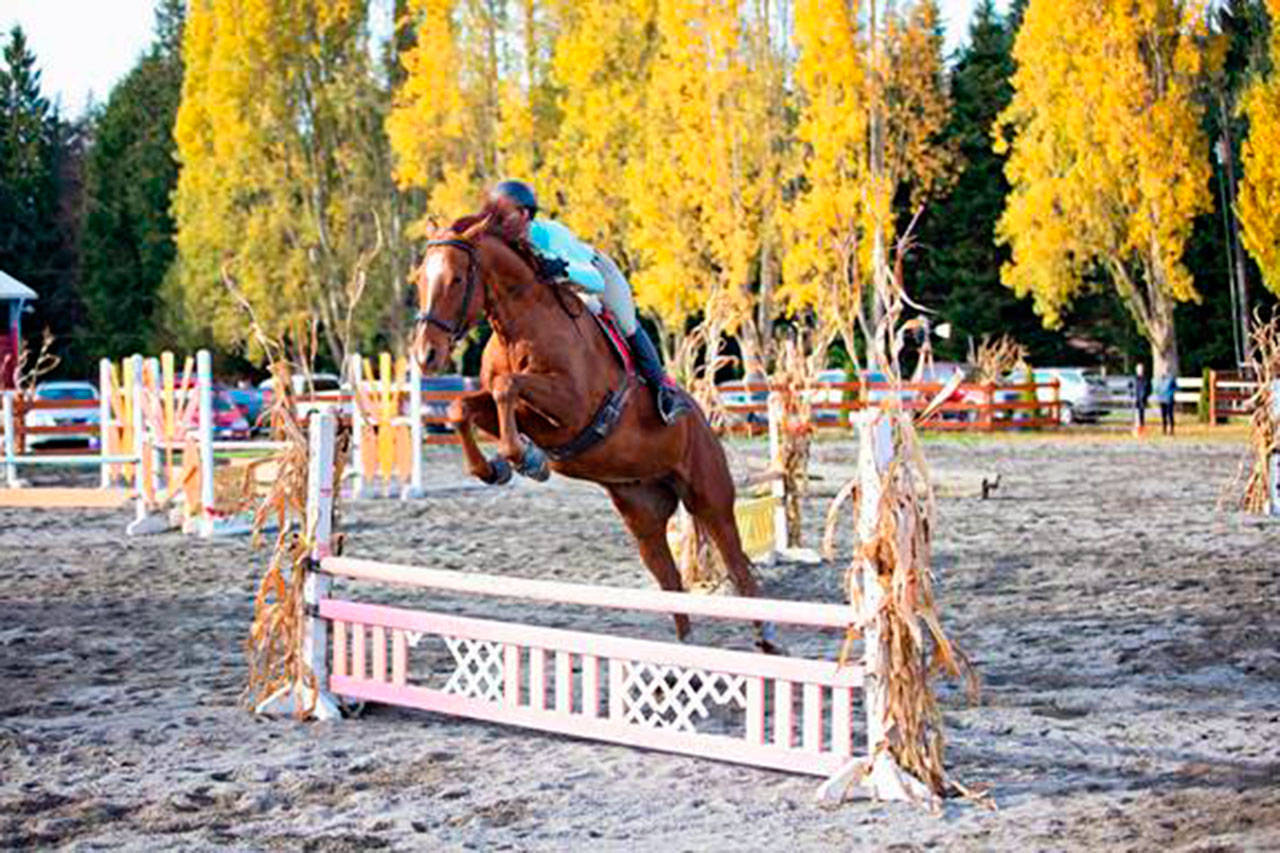
Another example is Cooper, a copper red-colored gelding adopted from a local rescue. One of Vaughan’s assistant coaches, Chloe McGee, is helping train the young horse that, as it turns out, loves to jump. Therefore, the two of them, under Vaughan’s guidance, are furthering their experience and training and — to me — looks as if they will have a champion show jumper on their hands.
Improvements
Since purchasing the farm a few years ago, Vaughan has made many improvements, and it looks fantastic. This year’s efforts include covered shelters in the pastures and what Vaughan refers to as her dream arena — a 130-foot by 280-foot outdoor area with all-season footing in which multiple students can ride at the same time and she can hold large horse shows.
Fox-Bell Farm offers boarding, training, lessons, horse shows, camps, birthday parties and other events. It’s located between Sequim and Port Angeles at 136 Finn Hall Road in Agnew. For more information, call or text Vaughan at 206-399-7683 or view Fox-Bell Farm & Training Facebook page at facebook.com/FoxBellFarm.
Wild hooves
In my previous column, I mentioned the importance of trimming a horse’s hooves every seven to eight weeks for optimal health and to avoid lameness issues. We never want to see horses with hooves that were neglected for so long they curl over. In fact, many choose to trim the hoof more frequently to keep the hooves balanced.
A reader wrote to ask if horses in the wild need their hooves trimmed, too. That’s a very good question. Horses in the wild do not need their hooves trimmed because they walk all day and wear them down. Domesticated horses need their hooves trimmed because people keep them confined and feed them well, so their hoof growth outpaces the rate at which they wear down on their own.
I have a rather large fenced paddock where I feed my horses that I put 5/8-inch minus gravel on. Usually, one gate is open to a pasture. Just walking back and forth on the gravel helps keep their hooves fairly worn, so for the most part, all I need to do is use a good rasp to level and balance each hoof.
________
Karen Griffiths’ column, Peninsula Horseplay, appears the second and fourth Sunday of each month.
If you have a horse event, clinic or seminar you would like listed, please email Griffiths at kbg@olympus.net at least two weeks in advance. You can also call her at 360-460-6299.
