By Tom James
The Associated Press
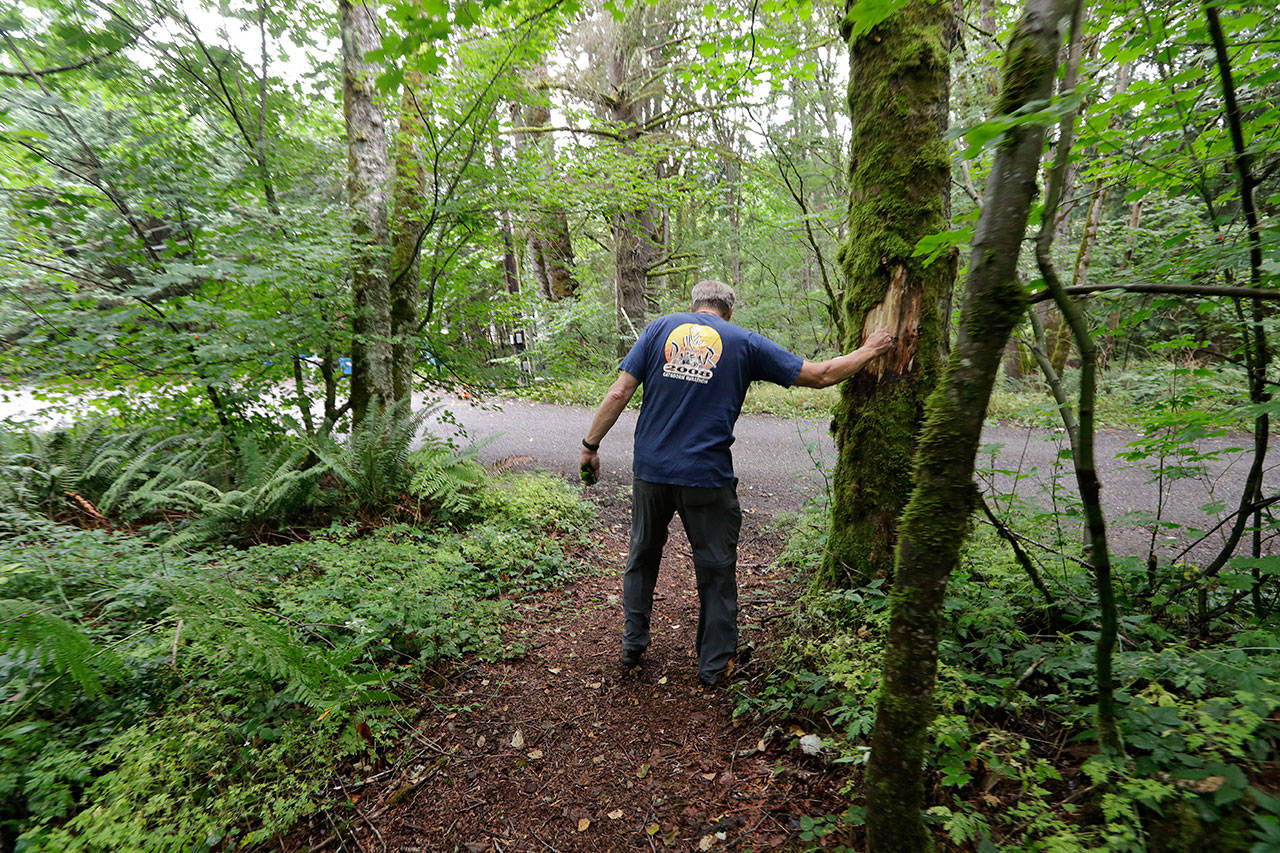
ISSAQUAH — Nestled in the foothills of Washington’s Cascade Mountains, the bustling Seattle suburb of Issaquah seems an unlikely candidate for anxiety over wildfires.
The region, famous for its rainfall, has long escaped major burns even as global warming has driven an increase in the size and number of wildfires elsewhere in the American West.
But according to experts, previously too-wet-to-burn parts of the Pacific Northwest face an increasing risk of significant wildfires due to the same phenomenon: Climate change is bringing higher temperatures, lower humidity and longer stretches of drought.
And the region is uniquely exposed to the threat, with property owners who are often less prepared for fire than those in drier places and more homes tucked along forests than other western states.
In Issaquah and towns like it across the region, that takes a shape familiar from recent destructive California wildfires: heavy vegetation that spills into backyards, often pressing against houses in neighborhoods with few escape routes.
“The only thing that’s keeping it from going off like a nuclear bomb is the weather,” said Chris Dicus, a California Polytechnic State University, San Luis Obispo professor and head of the Association for Fire Ecology, a national group that studies wildfire.
With historically short summers, the densely forested coastal territory stretching from northwestern Oregon to British Columbia has long been cloaked in a protective veil of moisture, making even medium-sized fires relatively rare.
But global warming is changing the region’s seasons.
A national climate assessment prepared by 13 federal agencies and released in 2018 said the Pacific Northwest had warmed nearly 2 degrees Fahrenheit since 1900 and that trend would continue into the century, leading to warmer winters and less mountain snowpack.
Experts have said these long-term changes create a special risk in Pacific Northwest forests: Even a modest increase in contributing factors, such as days without rain, could make them much more prone to burning.
“Those are the kinds of changes that amount to taking a forest and pushing it over the edge,” said Michael Medler, a fire scientist and chair of Western Washington University’s environmental studies department.
Exactly when any one part of the region will reach that point is hard to predict, and researchers stressed that unknowns exist in forests that have burned so infrequently in the past. But all pointed to changes already taking place.
For instance, the region’s fire danger this year reached above-normal levels three months earlier than at any time in more than 10 years, driven partly by an abnormally dry winter.
Fire counts up
And fire counts are up: As of late June, western Oregon forests had seen double the average number of fire starts from the previous decade — 48 compared with 20. Washington jumped even further, with 194 starts compared with an average of 74.
Even the region around Astoria, Ore., which frequently gets 100-plus rainy days per year, has seen a dozen small fires in 2018 and 2019, according to data from Oregon’s Forestry Department. That compares with an average of just two per year over the previous decade.
Last year, 40 percent of Washington’s wildfires were on its wetter western side, which was “alarming and a first for us,” Janet Pearce, a spokeswoman for the state’s natural resources agency, said in an email.
The risk is amplified by development patterns throughout the Pacific Northwest.
A 2013 Headwaters Economics survey of development within 550 yards of forestlands found that just six counties along the western foothills of Washington’s Cascade mountains host more homes in such zones than all of California.
Ray Rasker, who heads the nonprofit land management research group, cautioned the report was narrower than others — which count development up to 1.5 miles from any wildland — and other types of wild areas are more prone to burning than mature forests.
But while officials in California and other states have begun reforming forest-edge building and landscaping rules, such codes are rare in the Northwest, and virtually none apply to houses already built, said Tim Ingalsbee, who heads Firefighters United for Safety Ethics and Ecology, an Oregon-based nonprofit that works to update building codes.
“The western slopes of the Cascades and the Northwest are just woefully unprepared,” Ingalsbee said.
Wildfires get harder to fight when they penetrate neighborhoods, which happened last year in Paradise, Calif., where dozens died and thousands of homes burned.
Like Paradise, Issaquah has neighborhoods surrounded by dense forests, some with only a single road, and strong seasonal winds.
California’s fires were a wake-up call, said Rich Burke, deputy fire chief with the Eastside Fire Department, which oversees fire protection in and around Issaquah, population 39,000.
Not in codes
Wildfire-oriented setbacks and less-flammable materials still aren’t written into building codes on the city’s edges. But Burke said the department now hosts preparedness trainings and has four wildland fire engines.
Jason Ritchie, who owns a home just north of Issaquah, said a nearby 2015 fire drove home the risks.
“It grew so fast,” Richie said, adding that he previously hadn’t considered that his area has only two main routes out.
“Had the wind been blowing from the north to the south, it would have engulfed the neighborhood very, very quickly.”
