
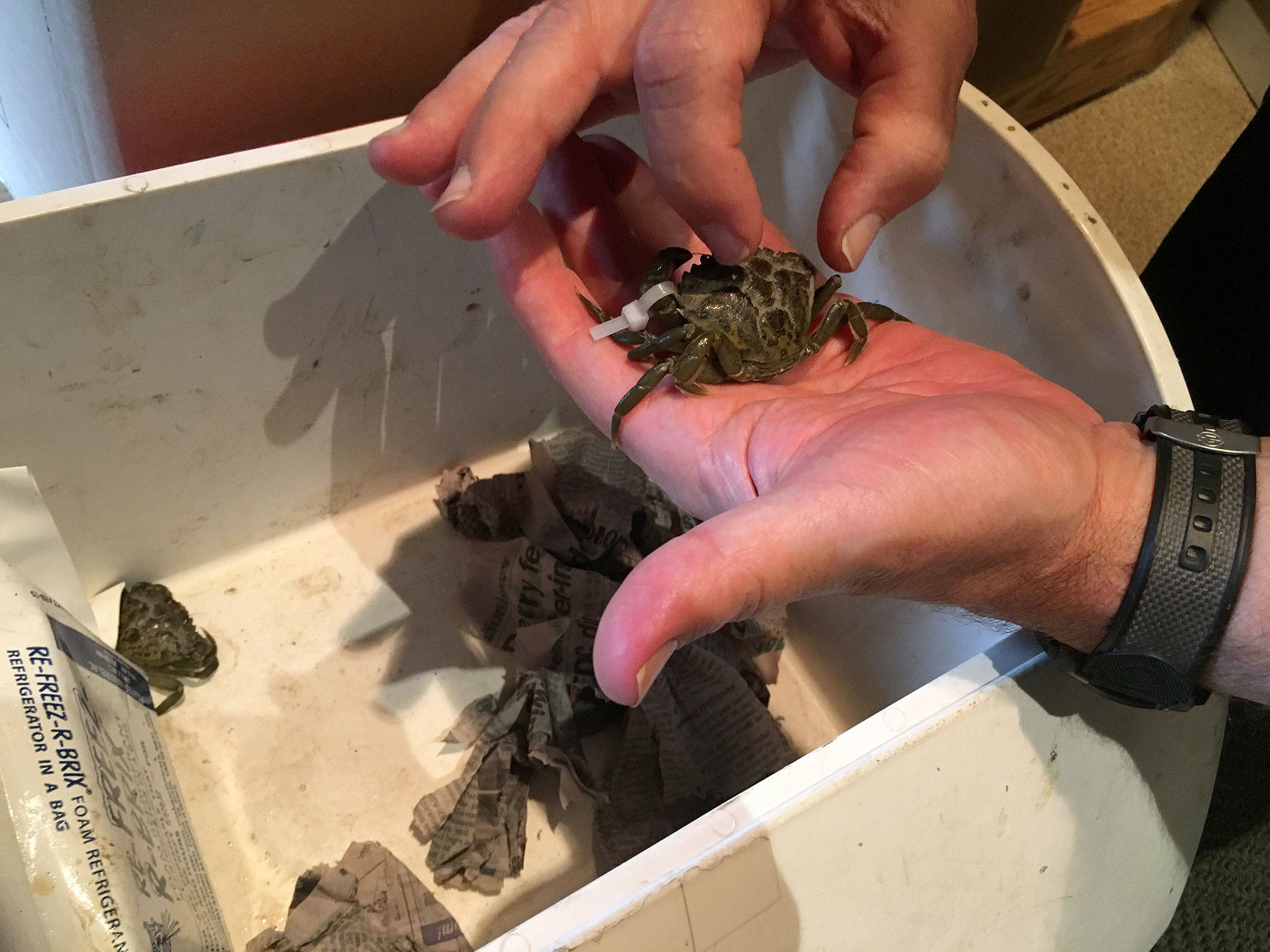
SEQUIM — The invasive European green crab count continues to rise on the Dungeness Spit.
Researchers said 60 crabs had been caught by crews as of Thursday after they had quadrupled the number of traps placed in Dungeness’ waters.
Lorenz Sollmann, deputy project leader at the Washington Maritime National Wildlife Refuge, said staff and volunteers put out 108 traps multiple times last week.
“We’ve got out what we can handle,” he said.
Researchers set out another round of traps Tuesday.
Sollmann said crews have a good system down of cutting bait, checking traps and recording where green crabs are found.
Crews at the Dungeness Wildlife Refuge first found a few green crabs April 13, which is the first sighting of the crustacean along the North Olympic Peninsula.
The green crab, which some scientists have called one of the worst invasive species on the planet, is identifiable by its five spines on each side of its eyes, and despite its name, it can be green, brown or reddish typically with orange joints, said staff with Washington Sea Grant’s Crab Team.
Researchers said the crab often is blamed for damaging shellfish harvests and seagrass beds in the northeastern U.S.
Sean McDonald with the Crab Team said there is a movement for homogenizing species around the globe but the effort doesn’t work out.
“If you care about native ecosystems, like the Dungeness crab and eelgrass, resist the spread of green crab,” he said.
Emily Grason, Crab Team project coordinator, said the green crabs will out-compete Dungeness crab when they are the same size but if the native crabs are larger, then they will out-compete the green crab.
More than 15 stakeholders, ranging from biologists to state officials, met in person and via phone at the Jamestown S’Klallam Tribe’s main campus May 4 to discuss options to prevent the green crab from growing its population.
“We’re trying to get rid of them as soon as possible,” said Allen Pleus, aquatic invasive species coordinator for the state Department of Fish and Wildlife.
Traps were placed across the Dungeness Spit, researchers said, but all of the crabs were found in the same channel on Graveyard Spit, across from Dungeness Landing near Sequim.
Staff with the wildlife refuge say the habitat there is terrific for green crab but it’s hard for crews to access because it’s so mucky.
Neil Harrington, environmental biologist for the Jamestown S’Klallam Tribe, said the tribe’s staff members have done some limited trapping in south Sequim Bay but haven’t caught any green crabs.
He said the tribe is working with other stakeholders to place traps in possible green crab habitat in Sequim and Dungeness bays a few times this season.
Pleus said training stakeholders such as the Jamestown S’Klallam Tribe through Washington Sea Grant to seek out green crabs is one of the next steps envisioned. Small teams would work in designated areas with 20 to 30 traps under an aquatics invasive species trapping permit.
“We’re going to find more crab,” Pleus said. “With resources being what they are, we can’t have someone out there every day, all summer long.”
Despite Graveyard Spit being a good spot for the green crab, Grason said researchers don’t believe there is much good habitat for the species along the Strait of Juan de Fuca west of Dungeness.
However, Sea Grant employees have identified a few sites owned by private property owners. They hope to work with the owners to explore monitoring options for green crab including the Hoko River, Clallam River, Pysht River and Port Angeles Lagoon.
The Crab Team monitors more than 41 sites with more than 170 volunteers.
When a green crab was discovered Sept. 19, 2016, in Padilla Bay, the Crab Team led three days of intensive trapping, placing 368 traps at 31 sites.
In early May, one crab was spotted at an early detection site in Padilla Bay near Mount Vernon, again leading Padilla Bay National Estuarine Research Reserve staff to place more traps as a precaution, Grason said.
The European green crab was first reported on the U.S.’s East Coast in 1817 and in San Francisco in 1989, Grason said. It was first observed in Washington in 1998 and by 2012, it was unintentionally brought by human transport to the Sooke Inlet, west of Victoria, she said.
Dungeness’ population is the largest reported so far in inland Washington. Researchers are still trying to pinpoint its origin.
McDonald said he and other researchers don’t think the cause of the outbreak is human transport or spawning and traveling from northern British Columbia because of the temperatures and currents.
Traveling from Vancouver Island, Oregon, other parts of Washington or Sooke Basin all remain possibilities because of their distance and/or the temperatures of those areas, McDonald said.
Green crab larvae in its earliest stages can travel upward of 100 kilometers (about 62 miles), he said.
One female can release up to a half-million larvae per brood, Grason said, and researchers have said it’s possible females can have more than one brood a year.
But whether local green crabs are mating is unknown, researchers report.
Four moltings have been found so far, which signifies those crabs could be ready to mate, but Grason said crabs molting or hardening their new shells do not come to traps as often, nor will crabs in pre-mating embrace.
For more resources on identifying the green crab, places to look and/or volunteering, visit wsg.washington.edu/crabteam. For those who may have found a green crab, send photographs and location to the Crab Team at crabteam@uw.edu.
________
Matthew Nash is a reporter with the Olympic Peninsula News Group, which is composed of Sound Publishing newspapers Peninsula Daily News, Sequim Gazette and Forks Forum. Reach him at mnash@sequimgazette.com.
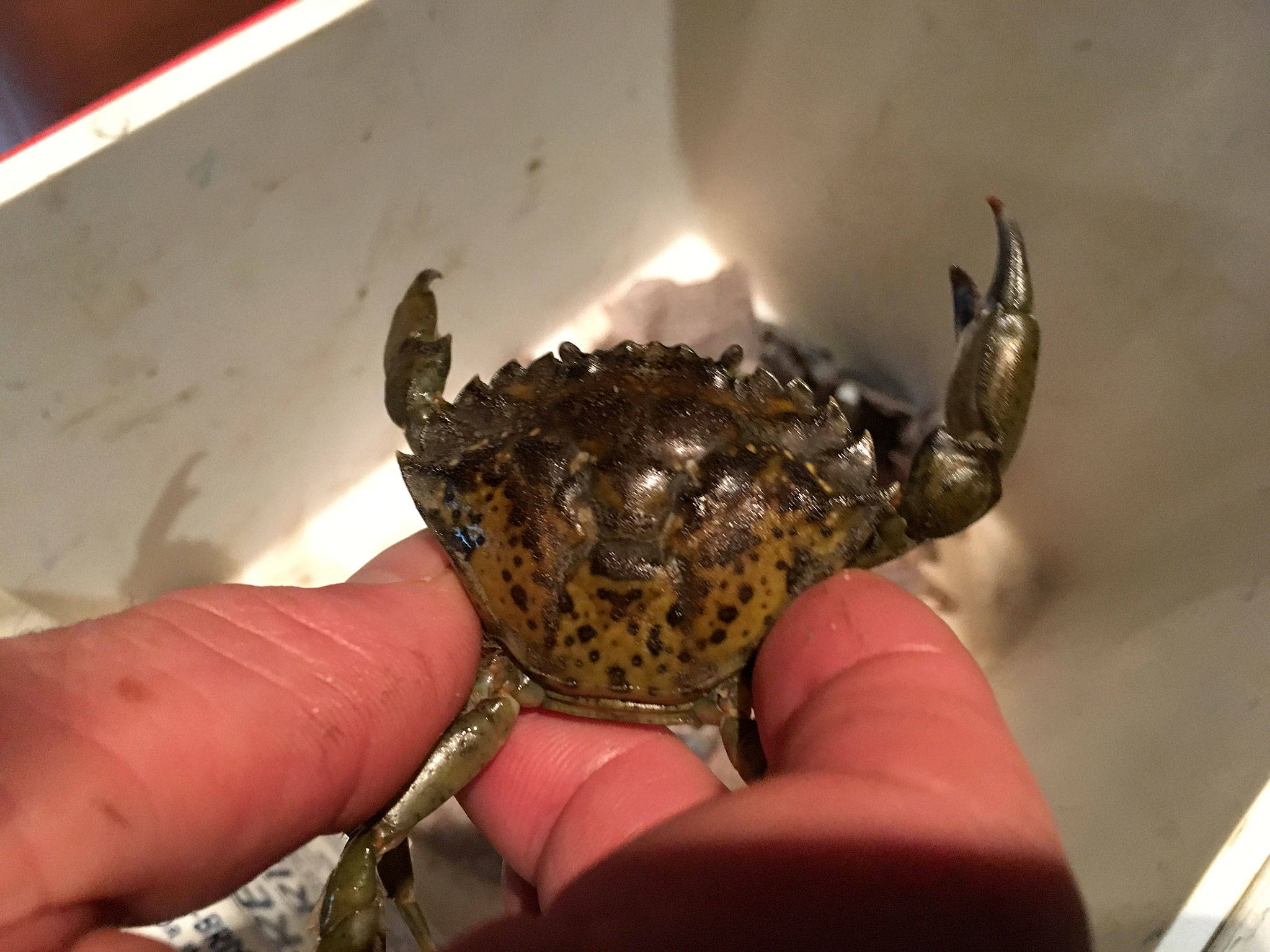
Researchers report they’ve captured 60 European green crabs, an invasive species, at Graveyard Spit on the Dungeness Spit as of Thursday. This green crab was one of four found in early May that was sent to Massachusetts for research purposes to determine if it came from British Columbia, California or elsewhere. (Matthew Nash/Olympic Peninsula News Group)

Speaking to a group of stakeholders May 4 in Blyn about the invasive European green crab threat in Dugeness, Allen Pleus, aquatic invasive species coordinator for the state Department of Fish and Wildlife, said, “We’re trying to get rid of them as soon as possible.” He and staff with the Washington Sea Grant Crab Team seek support for placing and monitoring traps for green crab in a few sites from the West End to Port Angeles. (Matthew Nash/Olympic Peninsula News Group)
