
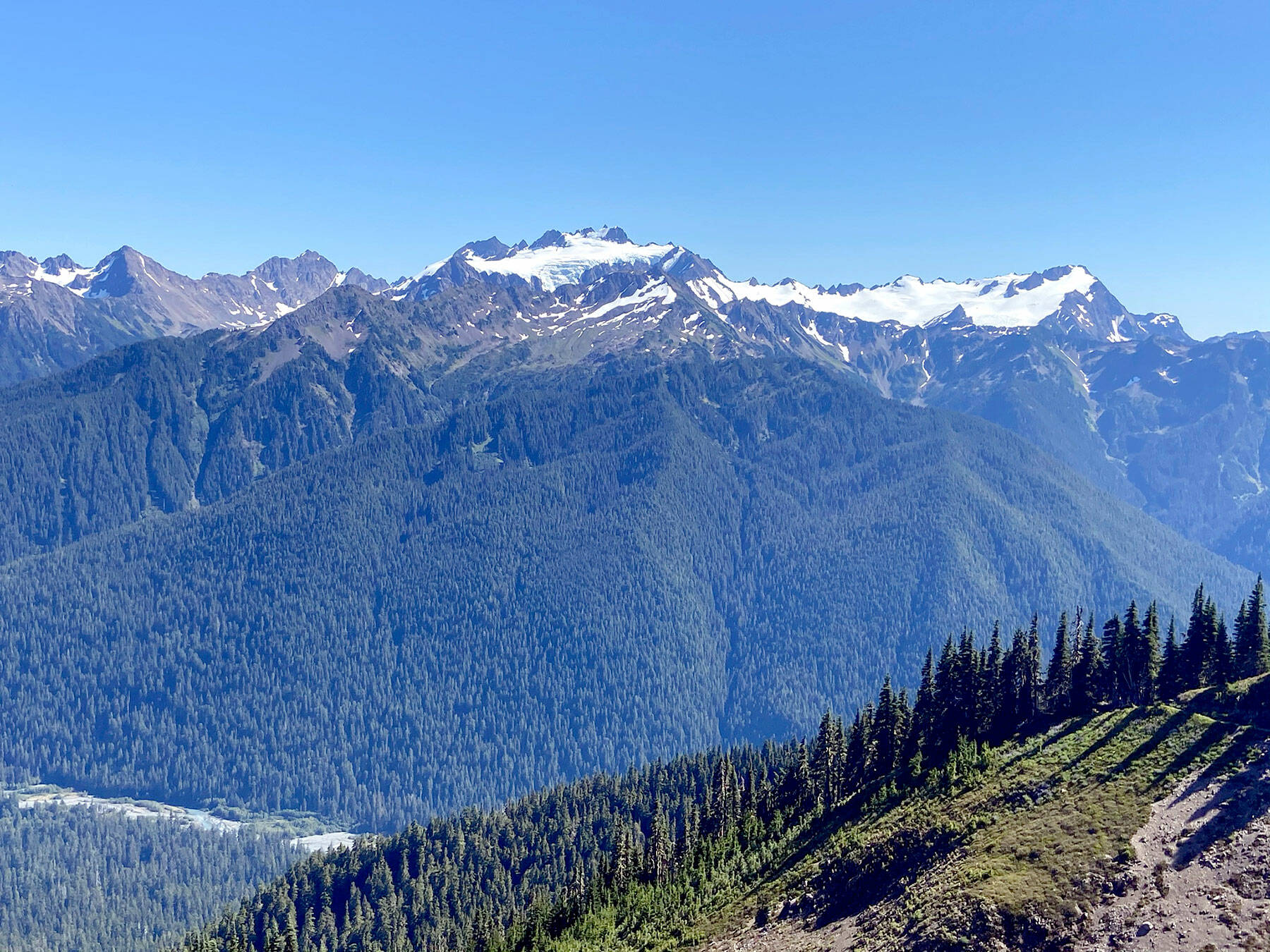
WASHINGTON, D.C. — By 2070, the glaciers on the Olympic Peninsula will have largely disappeared, according to a new study.
The loss will alter the region’s ecosystems and shrink a critical source of summer water for the lowlands, according to a study published this week in the Journal of Geophysical Research Earth Surface by AGU (Advancing Earth and Space Science)
Olympic National Park hosts some 200 Olympic Mountain glaciers, fed by more than 100 inches in annual precipitation — much of it snow.
But these mountains, which begin at sea level and top off at about 8,000 feet, are low-lying and as the climate warms, the glaciers and the water supply are threatened, according to the study.
The Peninsula has lost half of its glacier area since 1900.
Since 1980, 35 glaciers and 16 perennial snowfields have disappeared, the study said.
The few remaining glaciers likely will be shells of their former selves, said Andrew Fountain, professor of geology and geography at Portland State University who led the study.
“There’s little we can do to prevent the disappearance of these glaciers,” Fountain said in a press release.
“We’re on this global warming train right now. Even if we’re super good citizens and stop adding carbon dioxide in the atmosphere immediately, it will still be 100 years or so before the climate responds.”
Even though preventing climate change-driven glacier disappearances is not likely, ensuring things don’t get worse is a critical goal, Fountain said.
“This is yet another tangible call for us to take climate change seriously and take actions to minimize our climate impact,” he added.
Dan Cayan, a climate scientist at Scripps Institution of Oceanography who was not involved in the study, said that the long-term loss of glacial mass described in the research is a strong indication, uncontaminated by local human effects, of a warming global climate,
”This is a clear and compelling signal of changes that are rolling out across many North American landscapes,” Cayan said.
“It is regrettable that the Olympic glaciers are very likely to melt away as climate warming over the coming decades runs its course.”
U.S. Geological Survey data show a similar decline of glacier ice in the North Cascades, farther inland in Glacier National Park in Montana and farther north in Alaska, said Caitlyn Florentine, USGS research physical scientist.
The Olympic glaciers are particularly vulnerable to climate change because of their low elevation as compared to glaciers elsewhere at higher elevations where temperatures are significantly cooler such as the Cascade Mountains, the study said.
“As the temperatures warm, not only will the glaciers melt more in summer, which you’d expect, but in the wintertime, it changes the phase of the precipitation from snow to rain,” Fountain said.
“So the glaciers get less nourished in the winter, more melt in the summer, and then they just fall off the map.”
The double whammy “has downstream implications for glacier-adapted ecosystems in the U.S. Pacific Northwest,” Florentine said.
Glacier disappearances will trigger a chain of impacts, beginning with diminishing alpine streams and species like bull trout that have adapted to those cold waters.
Negative impacts can ripple throughout ecosystems and up food webs, the study said.
“Once you lose your seasonal snow, the only source of water in these alpine areas is glacier melt,” Fountain said.
”And without the glaciers, you’re not going to have that melt contributing to the stream flow, therefore impacting the ecology in alpine areas,” he added.
“That’s a big deal with disastrous fallout.”
