
SEATTLE — The National Oceanic and Atmospheric Administration’s National Marine Fisheries Service has extended to July 31 the period for public comment on the Makah tribe’s request to resume whaling.
The opportunity to comment on the draft environmental impact statement had been scheduled to close June 11.
Anti-whaling activists — who included Chuck and Margaret Owens of Joyce and D.J. Schubert of the Animal Welfare Institute of Washington, D.C. — had urged at an April 29 public meeting in Port Angeles that they be given more time to file objections to the tribe’s request for a waiver from the Marine Mammal Protection Act.
In its draft environmental impact statement, NOAA Fisheries recommends that the tribe receive permission to hunt and kill up to six Eastern Pacific gray whales a year under one of five proposed alternatives.
A sixth option would continue the current whaling ban. The others offer various protections for still-endangered Western Pacific gray whales.
The agency’s choice among them is pending while it prepares a final environmental impact statement.
That statement could go to a federal administrative law judge as early as the end of this year.
The judge will take public testimony before issuing a decision.
It in turn must be ratified by a NOAA Fisheries assistant administrator, who also will solicit public comment before deciding whether to issue a whaling permit.
If the permit is approved, it is almost certain to be appealed by anti-whaling organizations like the Owenses’ Peninsula Citizens for the Protection of Whales, activists have said.
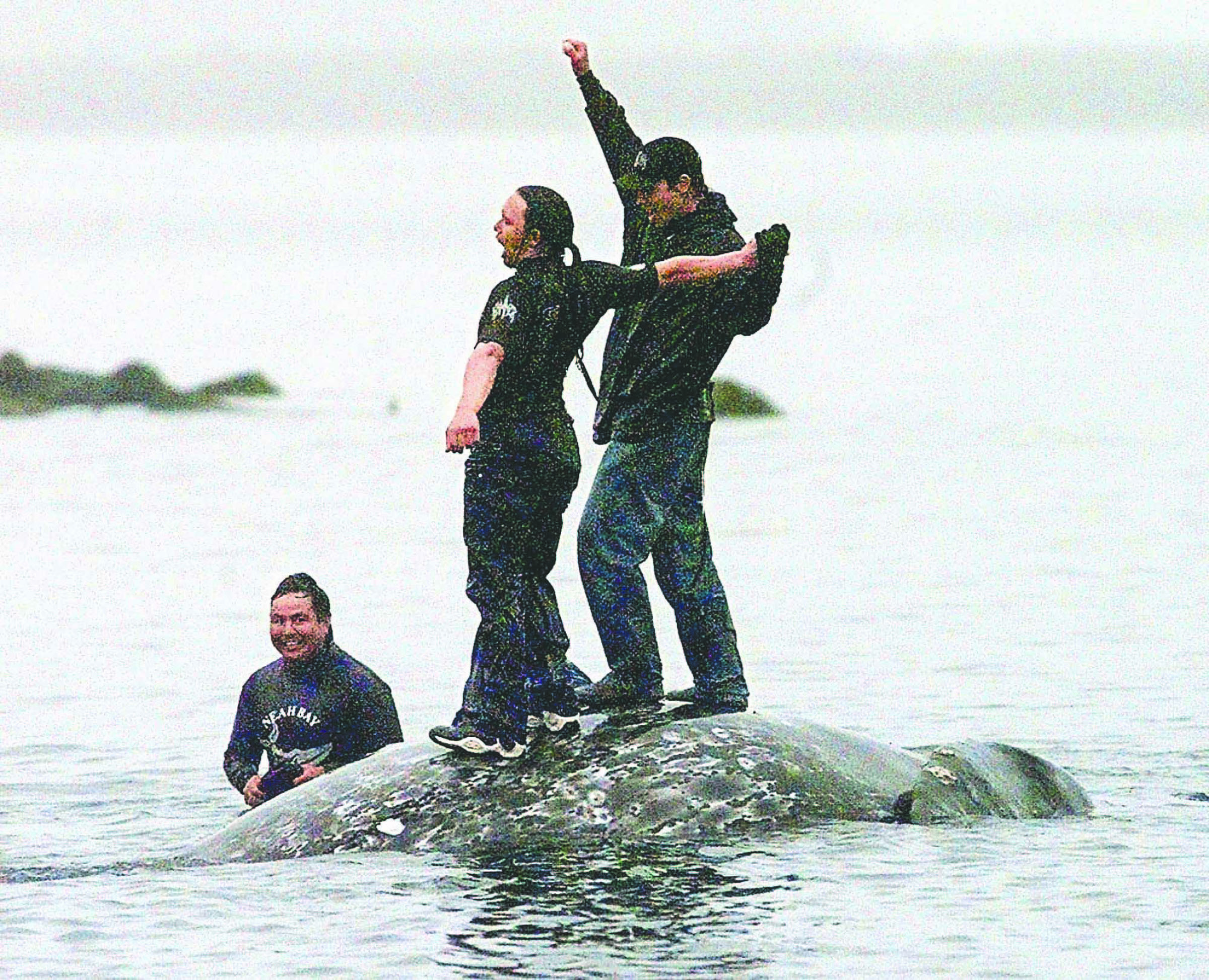
The Makah tribe, based in Neah Bay, has sought to resume hunting Eastern Pacific gray whales since the whales were removed from the Endangered Species List in 1994.
Whaling had been the tribe’s nutritional and economic mainstay for an estimated 1,500 years before commercial whalers nearly extirpated the great marine mammals in the 20th century.
Tribal hunters killed and butchered a whale legally in 1999. They hunted unsuccessfully in 2000, after which federal courts restrained whaling.
A botched rogue hunt in 2007 killed a whale that sank in the Strait of Juan de Fuca, and five Makah men were sentenced for federal misdemeanors.
The tribe cites the 1855 Treaty of Neah Bay, which preserves its rights to conduct whaling and sealing in its accustomed locations.
Tribal members say their ancestors ceded millions of acres of land for those rights that embrace Makah culture, diet and religion.
Opponents say the Marine Mammal Protection Act constitutes a treaty with the whales.
The options offered in the draft environmental impact statement:
■ A no-action alternative would continue to prohibit whaling.
■ Alternative 2 (the Makah’s proposal) would let the tribe harvest as many as five Eastern North Pacific gray whales a year, a maximum of 24 over six years, in tribal ocean fishing grounds except for zones around Tatoosh Island and White Rock during May.
No more than seven whales in a year, 42 over six years, could be “struck” — penetrated by harpoons, .50-caliber bullets or explosive projectiles — with a maximum of 18 struck and lost over six years.
The option would prohibit striking calves or adult whales accompanying calves and would avoid whales identified as Western North Pacific gray whales.
NOAA Fisheries also would prohibit taking more than three whales a year from the Pacific Coast Feeding Group — sometimes called “resident whales” — which frequents Pacific coastal waters from June to November.
■ Alternative 3 would allow 36 whales to be struck, 12 struck and lost. It would prohibit Makah hunters from striking a whale within 5 miles of shore, require a higher-caliber but shorter-range rifle and set a probable “mortality limit” of 2.7 resident whales a year. Only motorized vessels could conduct the hunt.
■ Alternative 4 would limit the hunt to June 1-Nov. 10 for only Eastern North Pacific gray whales identified by a trained onboard observer. The Makah would avoid killing more than one resident whale.
■ Alternative 5 would open two 21-day-long hunting seasons, Dec. 1-21 and May 10-31, and permit approaching only Eastern North Pacific gray whales. It would set a probable limit of 0.27 resident whales a year.
■ Alternative 6 would limit strikes to seven over two years and set a probable mortality limit of 2.25 resident whales.
A whaling permit would expire after three years, and the waiver would expire after 10 years.
To see the draft and for more information, visit http://tinyurl.com/PDN-drafteiswhaling.
Written comment on the alternatives will be accepted at makah2015deis.wcr@noaa.gov.
_______
Reporter James Casey can be reached at 360-452-2345, ext. 5074, or at jcasey@peninsuladailynews.com.
