
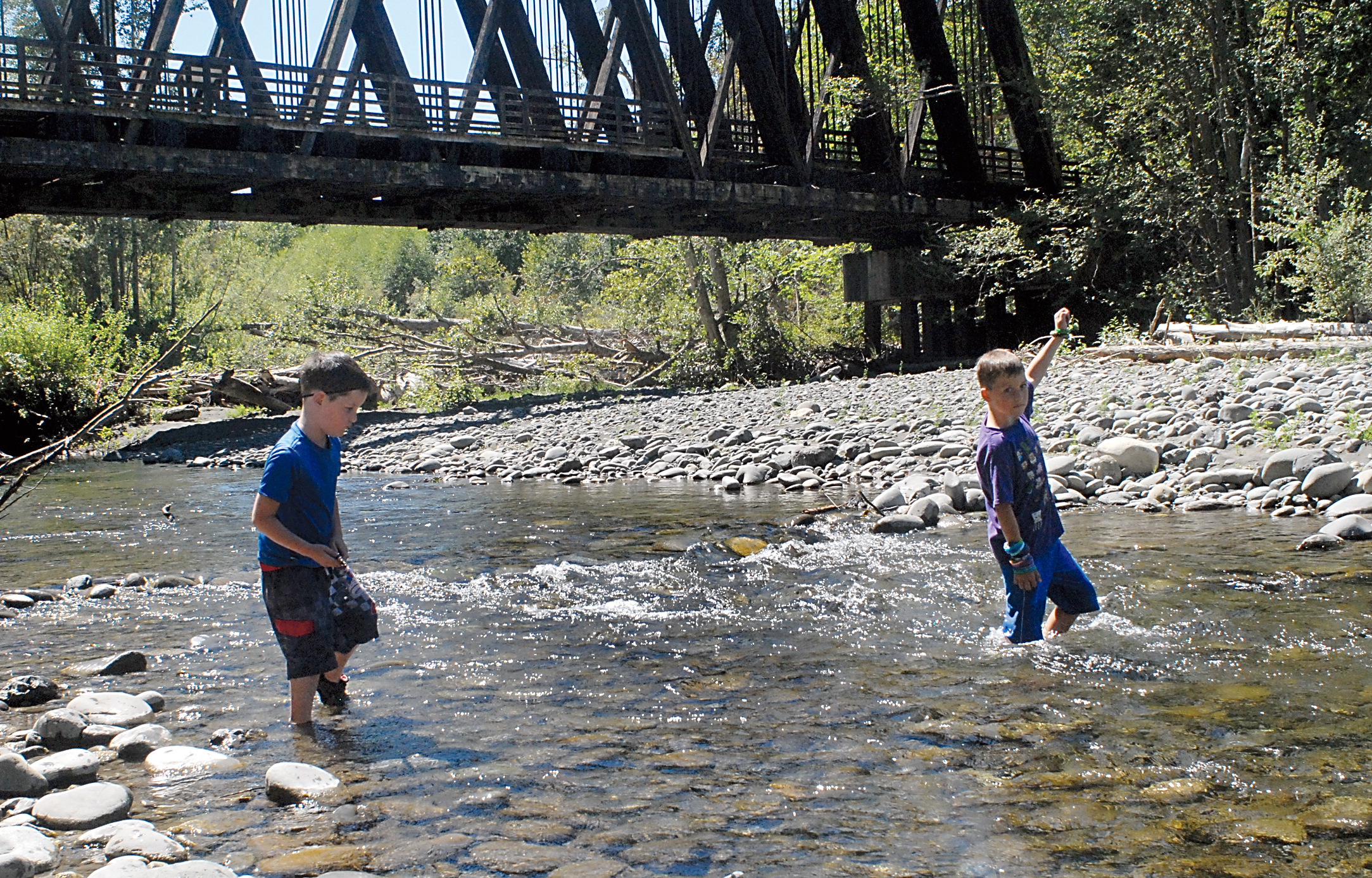
As drought conditions intensify on the North Olympic Peninsula, rivers are struggling at record-low flows, and there is no relief in sight for the near future.
The seven Olympic Peninsula rivers tracked by the U.S. Geological Survey have all reached record lows for late July and the point of “extreme hydrologic drought.”
In Clallam County, the rivers monitored by the USGS are the Elwha, Dungeness, Calawah, Hoh and Hoko rivers.
Jefferson County’s Duckabush and Big Quilcene rivers are monitored by the agency.
According to National Resources Conservation Service rain- and snow-monitoring sites in the Olympic Mountains, the 2014-15 rain season, which runs from Oct. 1 through Sept. 30, has so far supplied 97 percent of the average precipitation expected by July 30, while the winter season provided only 7 percent of the average snowpack.
However, the National Weather Service reported Thursday that the past three months’ rainfall is the third lowest on record in Forks, with 3.46 inches, using data going back to 1907.
The driest year on record was 2.97 inches, recorded in 1967, said Doug McDonnal, forecaster for the National Weather Service in Seattle.
The Weather Service has issued a warning that the coming winter is expected to be a strong El Niño one.
An El Niño winter brings rain to California and heavy snowfall to the California mountains — and exceptionally warm winters in Washington state, said Chris Burke, meteorologist at the Weather Service in Seattle.
“If the El Niño continues, we very well could get a repeat warm winter,” Burke said.
That could mean plenty of rain but another year of little to no snow — just like last winter.
The snowpack in the Olympic Mountains is long gone.
The lack of summer snowpack has been devastating to the rivers, which McDonnal said aren’t just running low but are also much warmer than a typical year — dual circumstances that endanger fish.
In a typical year, melting snow keeps the rivers cool, he said.
The state Department of Fish and Wildlife has reported low, warm river flows are causing high mortality among salmon trying to return to rivers to spawn.
While all of the North Olympic Peninsula’s measured rivers are setting new daily records with each dawn, the Elwha and Calawah rivers are at their lowest for the month of June recorded in 117 years.
Water flow records for the Elwha and Calawah rivers have been kept since 1897, according to the USGS website at www.tinyurl.com/PDN-rivers.
On Thursday, the Elwha River’s flow at the measuring station near McDonald Bridge had dropped to a daily historic low of 282 cubic feet per second (cfs) — lower than the 1926 record of 450 cfs.
The average flow for the Elwha for July 30 is 1,010 cfs.
The Calawah River near Forks, which also has more than 100 years of data on record, flowed at a sluggish 56 cfs on Thursday.
The Calawah’s record low for July 30 was 58, set in 2009, and the July 30 average for the river is 120 cfs.
All Peninsula rivers now have flows similar or lower than typical late-summer or early autumn flows — when the snowpack is exhausted and the rain is about to begin for the new water season.
Winter rains are still about three months out.
Other North Olympic Peninsula rivers have been running at record lows all summer and set new records nearly every day.
On Thursday, all of the North Olympic Peninsula rivers set new record lows or equaled past record lows:
■ The Dungeness River near Sequim dropped to 108 cfs.
With records kept since 1922, the record low for July 30 was 140, set in 1926, and the July 30 average for the river is 336 cfs.
■ The Hoh River at U.S. Highway 101 near Forks flowed at 868 cfs.
With records kept since 1960, the record low for July 30 was 884, set in 1987, and the July 30 average for the river is 1,310 cfs.
■ Hoko River, near Sekiu, measured 12 cfs.
With records kept since 1961, the record low for July 30 was 16 cfs, set in 1972, and the July 30 average for the river is 33 cfs.
■ The Big Quilcene River, below the diversion near Quilcene, flowed at 27 cfs.
With records kept since 1993, the record low for July 30 was 27 cfs, set in 2009, and the July 30 average for the river is 66 cfs.
■ The Duckabush River, near Brinnon, flowed at 47 cfs.
With records kept since 1937, the record low for July 30 was 83, set in 2009, and the July 30 average for the river is 197 cfs.
The state Department of Ecology tracks some rivers and creeks that do not have USGS flow gauges.
Data on the Ecology site lags by one day.
■ The Little Quilcene River measured 8.7 cfs Wednesday.
Records began in 2002, and the lowest July 29 flow was 8.9 cfs, set in 2003.
■ Morse Creek, west of Port Angeles, measured 22.2 cfs Wednesday.
Records began in 2003, and the lowest July 29 flow was 32.7 cfs, set in 2009.
■ The Sol Duc River measured 155 cfs Wednesday.
Records began in 2005, and the lowest July 29 flow was 203 cfs, set in 2009.
Gov. Jay Inslee declared a drought on the North Olympic Peninsula, among other areas, on March 13. On May 15, Inslee declared a statewide drought emergency.
The U.S. Drought Monitor, which considers such factors as snowpack, recent rainfall and soil moisture, has classified the North Olympic Peninsula as being in “severe drought” since June 23.
On Thursday, the Drought Monitor reclassified the southern Olympic Mountains, south of Jefferson County to Long Beach and east to Puyallup, as being in “extreme” drought.”
The Cascade Mountains and a portion of far Eastern Washington also were classified as being in extreme drought, which includes 32 percent of the state.
The remaining 68 percent of the state remained classified as being in severe drought.
Brent Bower, senior service hydrologist for the Weather Service in Seattle, has said that unless conditions change, the North Olympic Peninsula is likely to be reclassified as being in extreme drought by the end of August.
Drought Monitor maps are updated every Thursday at www.droughtmonitor.unl.edu.
_______
Reporter Arwyn Rice can be reached at 360-452-2345, ext. 5070, or at arice@peninsuladailynews.com.
