
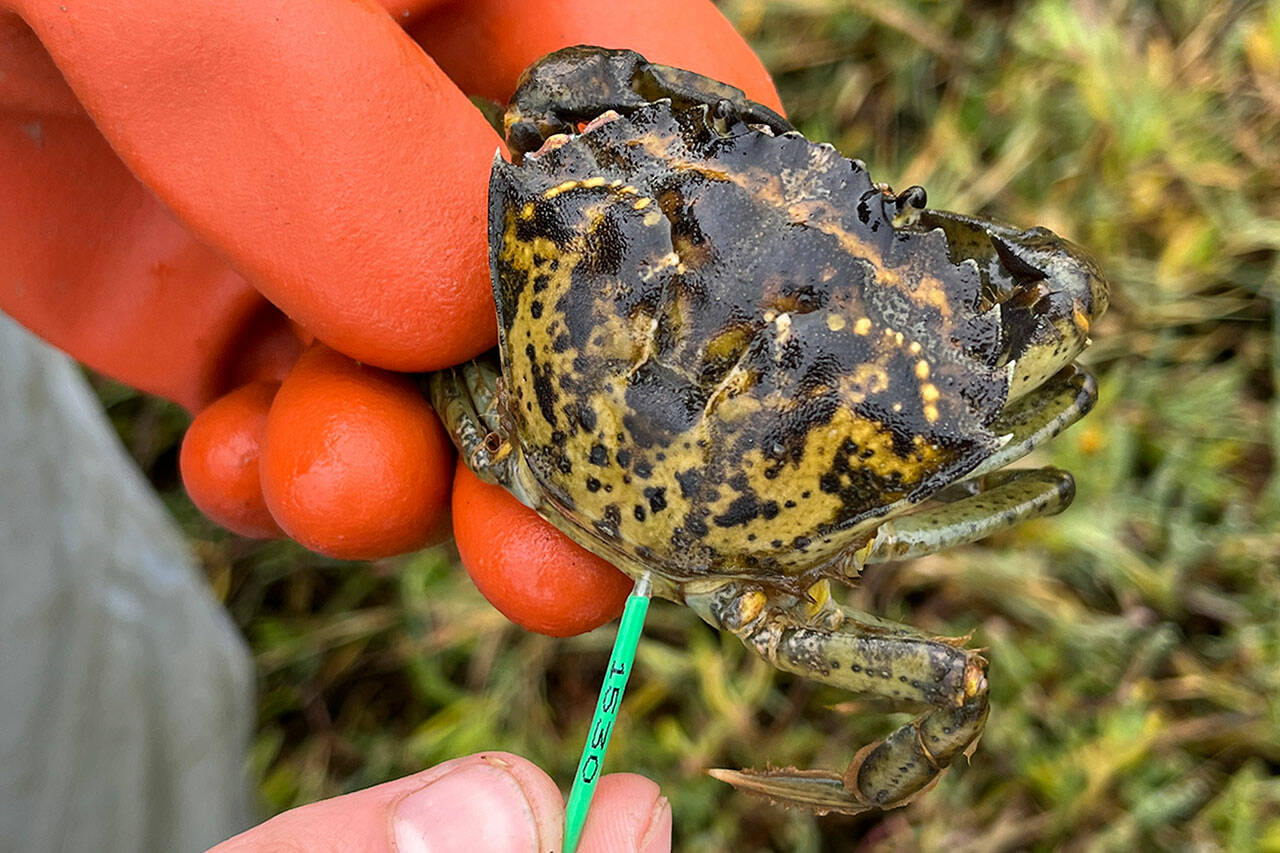
Last year saw some unwelcome firsts on the North Olympic Peninsula with the invasive European green crab.
While most captures typically occur in the spring and summer for Makah Fisheries Management, resource managers report they started year-round trapping in the Neah Bay area due to the continued presence of the crab.
They also discovered live green crabs within Neah Bay for the first time.
Adrianne Akmajian, Makah Fisheries Management marine ecologist, said in a Department of Fish and Wildlife report that they were “both surprised and unsurprised with regards to the positive detection of (green crab) in Neah Bay.”
“(We had) found molts of green crab along shorelines of the bay, so it seemed that detecting a live green crab was only a matter of time,” she said.
European green crabs are linked to the decline of Maine’s softshell clam industry, and researchers continue to investigate how they’re a threat to Dungeness crab and smaller shore crabs, and eelgrass that’s vital for salmon and many types of birds’ habitats and food supplies.
Four green crabs also were discovered at Salt Creek Recreation Area in October, and the Dungeness National Wildlife Refuge also saw its highest capture rate since first detecting the crab in 2017.
State Fish and Wildlife staff report that resource managers across Western Washington caught just under 340,000 European green crab as of Dec. 11, 2023. A large sum of that came from efforts in Willapa Bay and Grays Harbor, where resource managers removed more than 180,000 green crabs.
While Clallam County’s numbers are much smaller, Bridget Mire, Fish and Wildlife Coastal Region communications specialist, said “the Strait of Juan de Fuca remains on the front lines of the green crab invasion, and limiting these harmful crabs’ spread here is important for preventing them from becoming established in Puget Sound.”
Gov. Jay Inslee issued an emergency order in January 2022 for Fish and Wildlife staff to eradicate or prevent establishment of the crab.
Mire said the agency doesn’t expect to eradicate green crab from Washington state.
The “goal remains keeping populations below levels harmful to environmental, economic, or cultural resources.”
They’re seeing progress with trapping, such as in the Salish Sea where in Washington’s inland marine waters about 6,300 green crab were removed in 2023, compared with 80,600 in 2022.
“This decreased catch despite increased trapping efforts is a sign of progress,” she said.
Neah Bay
In 2022, Makah Fisheries Management (Makah Tribe) staff and volunteers caught 26,140 green crabs, their highest total since trapping began.
To counter that, Akmajian said they put out the most traps ever throughout 2023 with 3,500 set. They trapped 9,404 green crabs, mostly from April through September.
Most catches came from the main river channels of the Tsoo-Yess and Wa’atch Rivers, along with rocky interidal areas at Wa’atch Point and a rocky reef in Makah Bay.
She said the lower catch total was likely due to 2022 being a proliferate year for green crab, their heavy trapping rates, and the general trend of seeing less larval introduction/juvenile settlement.
Makah staff and volunteers caught 154 juvenile green crabs last year compared with more than 1,000 in 2022, Akmajian said.
On Nov. 8, tribal staff caught a live green crab within Neah Bay for the first time during routine trapping, which led to a rapid response trapping event on Nov. 20-21 for a total of 13 green crabs caught. Akmajian said 15 total were caught through the rest of the year there.
Previous trapping started in the Neah Bay area in 2018 with no captures in the bay. Staff report that due to the size of the green crab caught in 2023, they likely settled in 2020-21.
They plan to conduct a large rapid response event in the bay this year once winter conditions calm down, Akmajian said.
They continue to educate the community on how to spot and report green crab, while recruiting volunteers
Salt Creek
Coastal Watershed Institute staff, interns and volunteers spotted the green crab on Oct. 20 at the Salt Creek Recreation Area while conducting a nearshore fish use monitoring project, which led to rapid response trapping Oct. 24-26.
Staff reported to Fish and Wildlife staff they’ve been seining with two poles and a net for many years, but this was the first green crab they detected.
Four total were captured, with more trapping efforts projected in the spring.
Sequim, Dungeness
Mire said 270 green crabs were caught and removed in 2023 from the Eastern Strait and Admiralty Inlet management areas, including Dungeness and Discovery bays.
The Lower Elwha Klallam Tribe, Jamestown S’Klallam Tribe, state Department of Natural Resources, U.S. Fish and Wildlife Service’s Dungeness National Wildlife Refuge, U.S. Navy, McKinley Paper Co. and others have supported efforts in this area, she said.
Neil Harrington, an environmental biologist for the Jamestown S’Klallam Tribe, reports he did not trap any green crab in Sequim Bay last year despite placing 250 traps. In 2022, he caught two green crabs from about 800 trap sets.
Discovery Bay
Harrington said he continued to support Fish and Wildlife staff’s efforts in Discovery Bay, where resource managers caught 76 green crabs in 2022, and 157 in 2023 from 1,302 traps.
Resource managers at the Washington National Wildlife Refuge in Dungeness report their 2023 green crab totals topped their previous high (96) with 105 caught.
The invasive green crab was first detected in 2017 after many years of monitoring the Dungeness Spit when the most crabs were captured. Until 2023, there had mostly been a steady decline in captures.
In 2022, refuge staff and volunteers trapped 14 European green crabs.
Lorenz Sollmann, deputy project leader at the refuge, said staff and volunteers set 1,904 traps for the 105 captures in 2023 from April to September.
He said in the last seven years, their catch per unit effort rate had been 2.45, compared with 5.51 in 2023.
They also saw nearly double the number of males to females (69-36) along with two gravid females with eggs. Akmajian also reported Neah Bay caught nine gravid females.
Researchers estimate one female can release up to half-a-million larvae per brood, and the larvae in their earliest stages can travel as far as of 100 kilometers.
Sollmann said this year they included shrimp traps, which caught more than half of the 2023 total.
“We are in the planning stages to continue trapping again this year,” he said. “We will be working closely with our dedicated refuge volunteers and partners.”
What the public can do
Fish and Wildlife staff urge any who find a suspected green crab to photograph and report it to wdfw.wa.gov/greencrab or by email (ais@dfw.wa.gov) and leave it alone. The public is asked not to kill suspected green crabs due to cases of mistaken identities for other native crabs.
Most native crabs are regulated as “Unclassified Marine Invertebrates” and are illegal to kill, harvest, retain or possess, and if the agency verifies the crab as a European green crab, she said staff will follow up with trapping and monitoring if found in a new area.
European green crabs feature five spines behind their eyes, are up to 4 inches wide, and aren’t always green. They can be found in shallow areas, such as estuaries, intertidal zones and beaches.
Beachgoers, anglers, recreational crabbers, and others are asked not to tamper with European green crab traps often deployed in shallow areas exposed at low tide and are typically identified with a bright orange buoy and an official tag or permit.
Washington Sea Grant and Washington State University Extension will continue a “Molt Search” volunteer program this year with information at wsg.washington.edu/crabteam/moltsearch.
________
Matthew Nash is a reporter with the Olympic Peninsula News Group, which is composed of Sound Publishing newspapers Peninsula Daily News, Sequim Gazette and Forks Forum. Reach him at matthew.nash@sequimgazette.com.
