
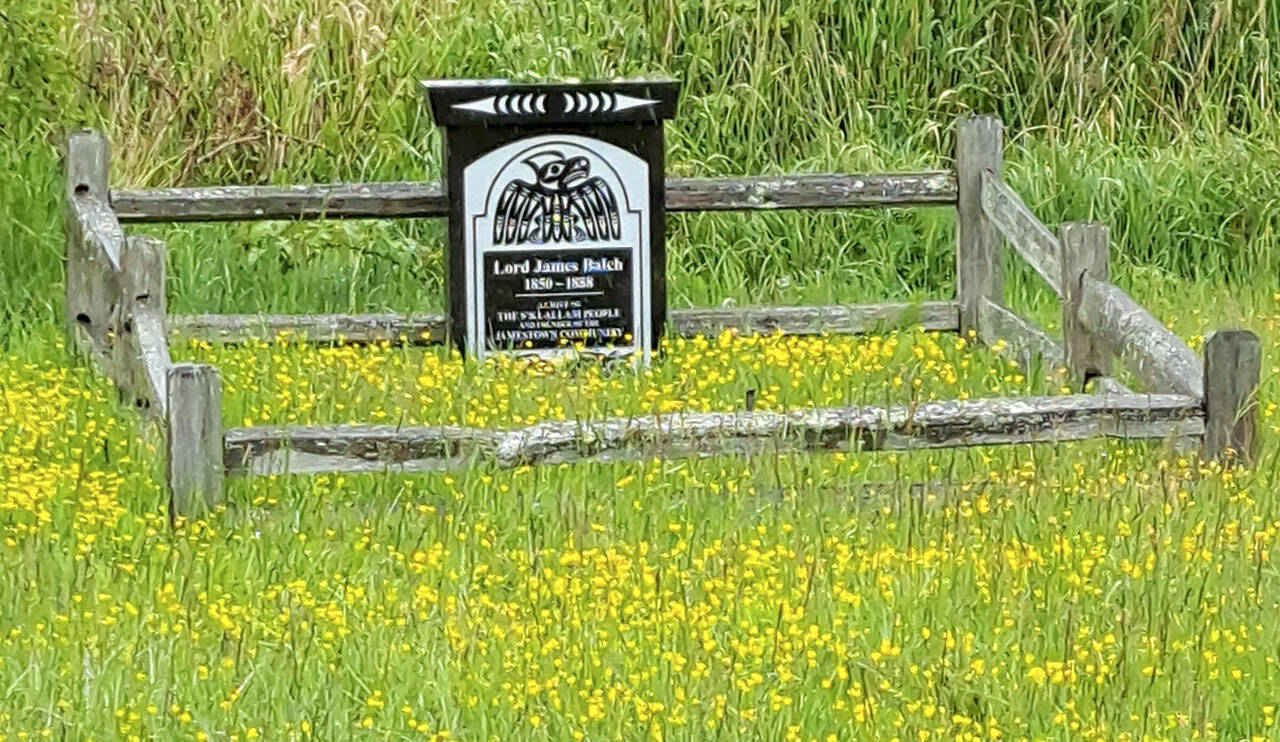
IT IS SAFE to say the people of the North Olympic Peninsula have been — and are — quite spiritual and that spiritual beliefs have been an integral part of people’s lives for centuries. From the perspective of those of European and Asian descent, the history is relatively short, but from the perspective of the indigenous peoples, it’s millennia. And it is thanks to the S’Klallam tribe that Clallam County got its first church building and bell.
In the 1870s, a wave of spiritualism arrived in Sequim. An old pioneer who had converted to spiritualism built a log spirit house with no windows. When the door was closed, it was dark inside. In it, a man named Vincent served as the medium during séances and spirit rappings. Arguments, discussions and bitter feelings broke out and lasted for many years.
The Native Americans’ belief system, referred to as Tamahnous in some early books, is Tamanowas. It may have taken three forms: Black Tamanowas was secret and used for purification; Red Tamanowas was ceremonial; and a third Tamanowas was used for the sick.
And because there were no church buildings in Clallam County, Christians took their spiritual lessons from traveling ministers who visited the area a couple of times a month, holding services in homes and other places.
The first minister to visit Dungeness was a member of the Disciples Church, which has been known under several names. Their desire was to disassociate from denominationalism and were proponents of congregational church governance. In 1861 and 1862, this minister visited Dungeness several times.
I do not know the name of this preacher, but his work got off to a wet start. After preaching in the homes of Elliot Cline and John Weir, his travels took him toward Port Townsend. On his way there, he stopped at the Irwin home on the east side of Sequim Bay near the Cornish home.
It seems that Irwin and Cornish were sampling some homemade brew when the preacher arrived. After some visiting, the preacher was given a bed to use and went to sleep. After, the drinking buddies began to discuss theology, and they came to an agreement that the preacher had not been properly baptized. They took care of this theological problem by grabbing a bucket of cold water and “baptizing” the preacher. To say the least, it was a rude awakening, and he got little sleep.
The Methodist-Episcopal Church began their work in 1868 under the Rev. H. Patterson. On June 7, 1874, the Rev. A. Laubach established regular services and organized a church. The first members were Mr. and Mrs. Hall Davis; Mr. and Mrs. Alonzo Davis and their daughters Fanny and Cora; Mrs. E.J. Weir, Allen Weir and Julia Weir; John Williamson; and Thomas Downie. Prior to building a church, services were held at the courthouse and the Good Templar’s Hall. Their church building wasn’t finished and dedicated until March 1890.
Soon, the Congregational Church also began to influence the Dungeness area. The Congregationalists rejected centralized authority in favor of allowing the local church to run their own affairs. This certainly sat well with the fiercely independent people.
Lord James Balch was chief of the S’Klallam in the Dungeness area. Up until 1873, he had a reputation for drinking and fighting. To the settlers, it seemed things were getting out of hand. So much so, the settlers requested the S’Klallam be moved to Skokomish.
Balch saw the writing on the wall, and in 1874, Balch and 14 other S’Klallam leaders pooled their resources and collected $500 in gold coin. They bought 210 acres fronting the beach and divided it into narrow strips, giving each family access to the beach. It was a subtly brilliant move — a tribe without a reservation now owned their own land and couldn’t be evicted from it.
In March 1875, Balch visited the Skokomish reservation on business. While there, he sought religious instruction from the local Congregation Church, pastored by the Rev. Myron Eells, who provided instruction, one or two Chinook songs and some Bible pictures.
During this time, Balch developed an enmity toward drunkenness.
Eells first visited Jamestown in the fall 1875, and for the next two years, he spent two Sundays, twice a year, in Jamestown. The majority of the congregation were Native Americans.
On April 8, 1878, Balch and the S’Klallam erected and dedicated a church of their own. Balch said no white man had suggested the idea, but he thought it must have been Jesus. It was the first church in Clallam County and measured just 16 feet by 24 feet. The dedication was attended by 90 S’Klallam, 10 Makah and 25 Caucasians.
Two years later, they bought a small bell, and it, too, was a first in the county.
Initially, this church was a branch of the Skokomish Congregational Church. Then, it became the Dungeness Congregational Church on April 30, 1882, with 11 members, nine of whom were S’Klallam. They sang in S’Klallam, Chinook and English while the readings and prayers were in English. Sermons were in Chinook translated into S’Klallam.
Soon, the Dungeness church began practicing Shaker beliefs. The Indian Shaker Church is a unique blend of Native American, Catholic and Protestant beliefs and practices, including the use of hand-held candles, the ringing of individual hand bells (to a very loud volume) and the sign of the cross usually repeated three times. Practices also included public testifying and confessions of shortcomings.
Still, the number of churches grew slowly on the North Olympic Peninsula. It would be 1888 before a church was organized in Port Angeles.
________
John McNutt is a descendant of Clallam County pioneers and treasurer of the North Olympic History Center Board of Directors. He can be reached at woodrowsilly@gmail.com.
John’s Clallam history column appears the first Saturday of every month.
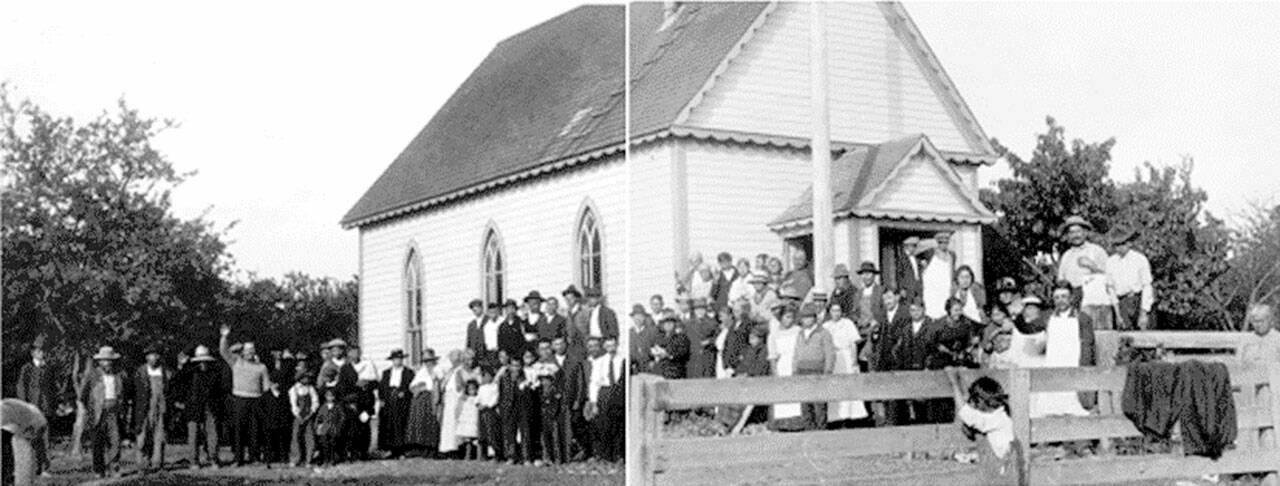
The Shaker Convention circa 1921. (Bert Kellogg Collection / North Olympic Library System)
