
RACE TO ALASKA: Canadian kayakers finish together; four more boaters still going
Published 4:15 pm Monday, July 6, 2026

PORT TOWNSEND — Up until this year, only eight kayaks, and six solo kayakers, had ever finished the Race to Alaska to Ketchikan, Alaska.
You can add two more to that tally, with another four human-powered boats still going Monday afternoon within tantalizing range of Ketchikan.
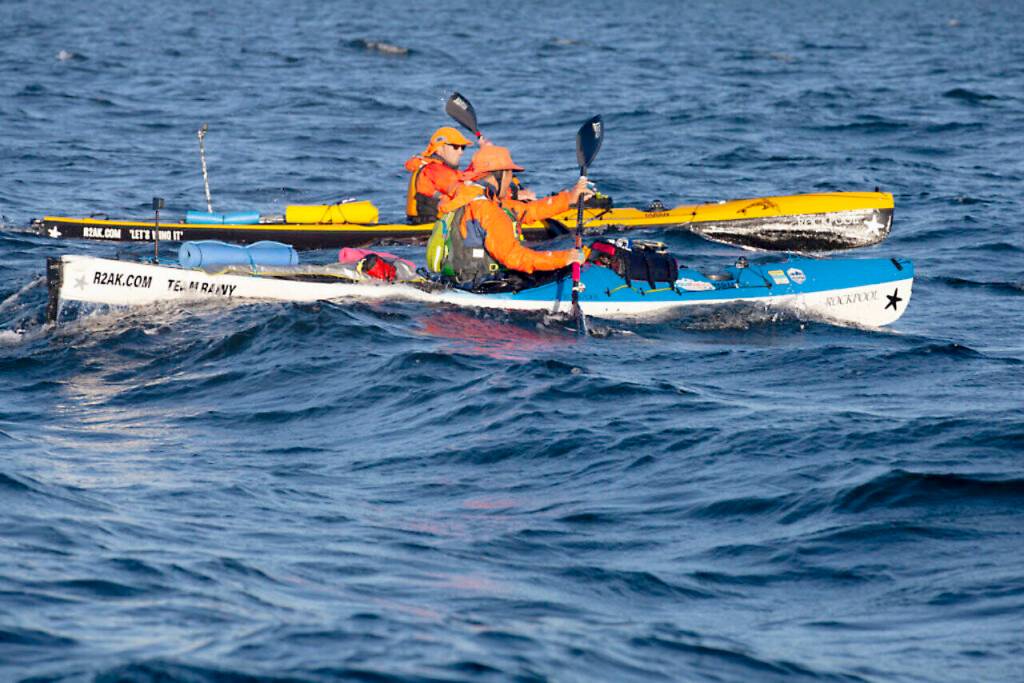
Rainy, a kayak paddled by Yato Kano of Prince Rupert, B.C., and Let’s Wing It, paddled by Martin Rother of North Vancouver, B.C., entered Ketchikan together at 5:21 p.m. Alaska time Sunday as the first kayaks to reach the finish line. They did the 750-mile Race to Alaska in 18 days, 5 hours and 21 minutes.
The kayaks were not necessarily together at the beginning of the race, but spent the past several days of the race essentially side by side up the British Columbia coast.
“The math of paddling to Ketchikan is unpleasant: 529 hours from the starting gun to the Grim Sweeper finding The End, and roughly 700 miles of race course,” stated Sunday’s Race to Alaska race report. “That sounds like a leisurely 1.3 mph — until you subtract sleep, food-time, beach landings, hauling gear, cooking mush, waiting out weather, and spreading wet gear around so that later it can lie to you about being dry. The real math: 35-40 miles a day, 11-16 hours in the boat, for three weeks.
“Which is what Team Let’s Wing It and Team Rainy have been doing, day after day, for eighteen days, putting in the miles with the consistency required to get to Alaska when the engine is you.”
The top human-powered boat was Boogie Barge, a four-person pedal-powered catamaran powered by crew Blake Hansen, Craig Bartlett, Kian Flynn and Taylor Ffitch of Tacoma. They finished in an impressive 11 days, 5 hours and 58 minutes, a full week ahead of Rainy and Let’s Wing It.
The winner of the Race 2 Alaska was a trimaran sail team Northbound Nutters out of Friday Harbor, in a time of 5 days, 8 hours, 4 minutes, winning the race by about 37 hours over second-place Celerity, a monohull sailboat out of Kelowna, B.C.
A total of 29 vessels have completed the race, which began on June 16 in Port Townsend. A total of 30 of the 37 boats that left Victoria, B.C., have dropped out.
There are still two kayaks, a stand-up paddleboard and a wherry out on the course near Prince Rupert in the northwestern corner of British Columbia.
Leading the way among the remaining human-powered vessels is Apple Bottom Boy, a stand-up paddleboard crewed by Eric Strickland of Bainbridge Island and the kayak Belly Full of Tea, paddled by Esther Wheeler from Sydney, Australia.
The pair were docked side-by-side in Prince Rupert on Monday afternoon. Prince Rupert is roughly about 80 nautical miles south of Ketchikan.
If Strickland can finish, he will be the second stand-up paddleboarder to ever complete the race.
Notes, a kayak paddled by Nathaniel Greene of Friday Harbor, was a few miles behind, coming in to the community of Port Edward, a couple of miles south of Prince Rupert, on Monday afternoon.
Still going is the wherry Lillian Signed up to Suffer rowed by Lillian Kuehl of Port Angeles. She is taking a different tack further offshore to the west along Porcher Island about six miles south of Port Edward. After 19 days of paddling and rowing, all four of these hardy souls were within 100 miles of Ketchikan on Monday.


Best of Olympic Peninsula