
The buoys are back: Undersea instruments help predict salmon runs
Published 12:01 am Monday, June 15, 2015
NEAH BAY — Oh, buoys.
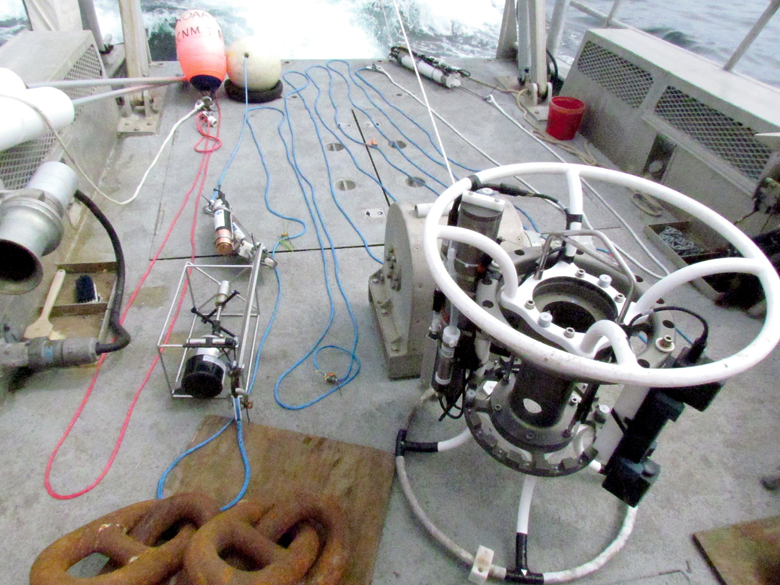
Olympic Coast Marine Sanctuary scientists have sunk 10 monitors beneath the waves to take water temperatures at various depths along the 135-mile-long protected shore.
Sure, they understand the ocean is chilly. What they want to learn is if it’s cold enough — specifically, does the water rising shoreward from the cold depths to the surface bring sufficient nutrients to supply the food chain that allows salmon and other creatures to thrive?
The research vessel Tatoosh dropped the instrument buoys last month at locations from Makah Bay to Cape Elizabeth north of Tahola on the Quinault Reservation.
It’s an annual event that’s been repeated since 2000, with scientists from the National Oceanic and Atmospheric Administration visiting the buoys monthly to download data before they retrieve them before the onset of winter storms.
A lot of variables
The task sounds simple. It’s not.
“It’s really important because our cold, productive water off the coast has so many variables in it,” Carol Bernthal, sanctuary manager, said recently.
The cold water that “upwells” shoreward from the edge of the continental shelf is richer in nutrients than warm water.
If it doesn’t arrive at the right temperature at the right time, life grows lean at the other end of the food chain.
“When the waters here tend to be warmer, you don’t get that flush of food,” Bernthal said.
“Our salmon and our whales are tied to these organisms in the ocean that are really cold-water-dependent.
“Warm water here, while it’s great for swimming, isn’t great for the salmon population. When you have cold-water years, you have more-abundant salmon.”
Reading the water
Besides supersensitive thermometers, the buoys carry instruments that measure currents and concentrations of tiny organisms called plankton, plus the water’s salinity, clarity and acidity.
Acidity is another chain-linked phenomenon that starts with atmospheric carbon dioxide produced by humans’ burning fossil fuels, Bernthal said.
The earth’s oceans absorb much of that acidity — commonly calculated as the concentration of hydrogen ions in water, or pH — but at a cost to calcium carbonate-based organisms known as pteropods.
Commonly called “sea butterflies,” the mollusks are about the size of a small pea, but they feed creatures as large as gray and humpback whales, Bernthal said. They also are a diet mainstay of juvenile salmon.
Thus, when more carbon dioxide is in the air, the long-term result is fewer salmon, she said.
And when scientists have more measurements, they can better model and predict such phenomena.
‘The blob’
The buoys also will track an area of unusually warm water that University of Washington meteorologist Nicholas Bond has nicknamed “the blob.”
It spans the North Pacific from Alaska to Japan and since September 2014 has been measured at 5.4 degrees warmer than normal.
Like increased acidity, the higher temperatures have huge implications for marine life, according to NOAA.
“When you think about weather and the water,” said Bernthal, “that’s what we’re trying to get at.”
The instruments are sunk at depths of 50 to 138 feet in five locations off the coast.
Besides visiting them monthly to download their data, the Tatoosh will return to retrieve the buoys in October because they aren’t designed to withstand winter storms.
Where sanctuary is
The Olympic Coast National Marine Sanctuary embraces 3,310 square miles of nearshore ocean from Cape Flattery at Washington’s northwesternmost tip to the Copalis River at Griffiths-Priday Ocean State Park in Grays Harbor County.
That’s more than 1.5 times larger than the entire Puget Sound and 2.5 times larger than Olympic National Park.
It was established in 1994 for study, protection and education of the marine environment.
Its headquarters and a Discovery Center are in The Landing mall, 115 E. Railroad Ave., Suite 301, Port Angeles, where it employs a staff of 11 people.
The center is open from 10 a.m. to 5 p.m. daily through Labor Day and on weekends until mid-October.
Admission is free.
To learn more about the sanctuary and its programs — including citizen volunteer activities like seabird surveys and mussel sampling — visit www.olympiccoast.noaa.gov.
“A lot of people,” Bernthal said, “want to know what’s going on in the ocean these days.”
_______
Reporter James Casey can be reached at 360-452-2345, ext. 5074, or at jcasey@peninsuladailynews.com.