
By RICHARD RUBIN
c. 2014 New York Times News Service
BY THE TIME it abruptly ended at 11 a.m. on Nov. 11, 1918, between 15 million and 20 million men had perished in the First World War.
That statistic can be difficult to grasp, much less believe; but hike through a couple of forests in the hills of Lorraine, and you begin to see how it happened.
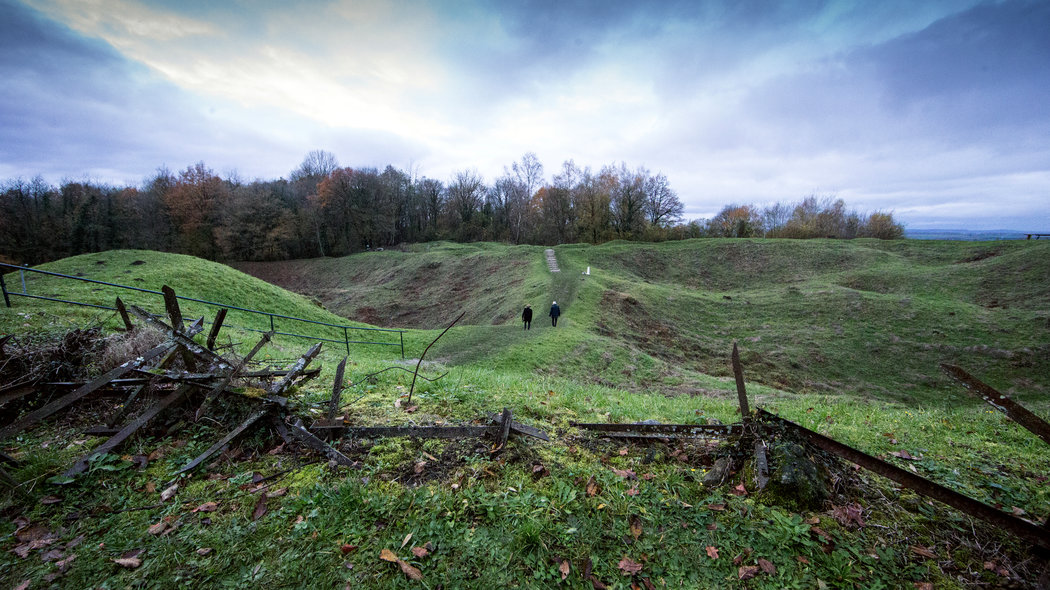
What’s now known as Bois Brûlé, or the burnt woods — scorched in four years of fighting — was forest primeval until September 1914, when the Germans came.
The month before, just as the war was beginning, they had stormed in and seized the Argonne Forest and the heights above the Meuse River, territory of tremendous strategic value; now they charged into the Woëvre Plain, to the east, and quickly captured a couple hundred square miles of equal importance, cutting the roads from the industrial center of Nancy to Verdun, an old walled city ringed by forts and seen by many as an indispensable bulwark in the east. T
They killed a great many French soldiers in the process.
They knew the French would try their utmost to take that territory back.
And they were prepared: They riddled those 200 square miles with some of the most formidable defenses ever created by man. In Bois Brûlé, they are particularly well preserved.
There are French trenches there, too, jagged ditches where the dirt walls were once supported by logs that have long since rotted to splinters.
But the German trenches are something else entirely — concrete, extensive, tremendously sophisticated, with steps and drainage systems, snipers’ galleries and machine gun shelters.
There are bunkers fitted for periscopes, networks of big gun pits and ammunition dumps, sprawling rest camps with superb waterworks, even the remains of officers’ villas. Somewhere out there is a majestic cement tabernacle festooned with an enormous Maltese cross.
The Germans, it is obvious, came to stay. For four years, despite innumerable French attempts to drive them out — very costly attempts — they did.
Hike around these woods, and you quickly come to understand that this was a war unlike any other when it came to murderous ingenuity, and that the Germans had a distinctive technological edge.
They also had better weapons, better-trained soldiers, better generals, better spies, better maps, better barbed wire, better barbed wire cutters. They always seemed to hold the better ground; their strategy was better. You can’t help but wonder: How did they lose?
In September 1918, the Americans accomplished in a few days what the French had been attempting for four years in this area, known as the St.-Mihiel Salient.
It wasn’t easy: More than 7,000 doughboys died in those few days.
Afterward, the French built monuments in the area — to the Americans.
The finest of these, a life-size statue of a doughboy and French poilu shaking hands, has been removed from its pedestal, in the middle of the town of Thiaucourt, for restoration; I have been assured it will be coming back.
I hope so. It is the most compelling and beautiful physical evidence of Franco-American amity I have ever beheld, with the possible exception of another, much larger statue in New York Harbor.
READ MORE: http://www.nytimes.com/2014/12/28/travel/in-france-vestiges-of-the-great-wars-bloody-end.html?ref=travel
