
By JEFF BARNARD Associated Press
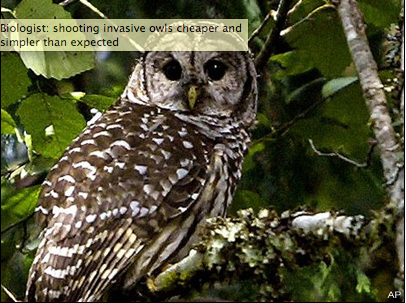
GRANTS PASS, Oregon — It turns out that the mechanics of shooting invasive barred owls to make room for threatened northern spotted owls are cheaper and easier than some people had imagined.
Equipped with a specially modified shotgun and a remote-controlled digital owl caller, biologist Lowell Diller found that once he arrived at a known site, it took two hours and 23 minutes to call in, shoot and process a barred owl. He estimates direct costs at $100 to $150 per bird.
Done in conjunction with the California Academy of Sciences using a scientific-collection permit authorized by the Migratory Bird Treaty Act, the study represents the first look at the feasibility and cost of removing barred owls. The study, the results of which were published online last month in Wildlife Society Bulletin, covered 73 barred owls killed from 2009 through 2012 on private timberland owned by Green Diamond Resource Co. outside Eureka, California
It comes as the U.S. Fish and Wildlife Service has started a $3.5 million experiment to see if killing 3,600 barred owls over six years in California, Oregon and Washington helps spotted owls, whose population has continued to decline despite designating 18.5 million acres of forest reserves for habitat.
The barred-owl trait that makes it a threat to spotted owls — that it will aggressively defend its territory — makes it an easy target for someone with a digital owl call, Diller said.
Diller said the data have not been analyzed, but in nearly 100 percent of places where barred owls were completely removed, spotted owls soon moved back.
Barred owls are bigger, more aggressive and less picky about food than spotted owls. They also need less territory. They started working their way from the East across the Great Plains in the early 1900s, and by 1959 were in British Columbia.
In a typical encounter, the bigger female barred owl will fly into a spotted owl, knocking it off its perch. One or two body-slams is usually enough to convince a pair of spotted owls to look for a new place to live. Barred owls now cover the spotted owl’s entire range, in some places outnumbering them as much as 5-to-1.
The actual shooting represents less than 1 percent of the costs of surveys and other work that go into removing barred owls. All the owls were dispatched with one shot. Once one member of a breeding pair was collected, the mate usually returned within 10 to 15 minutes, and was also killed. Using a shotgun equipped with a perforated barrel extension to make it quieter made it easier to kill the surviving bird.
The biggest variable in time and cost is getting to known barred-owl sites, Diller said. In areas with existing roads, like the Green Diamond forests, it takes a couple hours of driving. In remote wilderness, it would take a day or more of walking.
Diller said that despite hunting all his life, he found it difficult, emotionally and ethically, to shoot the barred owls. They are very similar to the spotted owl, which he had studied and admired for decades.
“People who don’t want to see it done like to also say it will be too expensive,” he said. “They try to include that as part of the reason that we shouldn’t do it. In my mind, we need to separate those two” issues.
While it is unusual to kill a raptor like an owl to protect a threatened or endangered species, it is not unusual to kill one animal to help another survive.
Paul Henson, Oregon state director of the U.S. Fish and Wildlife Service, said the study answered important questions about managing the incursion of barred owls into spotted owl territory. The experiment now underway will take it to the next level, from a few score birds to a few thousand.
“This is the first good technical quantitative evaluation of what it will take to do some of this,” he said.
Dan Rosenberg, co-director of the Oregon Wildlife Institute in Corvallis, said in an email that the study confirmed “small-scale removal is a feasible approach. It is planning the long-term, range-wide management to address barred owls that remains the challenge.”
Hanson said it may only be necessary to remove 20 percent of the barred owls from the Northwest to provide enough refuges for spotted-owl numbers to start recovering.
