
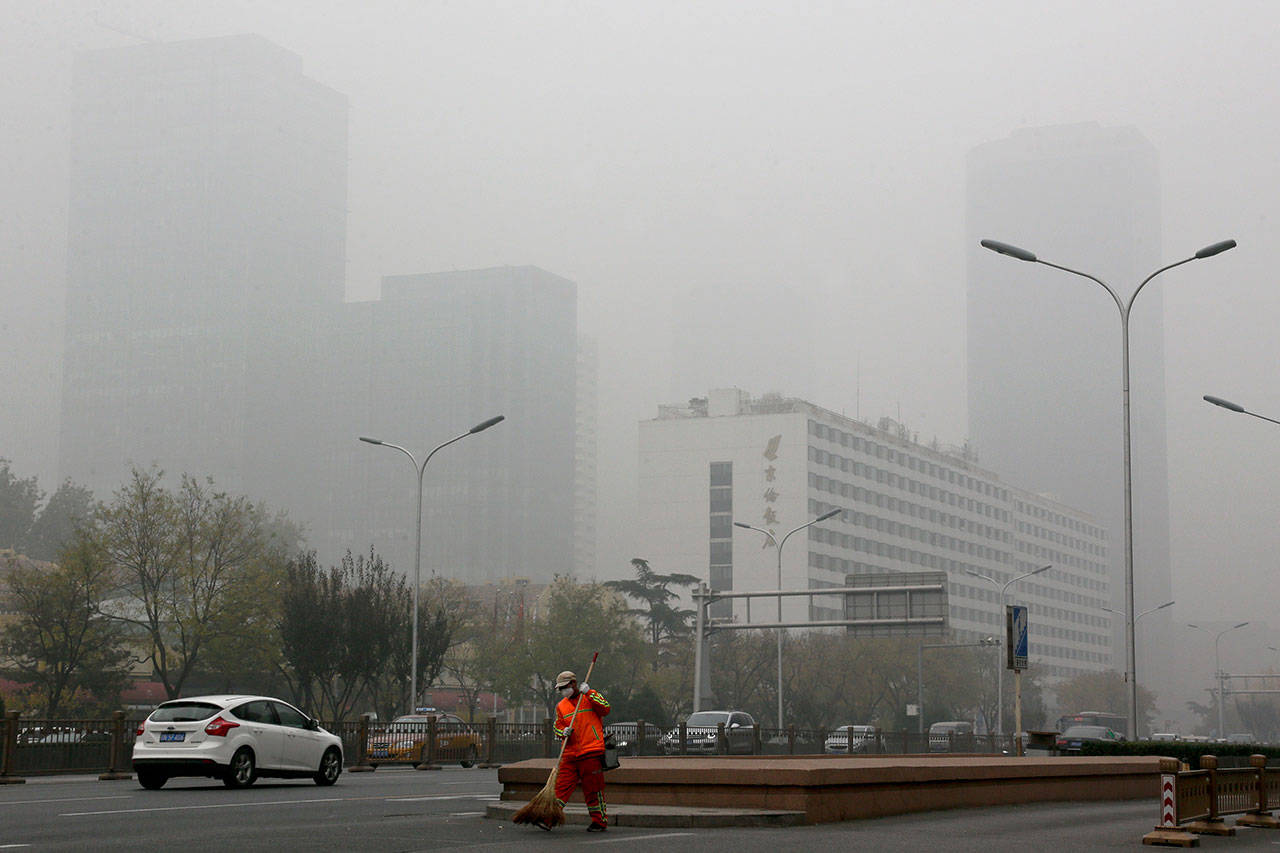
In this Nov. 14, 2018, file photo, a cleaner wearing a mask against pollution sweeps a street in Beijing. The world cut its daily carbon dioxide emissions by 17 percent at the peak of the pandemic shutdown last month, a new study found. But with life and heat-trapping gas levels inching back toward normal, the brief pollution break will likely be “a drop in the ocean” when it comes to climate change, scientists said. (Andy Wong/Associated Press file)

In this Nov. 14, 2018, file photo, a cleaner wearing a mask against pollution sweeps a street in Beijing. The world cut its daily carbon dioxide emissions by 17 percent at the peak of the pandemic shutdown last month, a new study found. But with life and heat-trapping gas levels inching back toward normal, the brief pollution break will likely be “a drop in the ocean” when it comes to climate change, scientists said. (Andy Wong/Associated Press file)

Study: Carbon pollution falls during pandemic

  • By SETH BORENSTEIN AP Science Writer
  • Wednesday, May 20, 2020 5:29am
  • NewsCoronavirus

By Seth Borenstein | The Associated Press

KENSINGTON, Md. — The world cut its daily carbon dioxide emissions by 17 percent at the peak of the pandemic shutdown last month, a new study found.

But with life and heat-trapping gas levels inching back toward normal, the brief pollution break will likely be “a drop in the ocean” when it comes to climate change, scientists said.

In their study of carbon dioxide emissions during the coronavirus pandemic, an international team of scientists calculated that pollution levels are heading back up — and for the year will end up between 4 percent and 7 percent lower than 2019 levels. That’s still the biggest annual drop in carbon emissions since World War II.

It’ll be 7 percent if the strictest lockdown rules remain all year long across much of the globe, 4 percent if they are lifted soon.

For a week in April, the United States cut its carbon dioxide levels by about one-third. China, the world’s biggest emitter of heat-trapping gases, sliced its carbon pollution by nearly a quarter in February, according to a study Tuesday in the journal Nature Climate Change. India and Europe cut emissions by 26 percent and 27 percent respectively.

The biggest global drop was from April 4-9 when the world was spewing 18.7 million tons of carbon pollution a day less than it was doing on New Year’s Day.

Such low global emission levels haven’t been recorded since 2006. But if the world returns to its slowly increasing pollution levels next year, the temporary reduction amounts to “a drop in the ocean,” said study lead author Corinne LeQuere, a climate scientist at the University of East Anglia.

“It’s like you have a bath filled with water and you’re turning off the tap for 10 seconds,” she said.

By April 30, the world carbon pollution levels had grown by 3.3 million tons a day from its low point earlier in the month. Carbon dioxide stays in the air for about a century.

Outside experts praised the study as the most comprehensive yet, saying it shows how much effort is needed to prevent dangerous levels of further global warming.

“That underscores a simple truth: Individual behavior alone … won’t get us there,” Pennsylvania State University climate scientist Michael Mann, who wasn’t part of the study, said in an email. “We need fundamental structural change.”

If the world could keep up annual emission cuts like this without a pandemic for a couple decades, there’s a decent chance Earth can avoid warming another 1.8 degrees from now, study authors said. But getting the type of yearly cuts to reach that international goal is unlikely, they said.

If next year returns to 2019 pollution levels, it means the world has only bought about a year’s delay in hitting the extra 1.8 degrees of warming that leaders are trying to avoid, LeQuere said. That level could still occur anywhere from 2050 to 2070, the authors said.

The study was carried out by Global Carbon Project, a consortium of international scientists that produces the authoritative annual estimate of carbon dioxide emissions. They looked at 450 databases showing daily energy use and introduced a measurement scale for pandemic-related societal “confinement” in its estimates.

Nearly half the emission reductions came from less transportation pollution, mostly involving cars and trucks, the authors said. By contrast, the study found that drastic reductions in air travel only accounted for 10 percent of the overall pollution drop.

In the U.S., the biggest pollution declines were seen in California and Washington with plunges of more than 40 percent.

More in News

Mark Gregson.
Interim hospital CEO praises partnership, legacy

Gregson says goal is to solidify pact with UW Medicine in coming months

Jefferson County Auditor Brenda Huntingford, right, watches as clerk Ronnie Swafford loads a stack of ballots that were delivered from the post office on Tuesday into a machine that checks for signatures. The special election has measures affecting the Port Townsend and Brinnon school districts as well as East Jefferson Fire Rescue. (Steve Mullensky/for Peninsula Daily News)
Jefferson County voters supporting school district measures, fire lid lifts

Port Townsend approving 20-year, $99.25 million construction bond

Port of Port Townsend Harbormaster Kristian Ferrero, right, watches as a crew from Seattle Global Diving and Salvage work to remove a derelict catamaran that was stuck in the sand for weeks on a beach at the Water Front Inn on Washington Street in Port Townsend. The boat had been sunk off of Indian Point for weeks before a series of storms pushed it to this beach last week. (Steve Mullensky/for Peninsula Daily News)
Derelict boat removal

Port of Port Townsend Harbormaster Kristian Ferrero, right, watches as a crew… Continue reading

Rob Birman has served as Centrum’s executive director for 14 years. When the arts nonprofit completes its search for its next leader, Birman will transition into a role focused on capital fundraising and overseeing capital projects for buildings Centrum oversees. (Centrum)
Centrum signs lease to remain at Fort Worden for next 35 years

Executive director will transition into role focused on fundraising

Clallam approves contracts with several agencies

Funding for reimbursement, equipment replacement

Mark and Linda Secord have been named Marrowstone Island Citizens of the Year for 2025.
Secords named Marrowstone Island citizens of year

Mark and Linda Secord have been chosen as Marrowstone… Continue reading

The members of the 2026 Rhody Festival royalty are, from left, Princess Payton Frank, Queen Lorelei Turner and 2025 Queen Taylor Frank. The 2026 queen was crowned by the outgoing queen during a ceremony at Chimacum High School on Saturday. (Steve Mullensky/for Peninsula Daily News)
Rhody coronation

The members of the 2026 Rhody Festival royalty are, from left, Princess… Continue reading

Jefferson considering new site for solid waste

Commissioners direct further exploration

Public feedback still shaping Clallam ordinance on RV usage

Community Development department set to move sections of its proposal

Jen Colmore, Sequim Food Bank’s community engagement coordinator, has been hired as the executive director. She will start in her new role after outgoing director Andra Smith starts as executive director of the Washington Food Coalition later this month. (Sequim Food Bank)
Sequim Food Bank hires new executive director

Sequim organization tabs engagement coordinator

Sara Nicholls, executive director of the Dungeness Valley Health and Wellness Clinic, also known as the Sequim Free Clinic, inspects food items that are free to any patient who needs them. Soroptimist International of Sequim sponsors the food pantry, she said. (Austin James)
Sequim Free Clinic to celebrate 25th year

Volunteer-driven nonprofit will reach quarter-century mark in October

Weekly flight operations scheduled

Field carrier landing practice operations will take place for aircraft… Continue reading