
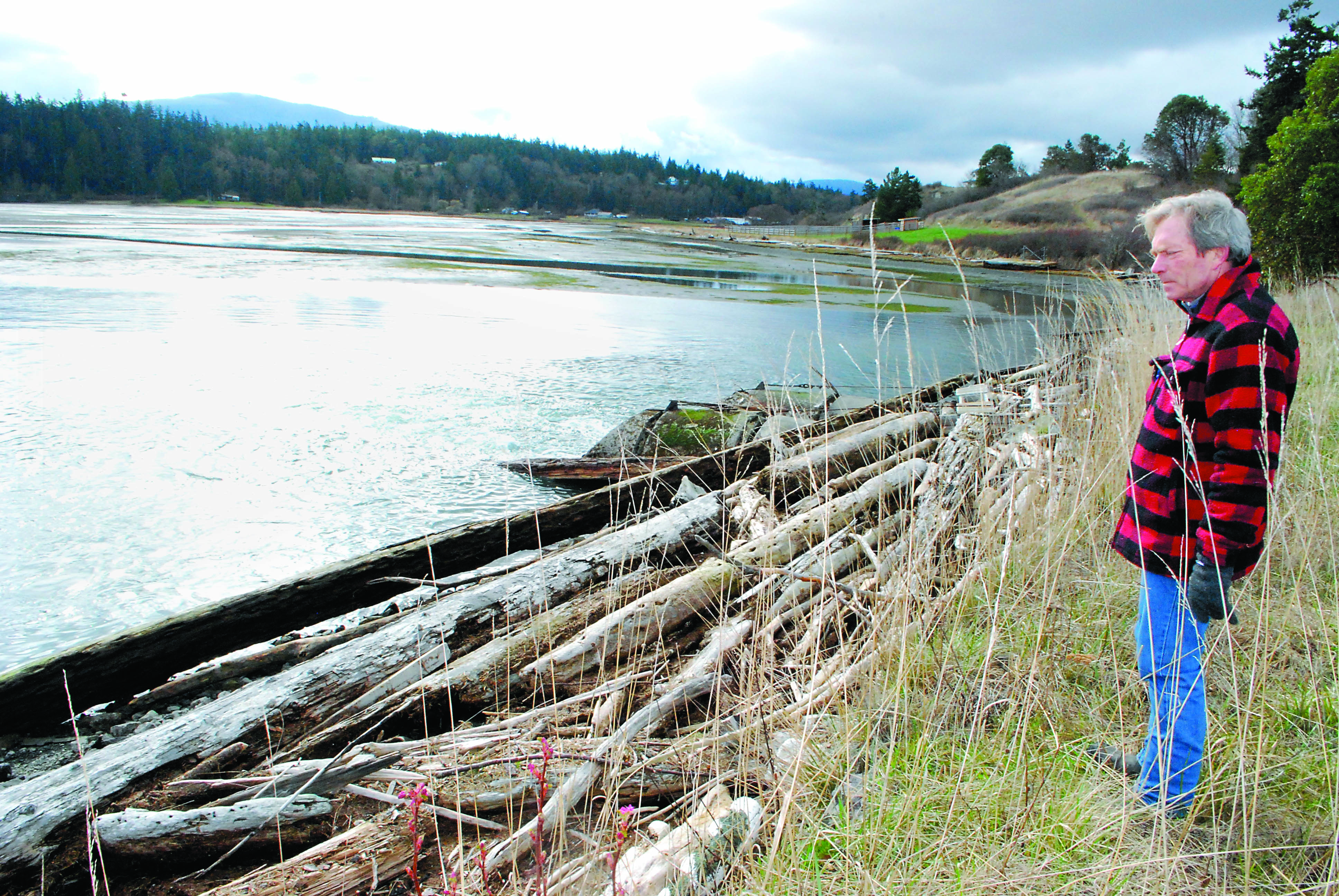
SEQUIM — The landowner whose family holdings include Washington Harbor fully supports a city of Sequim and Jamestown S’Klallam tribe proposal to remove the earthen causeway leading to the city’s water reclamation outflow pipe.
The work will be a major piece of an ongoing effort to restore salmon habitat lost or diminished in the past to man-made obstructions.
“I thought they did a great job,” said Mark Burrowes, talking about the project to remove about 600 feet — or about 10,000 cubic yards of soil — over the city outfall pipe that empties treated wastewater into the Strait of Juan de Fuca near the mouth of Sequim Bay at Gibson Spit.
“Our main focus as a family has been the preservation and restoration of our land at Washington Harbor,” he said.
Soil to build the 1,300-foot causeway was originally excavated from the bluff near the Burroweses’ home.
The $1.86 million government grant-funded project will restore juvenile fish passage into the northern 37 acres of Washington Harbor estuary marsh and tide flats.
The causeway, which was built by the city some 50 years ago, blocks the free and natural flow of much of the lagoon, with only two 6-foot culverts for water passage during the tide’s ebb and flow.
It will be replaced by a low-lying 600-foot bridge the family will own and which the city can use as continued easement to its outfall line, under a mutual agreement the City Council approved in February.
The project is scheduled to begin in June and be completed in October, said Randy Johnson, Jamestown S’Klallam tribe restoration planner.
Two species of salmon will benefit from the project.
Washington Harbor is the largest of the four estuaries around Jimmycomelately Creek to the southeast on Sequim Bay.
The creek, which was straightened for agricultural purposes, was restored to its natural meander in the late 1990s, and Johnson said returns of salmon stocks have dramatically increased since then.
Burrowes, who intimately knows Washington Harbor’s natural behavior — right down to how its shifting sands, water flows and the movements of man-made debris and driftwood around the waterway — said he will continue to observe its evolution from his family’s home on a bluff above the harbor.
He believes the project will reshape the harbor, but how so is yet to be seen.
“What’s going to be interesting is to see how this plays out over the next 30 years,” Burrowes said at the causeway.
Burrowes, 58, figures he has been watching what goes on in scenic Washington Harbor for at least 50 years.
It has long been the family’s seaside playground although others frequently trespass onto the shoreline property from Marlyn Nelson County Park to the north from the end of Port Williams Road.
Burrowes, a career forester who still works as a consultant, said he has always been serious about conserving the family’s legacy at Washington Harbor.
“I’ll pass it on to the kids,” Burrowes said, just as his father, Stanley, did when he died in 2009, and his grandfather, David, did before that.
The Burrowes have three children, who are now in their 20s.
“My life goal is to get this in a situation where I turn it over to the kids, and it sustains itself,” Burrowes said.
Washington Harbor and Bell Creek, which flows into it, are just part of about 180 acres the Burrowes family has owned since the 1920s, an inlet near the mouth of Sequim Bay at Gibson Spit.
The site was originally used as a duck-hunting club and later as the family home site up on the bluff overlooking it.
The Sequim elk herd frequents the greener upland pastures on part of the Burrowes property, where barley and grass hay have been grown and harvested.
Burrowes and his wife, Debbie, stable horses near the home and rent the family-owned vacation cottage on Washington Harbor Road across the harbor.
Adjacent property owners include the Smith family’s Mapleview Dairy up Bell Creek west of Schmuck Road; the city of Sequim’s water reclamation plant, also west and adjacent to the dairy; the Sequim Marine Science Laboratory of the Pacific Northwest National Laboratories, also known as Battelle, on Sequim Bay to the south; and the Clapp family farm to the north.
The lagoon brims with the natural circle of marine, bird and mammal wildlife.
On any day, you can see eagles and hawks soaring over the roughly 120-acre harbor estuary.
Otters frolic and feed along the shoreline, seals, fish, ducks, blue herons and other waterfowl graze in the tidelands near Gibson Spit.
It is a paradise that the Burrowes family wants to protect.
The Burroweses also removed dikes at the mouth of Bell Creek that were originally constructed to protect farm fields upstream, a project that improved the protection of salmon smolt during their transition from fresh to saltwater, he said.
“In the 1960s, the [city’s] sewer outfall line was ruptured and discharging raw sewerage into the lagoon,” Burrowes said.
“Through our efforts and participation, the city was able to secure funding to construct the water treatment plant Sequim uses today.”
The family also owns about 75 acres near the intersection of U.S. Highway 101 and South Sequim Avenue, commercially zoned land that Burrowes tried to sell for development in the past without success.
He said that the property’s future is on hold, and it is still listed for sale.
Burrowes said he was approached about three years ago to work with the tribe, state Fish and Wildlife and the city of Sequim to get the lagoon restoration project in motion.
He insisted that volunteer Douglas firs and a madrona tree on the inner harbor side of the causeway remain, leaving a short link of the earthen dike in place.
Grant funding for the project primarily comes from the Estuary and Salmon Restoration Program — about $1 million — a protection and restoration funding opportunity developed by the Puget Sound Nearshore Ecosystem Restoration Project.
The balance of the funding comes from the Environmental Protection Agency — $131,000 — and the state Salmon Recovery Funding Board, about $635,000.
________
Sequim-Dungeness Valley Editor Jeff Chew can be reached at 360-681-2391 or at jeff.chew@peninsuladailynews.com.