
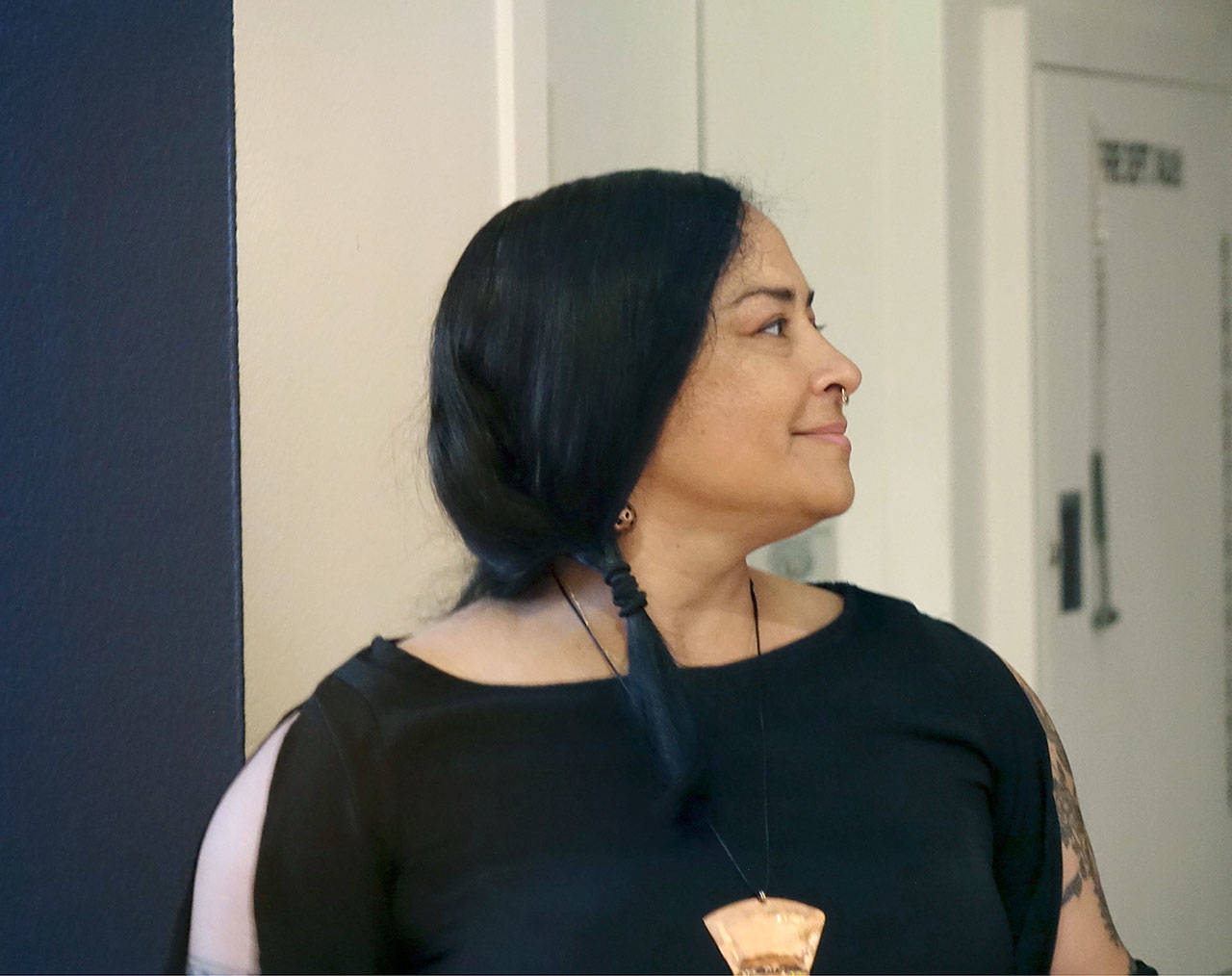
SEATTLE — Here, you can look into the eyes of an Apache girl, a Wisham bride, a Hopi chief.
The photographs of Edward Sheriff Curtis (1868-1952) capture the faces of American Indians across the West, in their regalia, in their canoes and surrounded by mountains and valleys. A cross-section — 150 prints — of his giant body of work is on display at the Seattle Art Museum in “Double Exposure,” a special exhibition that opened last week.
But Curtis, who set up his studio in Seattle 127 years ago and went on to publish the 20-volume collection “The North American Indian,” is not the only formidable artist in the SAM show. Threaded through his cyanotypes, goldtones, sepia photogravures and rare platinum prints are large-scale works by three living artists.
They are tribal members who speak in their own clear voices. And they make for a powerful show.
Curtis photographed Native people, including Chief Joseph, Geronimo and Princess Angeline, the daughter of Chief Seattle, with the belief that they and their cultures were almost gone. He sought to portray them as they were before Europeans arrived on the shores of what are now called Puget Sound, the Olympic Peninsula and Vancouver Island.
In 1915, Curtis traveled to Neah Bay, and his photogravure “Makah—Whaler” shows a man striding across the beach, hoisting his equipment, the towering evergreens behind him.
“They shared so much with [Curtis],” said Barbara Brotherton, SAM’s curator of Native American art.
But “he cast Native people forever in the past.”
In high contrast comes the work of the other three: Tracy Rector, a Seminole-Choctaw filmmaker; Marianne Nicolson, a First Nations artist-activist from Canada and Will Wilson, a Diné photographer who spent his formative years on the Navajo Nation.
Nicolson gives the show “The Seam of Heaven,” a shimmering glass image of the Milky Way galaxy, while Rector contributes her short films, including one about a female geoduck diver.
Wilson presents his extra-large metal prints of Native luminaries including Tulalip tribal member and Washington state Sen. John McCoy, Lummi violinist Swil Kanim and Madrienne Salgado, a Muckleshoot jingle dancer.
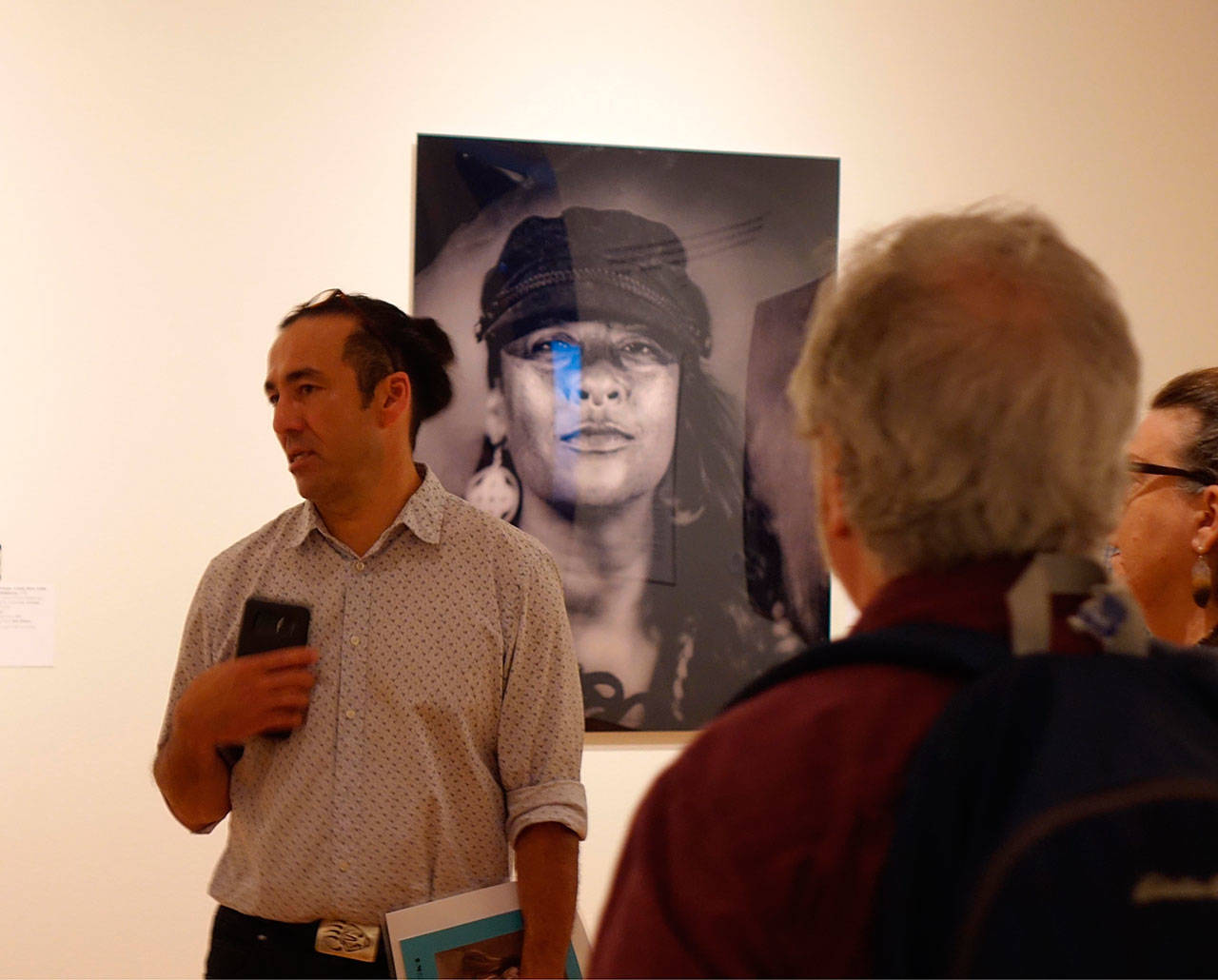
Wilson’s works are “talking tintypes,” using the free smartphone app Layar. Viewers who’ve downloaded the app can use it to scan the artwork and, suddenly, watch it come alive as a moving picture with audio. This content can also be seen on touch screens inside the exhibition.
The visitor walks through the galleries lined with photographs from the previous century and the current one — and then finds a panel bearing the show’s message.
“We are still here,” writes Asia Tail, a Cherokee.
“Against all odds and despite attempted genocide, Native peoples not only have survived but continue to thrive in the present …
“We are still here. This powerful statement is heard often in Indigenous communities. It is part rallying cry, part reminder of what should be obvious, and yet Native peoples are expected again and again to justify our mere existence to a non-indigenous society that widely believes — as did the photographer Edward S. Curtis a century ago — that all the real Indians died.
“Let’s use this moment, 150 years after Curtis’ birth, as a turning point … We are not only still here but will always be here; this is who we are, and what we never lost.”
Like their relations across the West, the tribes of the North Olympic Peninsula are telling their own stories today.
The Makah Cultural and Research Center stands near the entrance to Neah Bay; the Jamestown S’Klallam Tribe has the Northwest Expressions Art Gallery in Blyn, east of Sequim. At the Carnegie Museum in Port Angeles, the Lower Elwha Klallam tribe exhibits artifacts from the sweep of history, from the Tse-whit-zen village to the restoration of the Elwha River.
In “Double Exposure,” Rector has a 12-minute film — in luscious black and white — about the people of the Salish Sea showing continuously on a huge screen. In it, the waves of the Pacific Ocean meet the edge of the Olympic Peninsula; a herd of elk splashes through a river and into the forest. Orca fins slice the surface of Puget Sound, and tribal members sing and pull their way from islands to peninsulas in the annual Canoe Journey. The film illustrates how all living beings are related.
“We don’t own the land,” Rector said.
“We are part of the land.”
Details of the exhibit
“Double Exposure: Edward S. Curtis, Marianne Nicolson, Tracy Rector, Will Wilson” is a special exhibition through Sept. 9 at the Seattle Art Museum, 1300 First Ave.
Admission ranges from $14.95 for teens to $24.95 for adults; on the first Thursday of the month, tickets are half price for everyone and on the first Friday they’re half price for seniors.
For details about the show and many related events, see seattleart museum.org.
The Makah Cultural and Research Center, aka the Makah Museum at 1880 Bayview Ave., Neah Bay, is open daily from 10 a.m. to 5 p.m. For information, call 360-645-2711 and visit www.makahmuseum.com.
The Lower Elwha Klallam Tribe displays ancient artifacts, an Elwha River restoration exhibit and art by local tribal members at the Carnegie Museum, 207 S. Lincoln St., Port Angeles.
Admission is free; exhibit hours are 1 p.m. to 4 p.m. Tuesday through Friday and noon to 2 p.m. Saturday. For information, call the Elwha Heritage Center at 360-417-8545, ext. 2.
________
Diane Urbani de la Paz, a former features editor for the Peninsula Daily News, is a freelance writer living in Port Townsend.
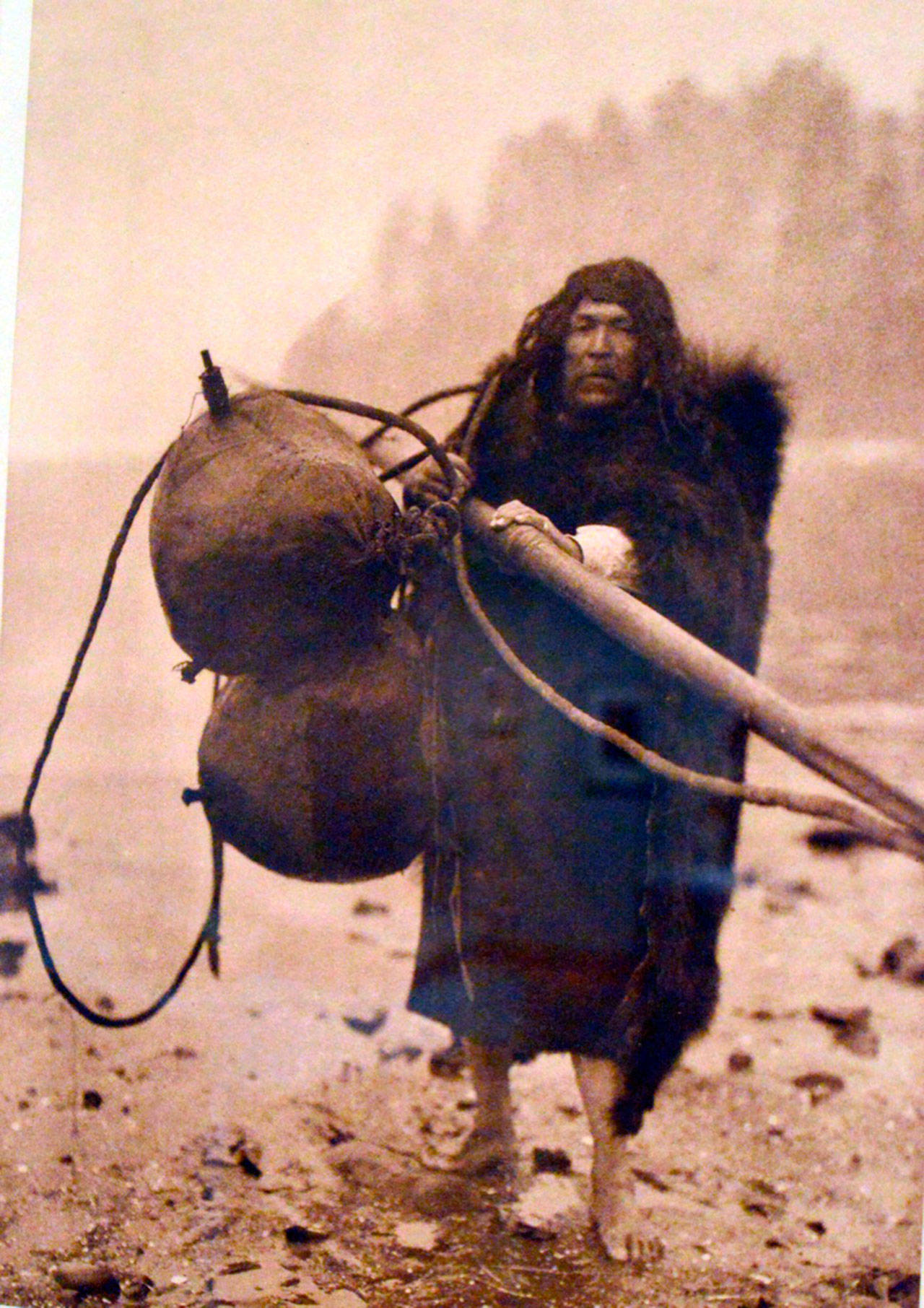
Edward S. Curtis, in his quest to photograph the tribes of the West, traveled to Neah Bay in 1915 for “Whaler — Makah.”
