

By Gillian Flaccus
The Associated Press
PORTLAND, Ore. — A long-awaited federal report out Friday rejected the idea of removing four hydroelectric dams on the lower Snake River in a last-ditch effort to save more than a dozen species of threatened or endangered salmon, saying such a dramatic approach would destabilize the power grid, increase overall greenhouse emissions and more than double the risk of regional power outages.
The four dams on the lower Snake River are part of a vast and complex hydroelectric power system operated by the federal government in Washington, Oregon, Idaho and Montana. The massive dams, built in eastern Washington between 1961 and 1975, are at the center of a years-long battle that pits the fate of two iconic Pacific Northwest species — the salmon and the orca — against the need for plentiful, carbon-free power for the booming region.
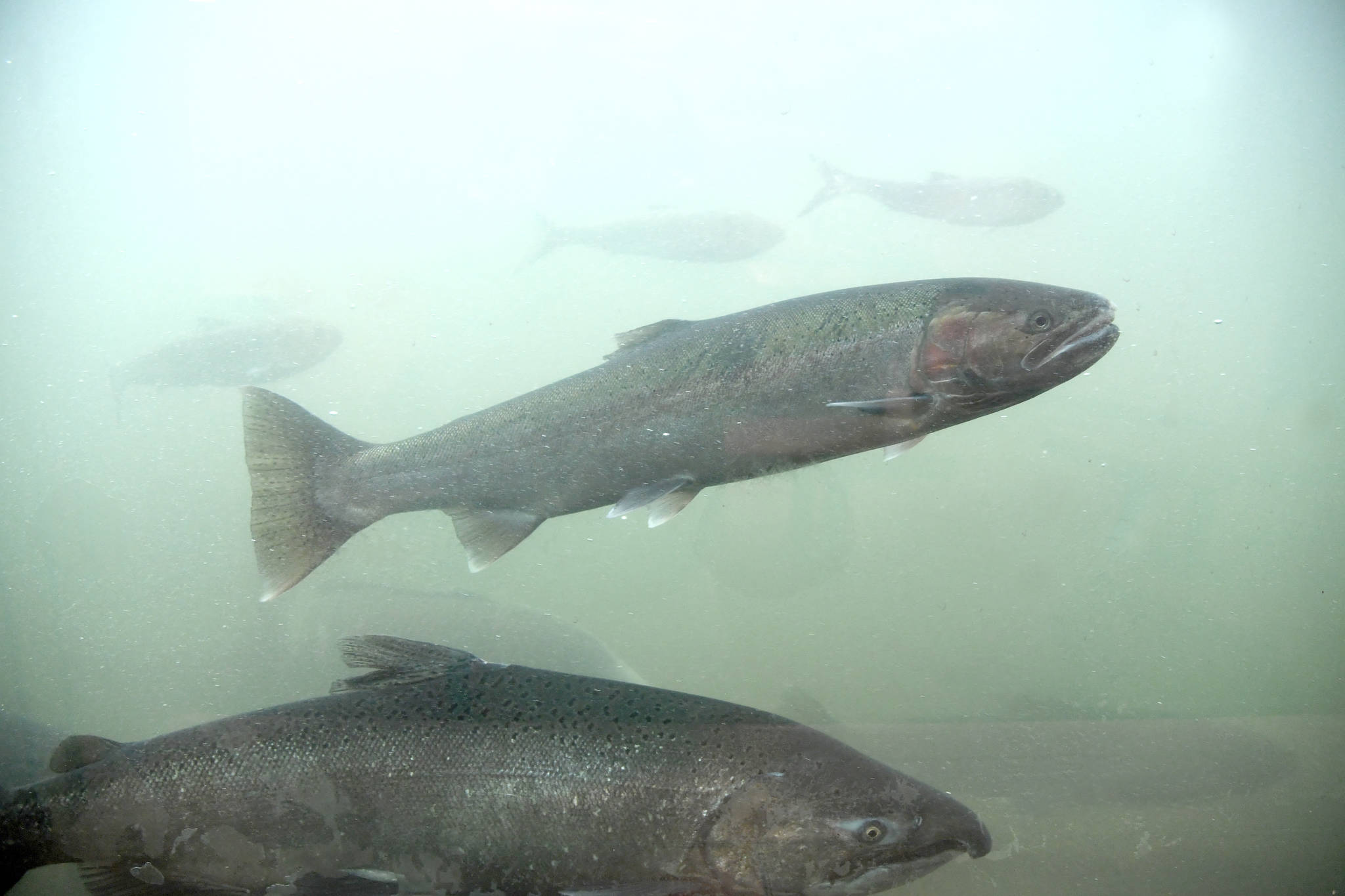
FILE - In this Oct. 19, 2016, file photo, a chinook salmon, below, and a steelhead, above, move through the fish ladder at the Lower Granite Dam on the Snake River in Washington state. A long-awaited federal report out Friday, Feb. 28, 2020, rejected the idea of removing four hydroelectric dams on a major Pacific Northwest river in a last-ditch effort to save more than a dozen species of threatened or endangered salmon, saying such a dramatic approach would destabilize the power grid, increase overall greenhouse emissions and more than double the risk of regional power outages. (Jesse Tinsley/The Spokesman-Review via AP, File)
Environmental groups that have pushed for years for the dams to come down immediately blasted the report. The three agencies in charge of overseeing the sprawling hydropower system recommended an alternative that prioritizes a “flex spill” approach — spilling more water over the dams when juvenile salmon are migrating to the ocean — and continuing the transport of young fish around dams using trucks and barges in some cases. Both approaches are already in use, but the report calls for additional studies and other dam improvements.
“Rather than seizing this opportunity to heed the public’s call for working together for a solution that revives salmon populations, the draft plan is built on the same failed approach the courts have rejected time and again,” said Todd True, an attorney for Earthjustice who has represented environmentalists and fishing groups in ongoing litigation over the dams.
“We need a different approach and leadership from elected officials,” he said.
Dam removal opponents, however, called the focus on the Snake River a “deadly distraction” from other efforts to help salmon, and said the report presented a balanced solution that won’t add costs for ratepayers or disrupt the region’s power supply.
“Once again, the science has determined that destroying the four Lower Snake River dams would have high environmental and economic costs,” said Todd Myers, environmental director at the Washington Policy Center, a conservative think tank.
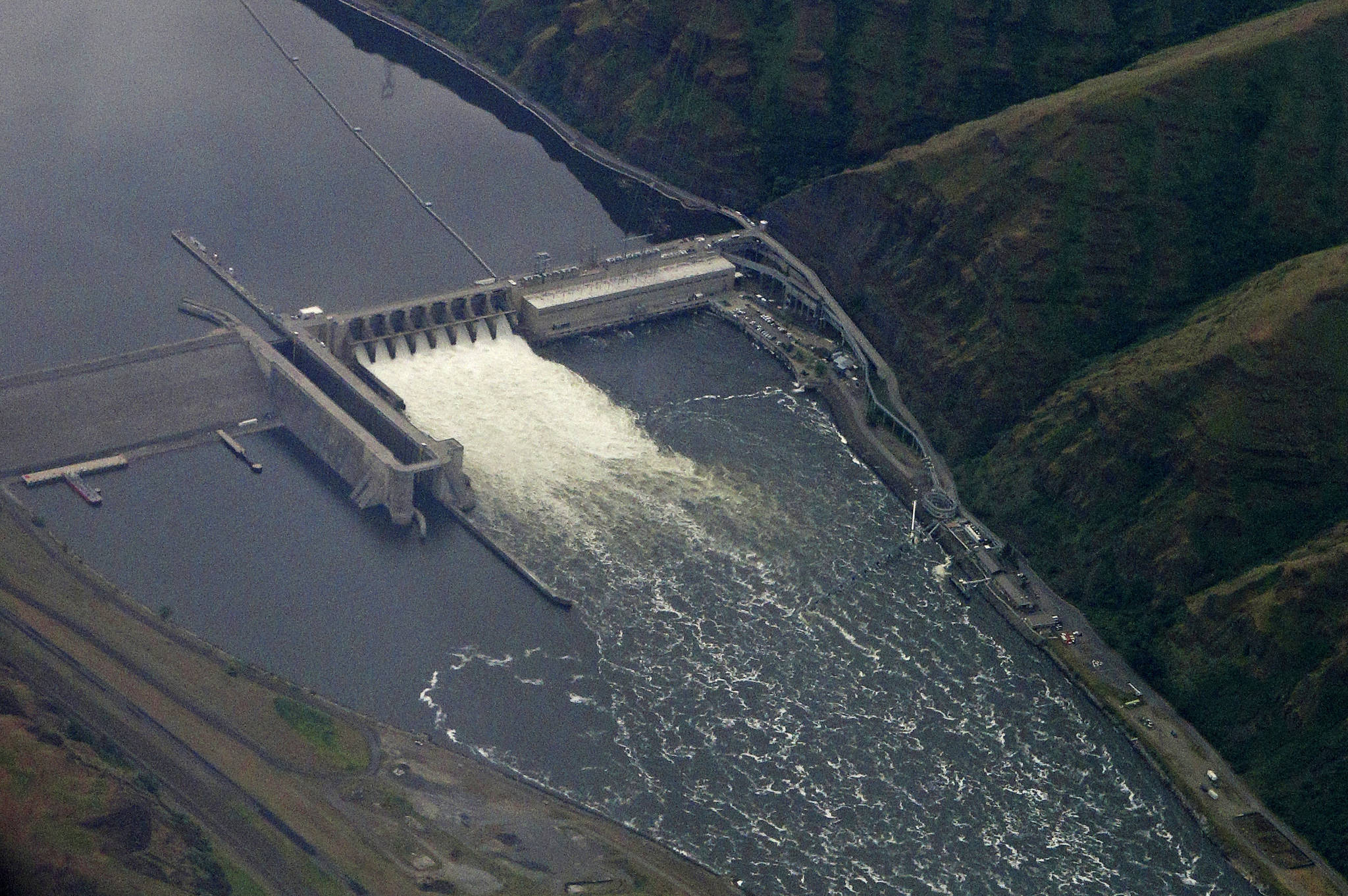
FILE - In this May 15, 2019 file photo, the Lower Granite Dam on the Snake River is seen from the air near Colfax, Washington Farmers, environmentalists, tribal leaders and public utility officials are eagerly awaiting a federal report due Friday, Feb. 28, 2020, that could decide the fate of four hydroelectric dams on the Snake River. (AP Photo/Ted S. Warren,File)
Oregon Gov. Kate Brown voiced support for demolishing the Snake River dams in a letter to Washington Gov. Jay Inslee this month.
The 14 federal dams on the Columbia and Snake rivers together produce 40 percent of the region’s power — enough electricity to power nearly 5 million homes, or eight cities roughly the size of Seattle. They also contain a system of locks that allows cities nearly 500 miles inland from the Pacific Ocean access to Asian markets via barges that float down the massive rivers to the sea. Roughly 50 million to 60 million tons of cargo navigate the Snake and Columbia river system each year.
Yet the towering dams have proven disastrous for salmon that struggle to navigate past them on human-made fish ladders as they migrate to and from the Pacific Ocean. Salmon are unique in that they hatch in freshwater streams and then make their way hundreds of miles to the ocean, where they spend years before finding their way back to their natal streams to mate, lay eggs and die.
Snake River sockeye were the first species in the Columbia River Basin listed under the Endangered Species Act in 1991. Now, 13 salmon runs are listed as federally endangered or threatened.
The Columbia River system dams cut off more than half of salmon spawning and rearing habitat, and many wild salmon runs in the region have 2 percent or less of their historic populations, said Meg Townsend, an attorney for the Center for Biological Diversity.
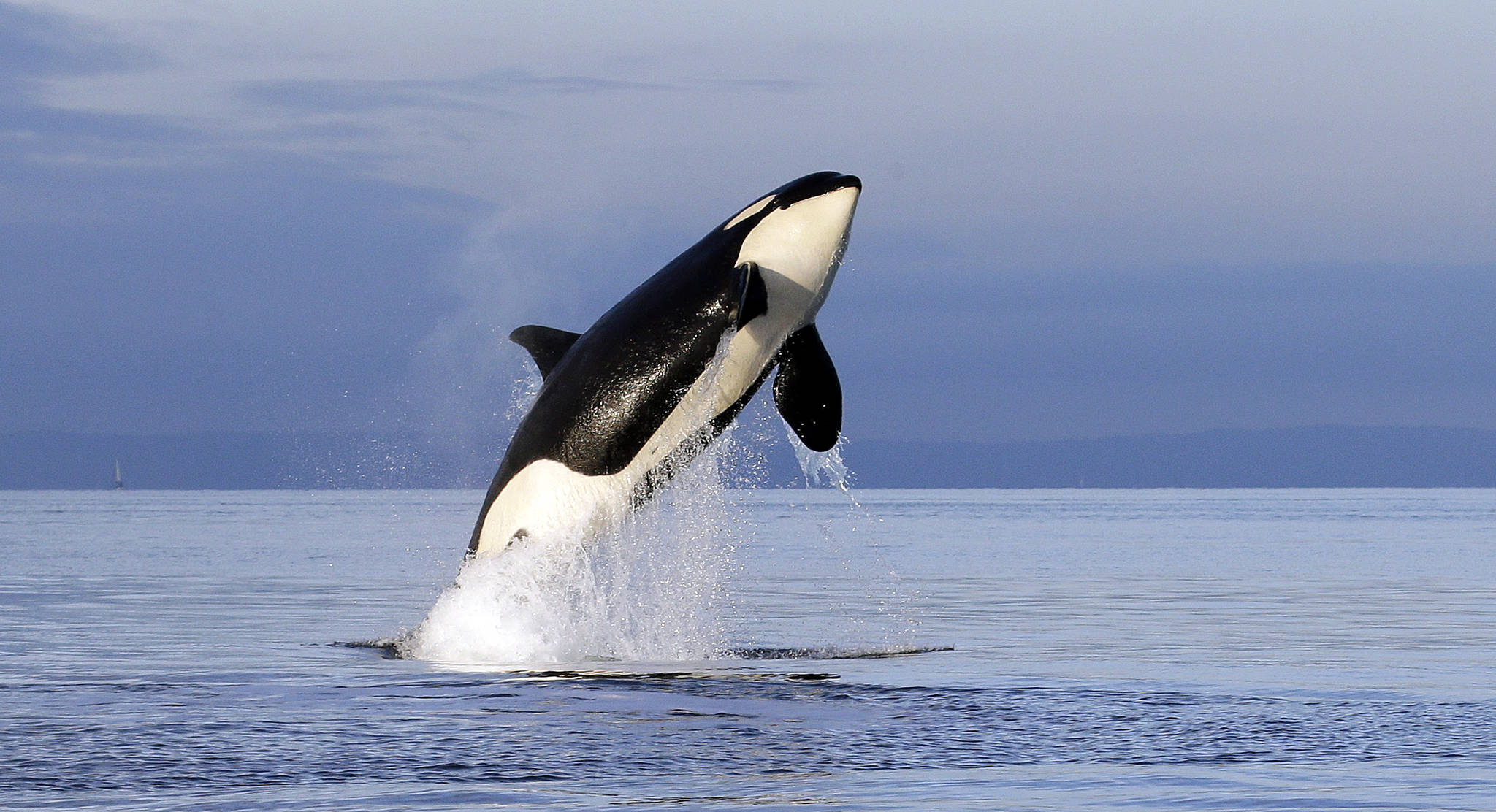
FILE- In this Jan. 18, 2014, file photo, an endangered female orca leaps from the water while breaching in Puget Sound west of Seattle, Wash. A federal report released Friday, Feb. 28, 2020, rejected the idea of removing four hydroelectric dams on a major Pacific Northwest river in a last-ditch effort to save threatened and endangered salmon. Scientists also warn that southern resident orcas are starving to death because of a dearth of the chinook salmon that are their primary food source. Dam removal could increase the numbers of two key stocks of chinook salmon for orcas. (AP Photo/Elaine Thompson, File)
The Snake River dams have fish ladders, but the salmon can get bottle-necked at the dam before they are swept into the ladder, and many get picked off by birds or other predators, Townsend said. Still more get sucked into the dams’ turbines before they discover the fish ladders and get “churned up in a meat grinder,” she added.
Fish ladders are concrete chutes filled with rushing water that bypass the dams and attempt to mimic the environment a salmon would navigate if it were swimming upstream or downstream in river rapids.
“The science shows that pulling out the four lower Snake River dams is the only way to save Columbia river salmon,” she said.
Scientists also warn that Southern Resident orcas are starving to death because of a dearth of the chinook salmon that are their primary food source.
The Pacific Northwest population of orcas was placed on the endangered species list in 2005. A mother orca that carried her dead baby on her back for 17 days brought international attention in 2018 as their numbers have dwindled to 72 animals.
Opponents of dam removal say they want salmon to flourish, but they aren’t sure breaching four major hydroelectric dams will help — and it could instead damage the regional economy and the stability of the power supply.
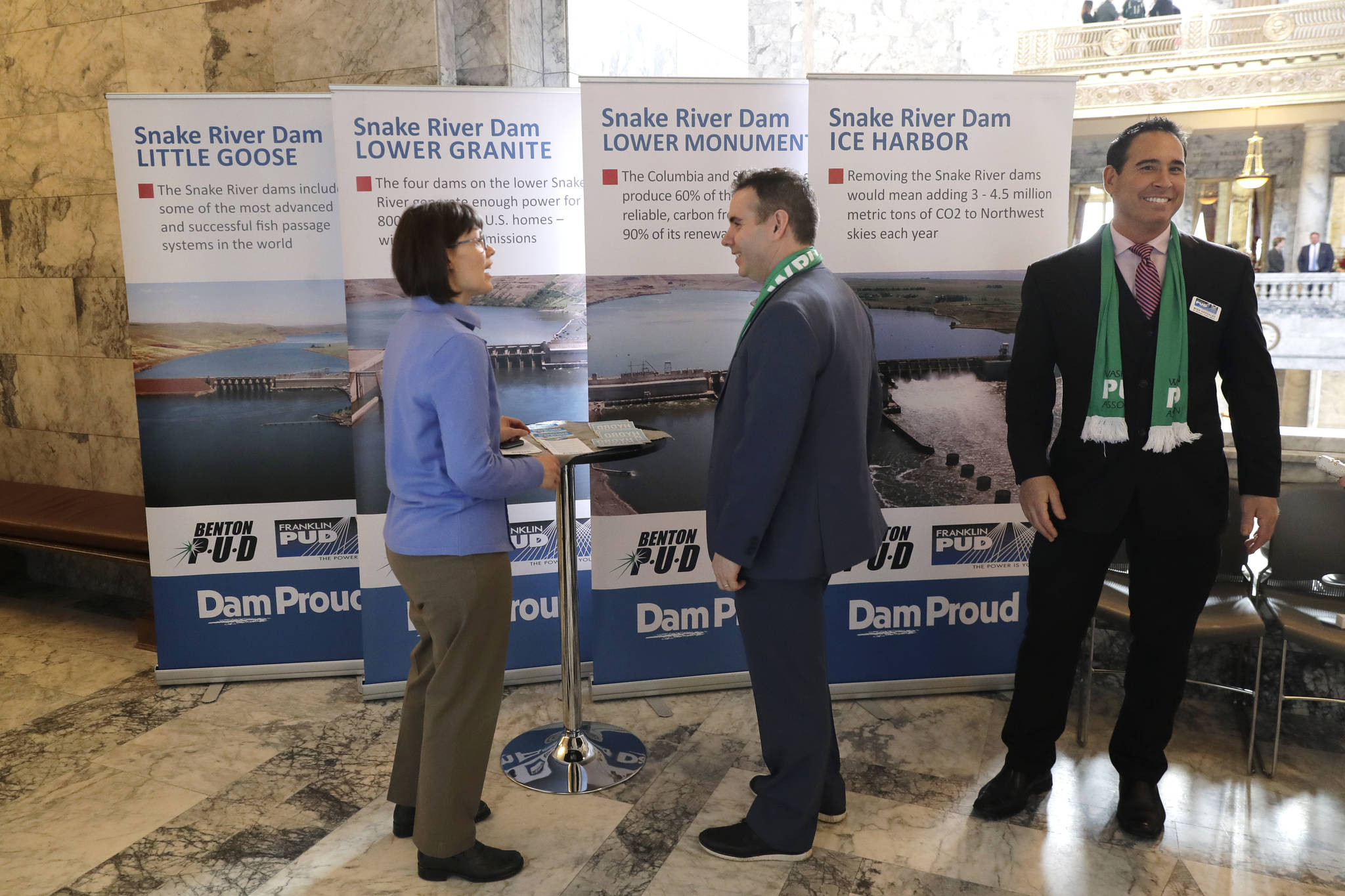
In this Feb. 12, 2020, photo, Mike Gonzalez, right, senior manager of public affairs at the Franklin Public Utility District, stands next to informational signs promoting dams on the Snake River during a lobby day at the Capitol in Olympia, Wash. A federal report released Friday, Feb. 28, rejected the idea of removing four hydroelectric dams on a major Pacific Northwest river in a last-ditch effort to save threatened and endangered salmon. The report says breaching the dams would destabilize the power grid, increase greenhouse emissions and raise the risk of power outages. (AP Photo/Ted S. Warren)
Reservoirs behind some of the dams allow the Bonneville Power Administration to even out the more erratic power supply from wind and solar by spilling water to generate electricity on short notice. And a move away from low-cost coal plants in the Pacific Northwest has some worried about what the future could hold for ratepayers if the Snake River dams are removed, said Kurt Miller, of Northwest River Partners, which represents community-owned utilities across Oregon, Washington, Idaho and Montana.
“This is a much, much bigger issue than the Snake River dams. If worldwide salmon populations are doing poorly because of climate change and carbon, does it make sense to tear out 1,000 average megawatts of carbon-free electricity?” he said.
“For so many reasons, it’s bad public policy.”
The report Friday addressed those concerns in its recommendation regarding the dams.
Hydropower generation would decrease by 1,100 average megawatts under average water conditions, and 730 average megawatts under low water conditions, the report said. The risk of a regional power shortages would more than double and the lowest-cost replacement power would be $200 million a year, the report said. Those adjustments would increase the wholesale power rate up to 9.6 percent, the authors wrote.
U.S. District Judge Michael Simon ordered the U.S. Army Corps of Engineers, the Bureau of Reclamation and the Bonneville Power Administration to revisit the impact of the hydroelectric system in 2016 while overseeing litigation over salmon.
In all, three federal judges have thrown out five plans for the system over the decades after finding they didn’t do enough to protect salmon.
The report Friday is a draft and will be subject to 45 days of public comment. A final report — including the agencies’ final decision — is expected in September.

In this Feb. 12, 2020, photo, Mike Gonzalez, center, senior manager of public affairs at the Franklin Public Utility District, stands next to informational signs promoting dams on the Snake River during a lobby day at the Capitol in Olympia, Wash. A federal report released Friday, Feb. 28, rejected the idea of removing four hydroelectric dams on a major Pacific Northwest river in a last-ditch effort to save threatened and endangered salmon. The report says breaching the dams would destabilize the power grid, increase greenhouse emissions and raise the risk of power outages. (AP Photo/Ted S. Warren)
