
Elwha tribe to display more 2,700-year-old artifacts from Tse-whit-zen village
Published 6:07 pm Thursday, July 9, 2015
PORT ANGELES — History may hurt, but heritage can help heal, according to the chairwoman of the Lower Elwha Klallam tribe.
Pain will continue turning to pride today, said Frances Charles, when the Elwha Heritage Center displays 22 more artifacts from the ancestral tribal village of Tse-whit-zen.
Thousands of the items came to light in 2003 when excavators of an enormous dry dock ripped into the 2,700-year-old village site and burial ground on the Port Angeles harborfront.
It wasn’t the first time the remains and relics had been violated; archaeologists found water and electric lines had been run through graves to supply mills along Marine Drive.
“Seeing how our ancestors were treated, disrespected — it hurt; it still hurts today,” says a placard with Charles’s statement that stands amidst the display.
Yet the discovery — called the richest pre-European find in the Northwest — also set the Lower Elwha Klallam tribe on a journey that raised its profile in a community where some residents didn’t know the tribe was their neighbor, Charles said.
“It’s benefiting everybody,” she said Wednesday at the Heritage Center, 401 E. First St., which is open from 8 a.m. to 5 p.m. weekdays.
“We see more collaboration and connections in all aspects of it” — increased awareness by the community, pride for the tribe.
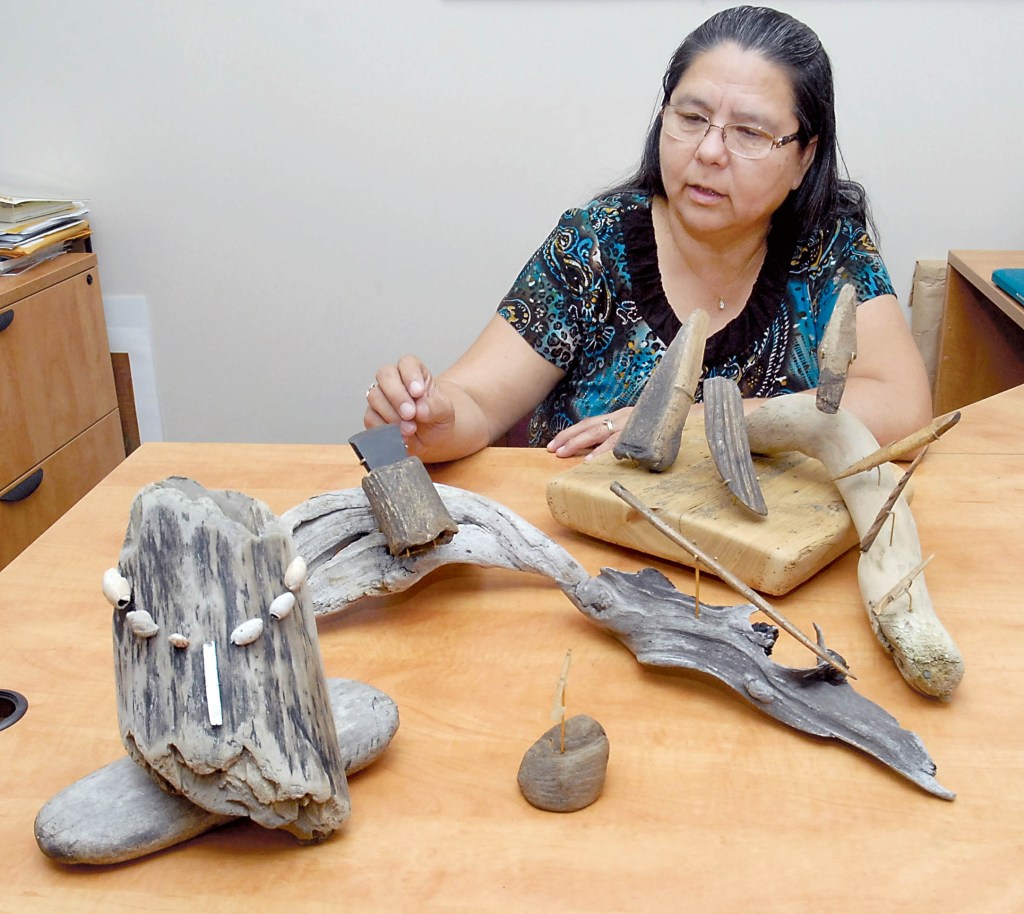
The newly added artifacts — including olive shells, a pendant, an antler wedge, a large wooden needle that might have sewn seal skins, an adze and handle, hunting and fishing points, and etched stones that share stories — will bring to 66 the total relics on display inside protective cases.
All but one of the additions are mounted on driftwood from the restored mouth of the Elwha River. The last is displayed on a board that was salvaged from a longhouse that once stood in Lincoln Park.
A reception with light refreshments and featuring the tribal drumming group will start at noon today.
The items are on indefinite loan from the Burke Museum at the University of Washington, Seattle, where more than 67,000 other articles are stored.
“We’ll renew the loan every three years,” said Suzie Bennett, manager of the heritage center.
“They’ll stay here as long as we’d like them to. This was the most natural place for them to come back to.”
The first six cases of relics went on display about a year ago, along with descriptions of their uses. Two more cases joined them, accompanied by texts of two Klallam legends.
The two newest cases will be arrayed alongside written recollections of people who unearthed them.
“They [the ancestors] used my eyes to show me the things they wanted me to show the rest of the world,” wrote Mark Charles, tribal monitor.
“I know you’re hurting,” was tribal safety officer Derek Charles’ message to his forbears.
“We’re here to protect you.”
Another tribal monitor, Phillip Charles, wrote, “The first thing I found was an ischium bone.
“It was the hip bone of a child; it fit in the palm of my hand.”
Frances Charles said tribal members who worked at Tse-whit-zen, recovering remains and relics sometimes only a few feet ahead of excavators, can recall where they were when they made discoveries.
“A lot of them have come in here and were amazed,” she said.
“It did a lot of healing in different ways.”
The tribe’s objections to the dry dock, called a graving yard — which would have built huge concrete replacement pontoons to refurbish the Hood Canal Bridge — and withdrawal of support by state and federal officials stopped the project three years after it began.
The failed $100 million excavation that would have been large enough to float three USS Missouri-class battleships has been filled and allowed to go fallow. The remains of 335 ancestors have been reburied there.
That hasn’t brought complete closure for either the tribe or the community, Charles said.
“You still have the remorse out there, but you still have the anger,” she said.
However, since the Tse-whit-zen discovery, the Lower Elwha have hosted the 2005 Tribal Canoe Journey, seen the restoration of their namesake river and the uncovering of their creation site, opened a small casino, started a counseling center, opened a tribal health center and dedicated the heritage center, plus other projects.
The artifacts are the sweetest of the tribe’s bittersweet recent history.
“It’s brought everybody forward,” Charles said.
“Having the respect for our ancestors, having the respect for the ground, having the respect for what is there — we thank the ancestors and the Creator.”
Charles visits the heritage center with her granddaughter, who was too young to understand the turmoil that occurred when Tse-whit-zen was uncovered or the culture the tribe rediscovered at the site.
“It brings things back to where she says, ‘Now I know what you’re talking about, Grandma,’” Charles said.
_______
Reporter James Casey can be reached at 360-452-2345, ext. 5074, or at jcasey@peninsuladailynews.com.