
That persistent fog caused by a ridge of high pressure over much of the West Coast that has blanketed coastal cities has reached almost legendary status.
Thursday’s near-collision between a Washington state ferry and a 60-foot fishing trawler between Mukilteo and Whidbey Island, and a giant pileup Friday morning on Interstate 5 near Seattle’s Boeing Field show just how dangerous the pea soup can be.
Be careful out there.
I grew up in Pacific Grove, Calif., an area known all too well for its long, foggy days, especially in summer.
The foghorn at Point Pinos was often a daily companion to all who lived in the city.
Now that my lovely wife and I live along the Strait of Juan de Fuca, the sound of the fog horn has been replaced by ships’ whistles — no less a harbinger of peril to any who fail to heed their warning.
Roger Ross, a ship’s master who works with ConocoPhillips on its fleet of five Endeavour-class tankers that transport crude oil from Valdez, Alaska, to various ports along the West Coast and Hawaii, was kind enough to chat with me about fog, foghorns and vessel-avoidance protocol.
Those topics have been a source of inquiries by readers of this column, most recently by Glenn Harper of Port Angeles.
Roger said the fog on the North Olympic Peninsula is caused by the air temperature being warmer than the water temperature.
Straightforward enough for today’s discussion, although there are other causes of fog, including the water being warmer than the air. That and other distinctions are for another column — perhaps when I become acquainted with a meteorologist.
One question readers asked in various forms: “How do recreational boaters find their way around Ediz Hook and into Port Angeles Harbor during a thick fog?”
Roger’s answer was quick and unequivocal: “They shouldn’t be out there.”
He added that there are navigational apps available for smartphones that are not only helpful in returning to the harbor but also indicate where commercial vessels are in the Strait.
I am also aware that there is a navigational aid in the form of a lighted buoy near the shoals of Ediz Hook that flashes every five seconds for 24 hours a day and also has a swell-activated bell.
Additionally, there is a foghorn that sits on land at the end of Ediz Hook that is operated by the Coast Guard.
However, it has shown itself to be unreliable to such a degree that it has been known to sound itself during clear weather and be silent during the thickest of fogs.
In the days of sailing navies, fog signals consisted of firing a gun at intervals, beating drums and ringing the ship’s bell.
In the modern era, fog signals can be mechanical, steam-generated and, in the case of recreational boaters and day-sailers, as basic as a handheld air horn.
Roger said that anytime there is a restriction in visibility, a mariner should begin to use his or her sounding device.
He explained that there are three types of vessel classifications: sailing vessels, towing vessels and power-driven vessels.
Each has its own signaling convention based on a number of criteria.
Basically, power-driven vessels underway — from the smallest of boats to the largest of the deep-draft ships — sound one prolonged blast on the ship’s whistle or foghorn every two minutes.
Likewise, a tug that is underway with a tow sounds one prolonged and two short blasts every two minutes.
A sailing vessel gives one blast every minute if she is underway on a starboard tack, or two blasts every minute if she is on a port tack.
Roger added that sailing vessels using their kicker motors to propel themselves are no longer considered a sailing vessel for these purposes but a power-driven vessel and must adhere to power standards.
The final question from Harper: “How do ships avoid turning into each other in a dense fog?”
Roger said there are inbound and outbound commercial shipping lanes from Cape Flattery through the Strait of Juan de Fuca and down through Puget Sound.
These well-separated lanes and the spacing required between vessels within these lanes all but eliminates the likelihood of two vessels turning into each other.
Roger added that no vessel can impede the passage of a deep-draft vessel in a shipping lane, and that includes sailboats.
He noted the misconception that sailboats have the right of way; that’s not so if the deep-draft vessel is in a shipping lane.
Thanks and a tip of the bosun’s cap to Harper and the other readers for the questions, and to Capt. Ross for his valiant effort in attempting to educate me.
Two-day visitor
The crude-oil tanker Kodiak moored to Port of Port Angeles’ Terminal 1 North on Friday night.
According to Chandra “Hollywood” McGoff at Washington Marine Repair, four mechanics are working on a boiler.
Look for the 869-foot vessel leaving Port Angeles tonight.
Kodiak, which is operated by SeaRiver Maritime, the shipping subsidiary of Exxon Mobil, was launched in 1978 as Tonsina. She was part of BP’s shipping affiliate, Alaska Tanker Co., until mid-2005 when ATC’s fleet of Alaska-class tankers came online and rendered her services unnecessary.
Made in Port Angeles
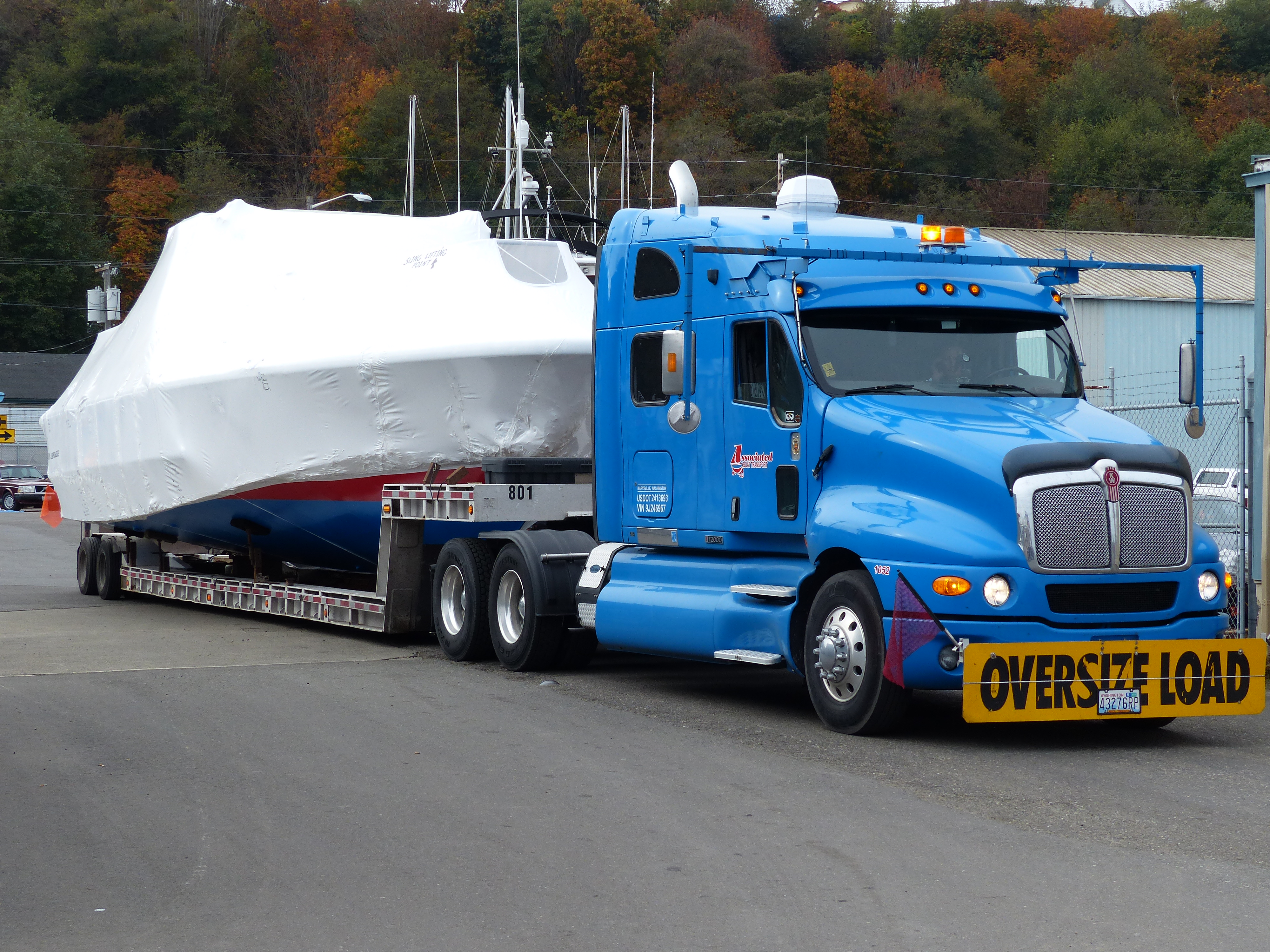
Associated Boat Transport of Marysville on Friday delivered a 45-foot aluminum boat to the Port of Houston for Port Angeles’ Lee Shore Boats.
She is the first of 20 Lee Shore vessels that are destined for a South American multinational corporation.
Joe Beck, who leads the sales department at Lee Shore, said the journey to Texas went off without so much as a hiccup.
Ironically, the only bump in the road occurred before the boat left the builder’s facility on Edgewood Drive.
Crews initially oriented the boat bow-to-stern on the lowboy trailer for the trip south.
By doing so, the overall height was more than 15 feet, which would have required an additional vehicle called a pole car to accompany the oversized load.
The purpose of a pole car is to follow the truck. When it comes to an overpass, the driver of the pole car stops by the side of the road, removes a pole from his vehicle and measures the overpass to verify that the truck and its cargo has the necessary height clearance to proceed.
If not, they have to find an alternate route.
Joe said they resolved the dilemma by having the truck driver take the shrink-wrapped boat to the Port Angeles Boatyard.
There, Dan Schmid and his crew used the yard’s 70-ton TraveLift to hoist the boat off the trailer and reposition it stern first.
When they measured the reconfigured load, it was 14 feet, 6 inches from the ground to the highest point of the boat — which, Joe commented, “was perfect.”
Port Angeles Harbor fillerup
Tesoro Petroleum on Thursday provided bunkers to the articulated tug and barge Pride.
The Crowley-owned vessel pushes barge 650-7, which has a payload of 7.7 million gallons of petroleum products.
On Friday, Tesoro refueled Nord Steady, a new petroleum-products tanker that is 600 feet long.
Tesoro on Saturday bunkered Alaskan Legend, a U.S.-flagged crude-oil tanker — one of the aforementioned ATC Alaska-class ships — that is 941 feet long.
________
David G. Sellars is a Port Angeles resident and former Navy boatswain’s mate who enjoys boats and strolling the area waterfronts.
Items and questions involving boating, port activities and the North Olympic Peninsula waterfronts are always welcome.
Email dgsellars@hotmail.com or phone him at 360-808-3202.
His column, On the Waterfront, appears every Sunday.
