
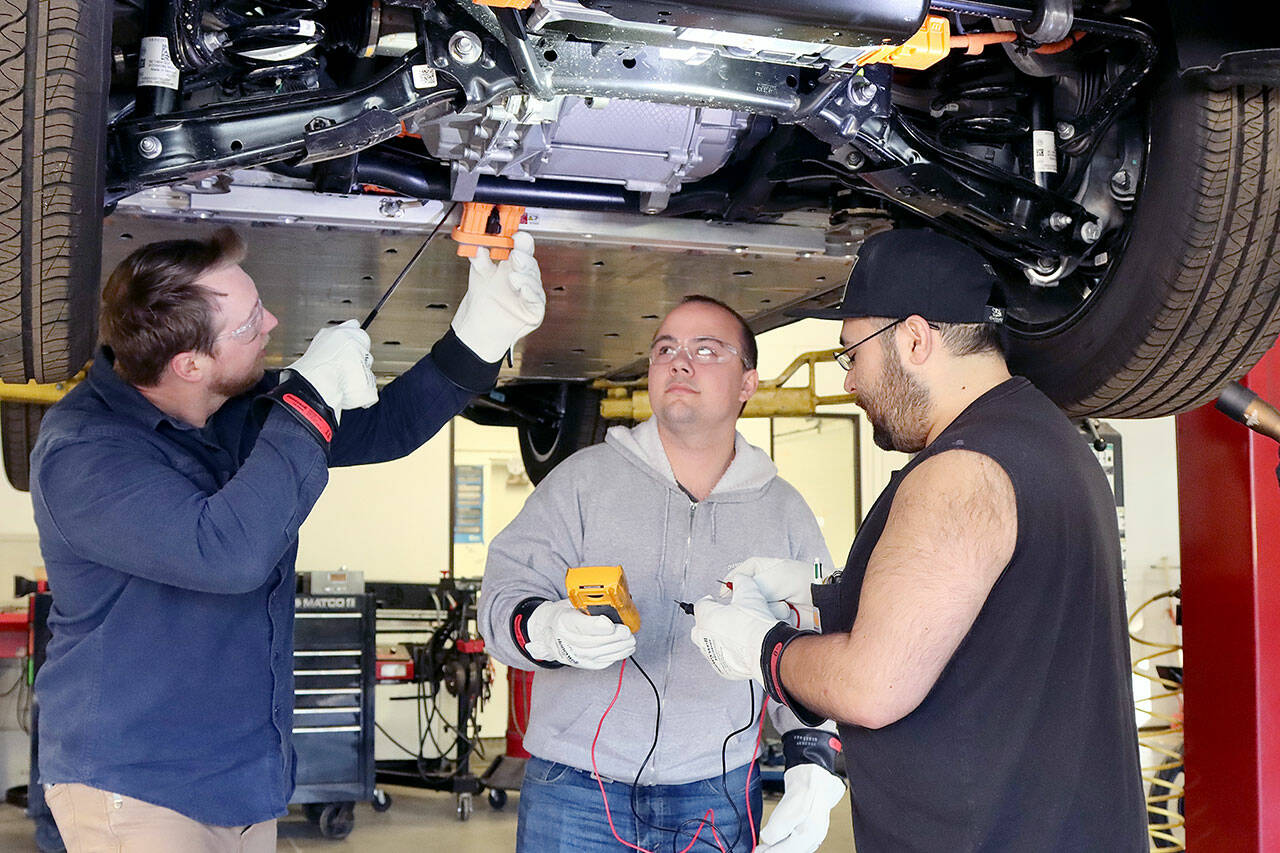
PORT ANGELES — Peninsula College has rebooted its automotive technology program with a new instructor, new curriculum and a renewed focus on workforce readiness that includes a course on electric vehicle diagnostics and repair.
The first cohort in the six-month automotive service technician certificate course began in January and will be ready to hit the job market in June.
The program had been on hiatus since about 2019 due to declining enrollment, said Brian Kneidl, associate dean for workforce programs. At one point, it had only two students.
The college wanted to re-think and re-organize the program so it could meet the demands of local employers, and it responded to students’ preferences for how they wanted to learn.
Kneidl talked to an advisory committee composed of local dealerships, repair shops and other automotive businesses to learn what they wanted and needed. Several common themes appeared.
“They weren’t looking for someone with a two-year degree, that’s when we decided we’d start with a short certificate program,” Kneidl said. “One of the biggest skills they looked for was being able to diagnose the vehicle quickly and have a good understanding of basic electronics.”
Funding from the Peninsula College Foundation ($309,111) and $150,000 from the Washington State Board for Community and Technical Colleges’ Workforce Development Fund got the program off the ground and enabled the college to purchase an electric Volkswagen IQ.4 and a hybrid Toyota Prius. (There are no plans to purchase a vehicle from Tesla, which requires vehicle owners to use its own technicians and certified repair shops.)
The college also purchased equipment necessary to train students on electric vehicles, such as insulated versions of tools like ratchets, pliers, screwdrivers and spanners, and high-voltage meters and personal equipment like insulated rubber gloves.
With about 1.6 million EVs sold in the United States in 2023 — a 60 percent increase from the 1 million sold in 2022, according to the International Energy Agency — the college wanted its students to be prepared with skills that would prepare them for the workforce.
With the shift in demand to electric vehicles still ongoing, the college also wanted to create a program that would assist as many employers as possible.
“Some were very much like, ‘Yeah, that’s the future,’ and others were like, ‘Wow, we’ve still got a lot of late-model vehicles,’” Kneidl said. “It was important to balance both of those.”
The college had originally planned to start the revised automotive technology program in fall 2023, but difficulty finding an instructor with the right knowledge and background pushed the start to the 2024 winter quarter.
“I got lucky and found someone and he just happened to have all of the right skills,” Kneidl said of Josh Taylor, who began his new job just a few weeks before classes started.
It was a return to campus for Taylor, who had studied at Peninsula College after graduating from Port Townsend High School. He found his niche in the automotive field working in electronics for about 15 years.
“After that, I worked for three different EV startups in the Seattle area, doing everything from electric vehicle conversions to battery upgrades to increase the range of electric vehicles,” Taylor said.
Most recently, he was lead engineer and project manager for Peace Vans in Seattle, which converts Volkswagens with internal combustion engines into electric vehicles.
Although he had never been a college instructor, Taylor said the role was appealing.
“As part of my positions I’ve held over the past few years, my favorite part of the job was always teaching, so I wanted to give it a try,” Taylor said.
For students, the automotive technology certificate program requires a smaller investment of time and money than a two-year degree to prepare them for a position as an entry-level technician.
Brian Selk of Port Angeles is one of eight students enrolled in program. He said he had taken some automotive classes when it was an associate’s degree program, but he returned partly because it would only take two quarters to earn a certificate.
“I want to be able to fix my own vehicle,” Selk said. “I’m not that interested in electric vehicles, but it’s something that you should know.”
This summer, Kneidl and Taylor will touch base with the program’s advisory committee and reassess the curriculum. Developing specialized automotive certificates that could prepare students for Automotive Service Excellence (ASE) testing and credentials is among the ideas they are considering.
“There is a lot of opportunity because there’s so much you can teach,” Kneidl said. “We’re hoping to get a diesel vehicle soon and maybe offer a diesel mechanic or heavy vehicles repair certificate.”
Taylor said it isn’t just automobile repair that has changed since he was a student, but the role of people who work on vehicles has changed as well. It is important that students understand that mindset, he said.
“I tell them, ‘You’re not auto mechanics, you’re automotive technicians,’” he said.
________
Reporter Paula Hunt can be reached by email at paula.hunt@peninsuladailynews.com.
