
SINCE I STRAINED the limits last week trying to connect the madness of basketball in March to vegetable gardening, let me begin today by starting with the first in the Brassica genus.
Latin for brassica is “caulis” meaning stem or cabbage, even though my industry uses the common term “cole crops.”
The varieties of cabbages grown today descended from wild cabbage that evolved in the Mediterranean.
The cabbage was well-known in the Roman and Greek empires, but we should come to know this plant as inexhaustible.
Cabbages absolutely adore cool nights and mild days and tolerate frost very well, so boy, do we have the Peninsula for cabbages.
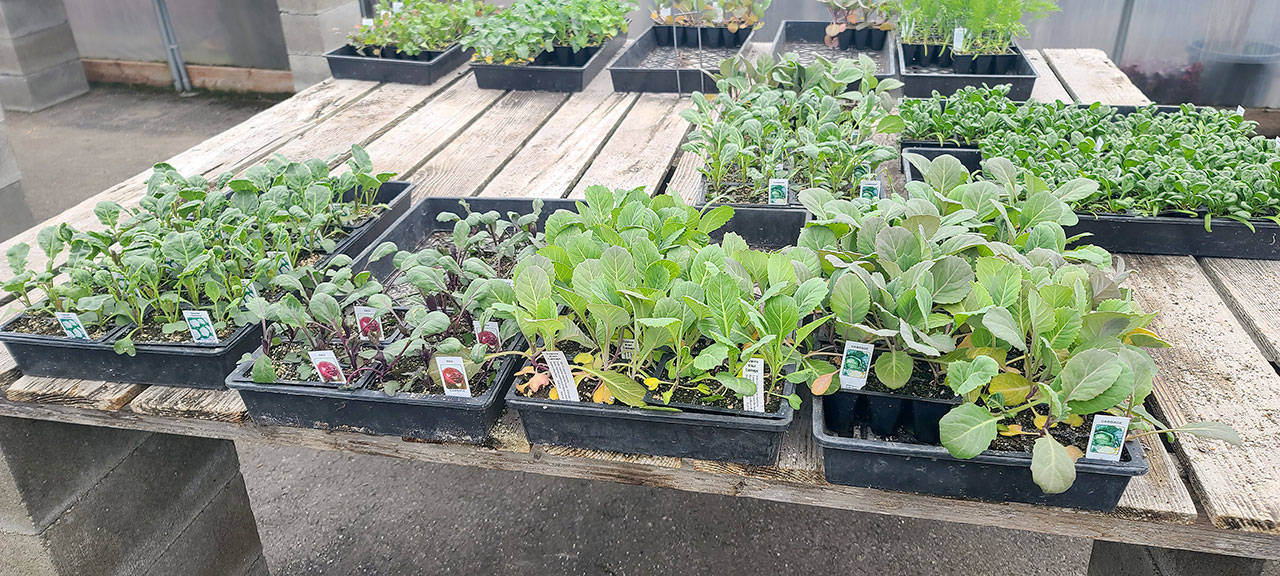
Frost tolerant means you should start planting this week (I did 10 days ago) or be sowing seed in the garden. I have seen packs of cabbage, as well as other brassica, for sale now at many plant outlets.
Savvy gardeners normally plant a few (three to five) varieties and types in 10- to 14-day successions, because prime picking conditions only last a short while.
They like rich, humus soil and plenty of nourishment — however, in our wet springs and winters, soil with more sand added for drainage greatly helps.
The most common cabbage is the head cabbage comprising smooth green and red types.
Head cabbage may also have crinkly, rough textured leaves and head — these are savoys.
Then, we have the Chinese cabbages, of which there exist two types as well. B. rapa (Pekinensis group) have elongated cylindrical heads, barrel heads or ones that are long and slender. B. rapa (Chinensis group) are headless cabbages with very succulent leaves that loosely cluster together, but do not condense.
The ornamental (and garnish) cabbages B. oleracea (acephala group) are prized for their fall and winter leaf color, and extreme tolerance to hard frosts.
But for usages, cabbage is the complete player and why you want a few plants harvestable every week.
They are used in soups and stews, cooked with corned beef and top barbecue as sauerkraut.
Cabbage rolls and coleslaw need the red-headed types.
The Chinese eat more cabbage than anyone else (more than 80 million pounds, according to a 2008 estimate from the food and agriculture organization of the United Nations) because of how well they boil and stir-fry.
When picked extremely young, they act as great raw treats or cooked baby veggies.
When possible with any brassica, it is best to get locally-produced seeds, seedling or plants, especially the seeds, which will acclimatize rapidly to our unique weather.
The kohlrabi (B. oleracea var gongylodes group), also known as German turnip, derives from “kohl” the German word for “cabbage” and “rube” meaning “turnip.”
It is known as such because of the succulent, fleshy, swollen stem just above ground that begets it’s German-given name.
I called them delish or ground-picked water chestnuts, because their crispness and flavor is much like the best tasting water chestnuts, though many others compare kohlrabi to apples in texture, taste and crispness.
The advantage of kohlrabi is the speed that one can sow, grow and consume this crop, which from seed to mouth only takes 55 to 60 days.
It also takes up little room in the garden, needing only 3- to 4-inches between plants.
The plants need fertile and moist soil to assist and maintain the rapidly-growing bulb, and a lack of constant moisture results in strings and piths in the edible bulb part of the plant.
Eaten raw, sliced or fresh with a salad makes kohlrabi an incredible food source for many nutrients, as well as a great source of dietary fiber (3.6 grams per average plant).
Collards B. oleracea (acephala group) is a group of loose-leaf cultivars harvested for use as greens.
The group comes from the Greek name “acephala,” meaning “without head.”
Collards thrive in cool weather and are frost tolerant, so they will perform fantastically in your garden.
They do grow large, about two feet in circumference, and the leaves should be harvested when young from the exterior of the plant.
Never cut away at the interior terminal tip, for leaf production will cease.
Collards like rich, humic soil and can be harvested for months at a time. Cool weather increases the sweetness and nutrition, and the Peninsula has both.
Collards are extremely high in vitamin K (592 percent per serving) as well as vitamins A, C and calcium, according to the U.S. Department of Agriculture.
In Egypt, collards are primarily used as an ingredient in soups.
Next week, we will go to a full court press, starting with broccoli.
But please, you keep the pressure on as well, and … stay well all!
________
Andrew May is a freelance writer and ornamental horticulturist who dreams of having Clallam and Jefferson counties nationally recognized as “Flower Peninsula USA.” Send him questions c/o Peninsula Daily News, P.O. Box 1330, Port Angeles, WA 98362, or email news@peninsuladailynews.com (subject line: Andrew May).

Our weather here is idea for all “Cole crops.” Be it seeds, plants or ideally both — now is the time to plant. Our own Peninsula local greenhouse, Sunny Farms, also produces many of its own vegetable starts right here, helping to acclimatize these plants even further, which is a real bonus. (Andrew May/For Peninsula Daily News)
