
Migration art exhibit to open in Port Townsend
Published 1:30 am Tuesday, August 11, 2026
PORT TOWNSEND — One fall evening, Port Townsend artist Kate Flores found herself shocked by the Cornell Lab School of Ornithology’s website. Its Migration Tracker showed 350,000 birds had migrated over Jefferson County the night before.
“Holy cow. I had no idea,” she thought.
This fact of migration also got Flores thinking about the resilience — and wonder — of the journeys wild creatures make across the planet.
She learned of the Sandhill Crane Festival in Othello, where 35,000 birds arrive in the Columbia Basin every March, on their way to their breeding grounds in Alaska.
Flores traveled to Othello to spend two full days observing the cranes. She created paintings and drawings of the birds: odes to these beings who are among the oldest flying creatures on Earth.
Taking her inspiration a step further, Flores invited three other artists to join her in an exhibit all about movement — of wildlife, humans and ideas — around the world.
The show, titled “Migration,” will open Thursday at Northwind Art’s Jeanette Best Gallery, 701 Water St., Port Townsend, where creations by Flores, Mary O’Shaughnessy, Carolyn King and Loran Scruggs will be on view. Gallery hours are from noon to 5 p.m. Thursdays through Mondays, with extended summer hours from 4 p.m. to 7 p.m. on Wednesdays in August.
Flores and O’Shaughnessy, both from Port Townsend, and King, who is from Tucson, Ariz., will give a free talk at 3 p.m. Saturday, and all are invited to join the discussion.
“Migration” will be on view through Sept. 28. Information about the show and other Northwind Art activities can be found at NorthwindArt.org.
“When Kate Flores asked me to participate in a group show about migration, I decided right away to focus on human migration — the historical, not contemporary,” O’Shaughnessy said.
“The statement that ‘the nature of life is movement’ set the course for how I wanted to approach the subject,” she added.
O’Shaughnessy created casts of hands and placed in them seeds she made out of plaster, beeswax and pastels. The seeds, which come in many colors, represent survival and sustainability for the people who moved to new places.
“We, as humans, are all connected through history and physicality,” O’Shaughnessy said, adding, “It’s imperative that we don’t lose that connection.”
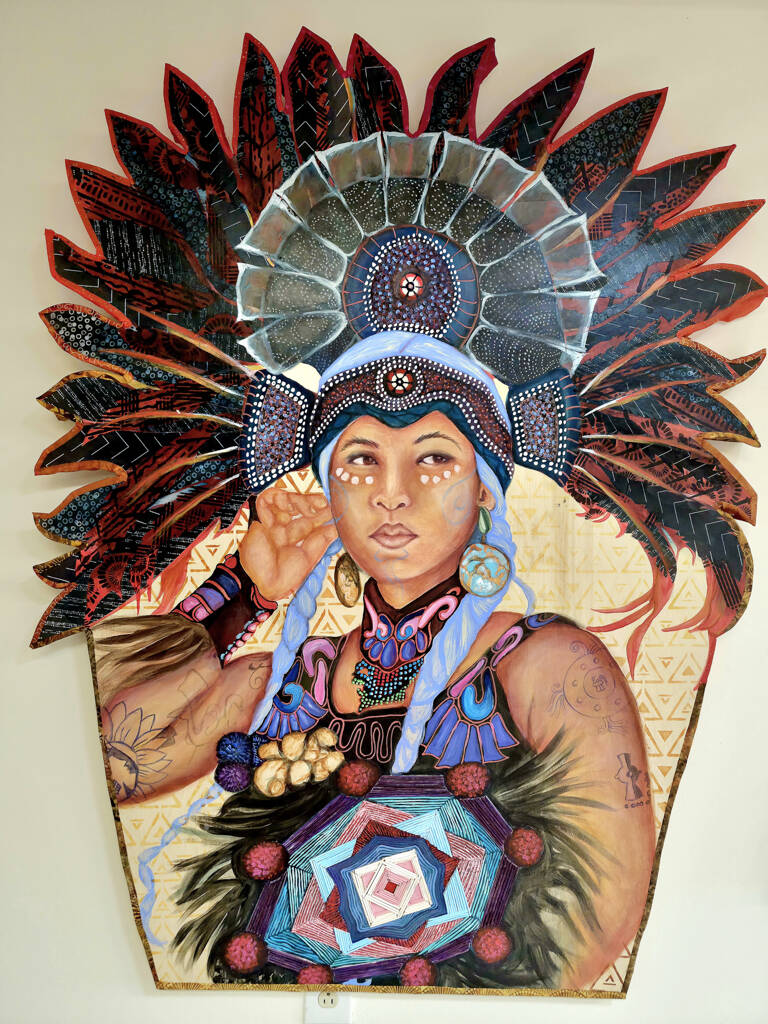
King created a series she named “El Espíritu de Las Abuelas,” the Spirit of the Grandmothers.
“Each piece honors women of specific tribal communities and regions of Mexico,” the artist said.
“At age 19, I went to Mexico, supposedly for one month. My intention was to take two art classes at the Instituto Allende, and then to return to college in Southern California. Little did I imagine that living in a small, arts-focused community in the early 1970s would change the course of my life,” King recalled.
In total, she lived in Mexico for more than two decades.
“Women, especially Indigenous women, taught me, influenced my evolution and helped me heal in those early young-adulthood years.”
In bringing “El Espíritu de Las Abuelas” to Port Townsend, King hopes to affirm deep respect for the ancestors of local residents of Mexican descent.
“This series is, in part, for the children of migrant workers,” she added.
The spirit, the values and, most of all, the artisan work of the abuelas is alive, King said: They’re a source for identity and spiritual nourishment.
“These images bring a small sliver of life from south of the border into the gallery,” she said, “to highlight the magic and beauty of some of the Indigenous cultures of Mexico.”
Scruggs also explores resilience — toughness — and beauty. She uses tin cans, bottle caps and other recycled materials in her art, to echo the resourceful nature we need to move through an ever-shifting world.
“By assembling images of animals alongside carefully chosen words, I draw parallels between human and nonhuman movement, survival and adaptation. These creatures become metaphors for displacement, instinct and belonging,” Scruggs said.
“Together, they form a visual language that asks viewers to consider what we carry, what we leave behind, and how transformation emerges from what is cast off.”

Best of Olympic Peninsula