
BACK WHEN: Under the big tent: A history of Peninsula circuses
Published 1:30 am Saturday, April 4, 2026
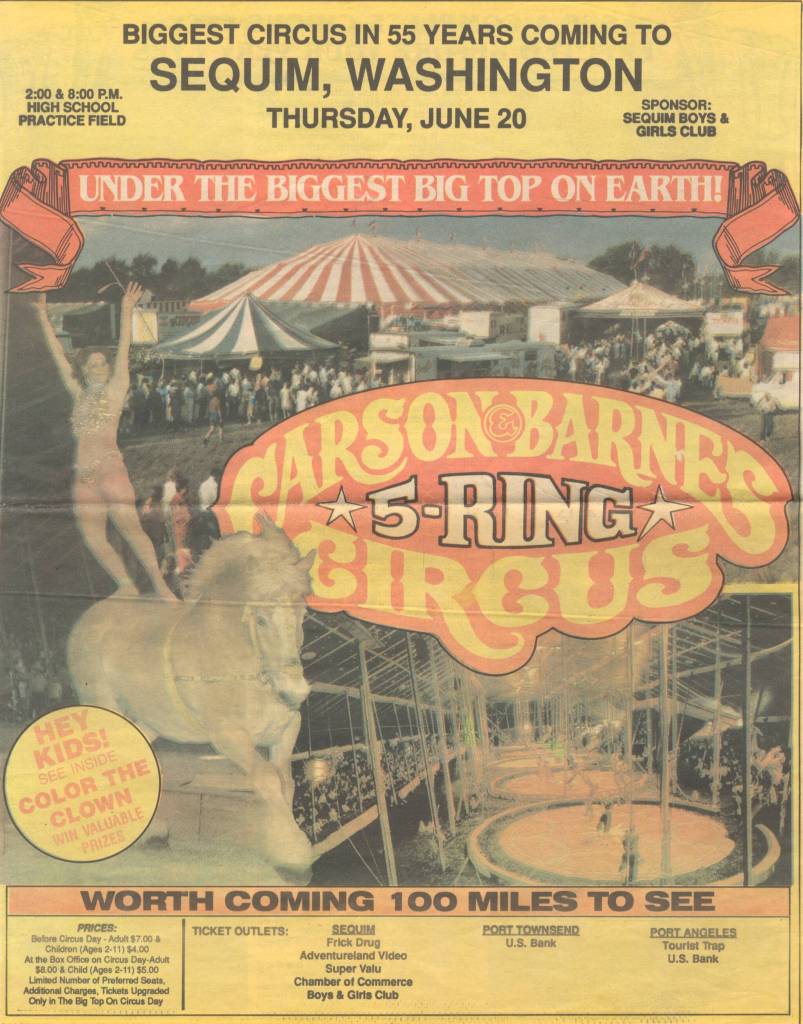
APRIL 3, 2026, was an important day. It was American Circus Day. Did you forget your grease paint and red rubber nose? That’s OK. Most people forget about it. There is so much else to do.
Life on the North Olympic Peninsula was not easy in the late 1800s. Life could be consumed with meeting basic needs. Whether you were clearing land to develop your homestead or building a home in town, basic needs were a priority. You needed a vegetable garden. You needed to store feed for your cattle during the winter. You needed firewood to heat your home.
Within that life, some sorts of entertainment and relaxation were important.
The traveling circus was a popular phenomenon in America by 1820. By the 1840s, P. T. Barnum had purchased other circuses and founded P. T. Barnum’s Grand Traveling Museum as the first traveling circus.
Smaller circuses formed and traveled annually around regions of the United States.
The first circus to come to Port Angeles was McMahon’s New United Shows. McMahon’s circus was a popular attraction in Northwest towns and cities in the late 1880s and early 1890s.
They were scheduled to be in Port Angeles on Saturday, May 16, 1891. A local newspaper stated that, “It is said the whole show, from first to last, is of unusual excellence. The horses are splendid specimens, while the artists are called from the best on every continent; that, together with its new features never before seen with other shows cannot fail to interest.” The show was to include Queen Jumbo, a large elephant described as the “mastodon of mastodons.”
For weeks, colorful posters told of the great attraction coming.
It was also advertised through hyperbole. “It is by far the greatest circus in the universe and our citizens, both near and far, should feel specially favored by its coming.” As far as greatness is concerned, McMahon could not match P. T. Barnum. (Trivia fact: P. T. Barnum died on April 7, 1891, but his circus continued under the leadership of J. A. Bailey.)
A large crowd was in town on May 16 to see the circus. People waited patiently, but disappointment was everywhere. The day was passing by. No circus in sight. Late in the day, people began heading home.
Around 9 p.m., the circus boat, the side-wheel steamer George E. Starr, arrived and landed at Dolan’s Wharf, which extended out from Valley Street at that time.
One of the traditions in show business is “the show must go on.” At dawn on Sunday, May 17, the circus “laid siege” to the town. Tents were erected near the mouth of Valley Creek. It seems that every tent stake driven in was followed by many curious eyes.
Animals were brought out. People even wondered if the wharf could bear the weight of the elephants. Animals also included a moth-eaten lion, horses, monkeys and snakes.
Our youth sought ways to get in to see the show without paying. The admission was 25 cents (more than $8 today). Children tried to get the necessary money. Some sold empty bottles. Some looked for coins under the Front Street sidewalk. Others performed various odd jobs.
It was a difficult decision to spend all your money on admission. After all, there was red lemonade. “Circus lemonade was then something talked about like the ancient people spoke of the nectar of the gods.” (Oh, for such simple times and simple pleasures.)
The circus had an ample supply of young volunteers to help tend the animals, all in exchange for the price of admission. Buckets of water were carried from Valley Creek. Green grass was gathered from the top of the hill on Cherry Street. The youth who managed to get these jobs gained enormous respect from their peers for years to come. “They were among the elect and had dreams of following the circus business as a vocation.”
On May 16, 1925, a Port Angeles Evening News article noted that some of these young people “were destined to become prominent in Clallam County and doubtless as men they will remember the thrills of their first circus.” That may have been a veiled commentary about similarities between business, politics and a circus. Maybe. Maybe not!
The circus had one performance that afternoon. Even though they were a day late, it was well attended.
The show included elephants, a bearded lady, jo-jo the dog-faced boy and snake charmers.
One recollection noted that people between Dungeness and Quillayute came to see the show. Those who traveled far to see the circus on May 16 likely spent the night in Port Angeles. Even though the show was a day late, they could still see it.
It was noted that, “The performance gave good satisfaction and was met with hearty approval.” Attendance was good, even considering the show was on Sunday.
The newspaper happily noted that there was an absence of fakirs plying their trade. The paper’s view was that fakirs would “seek suckers among a gullible public.”
Circus fakirs were performers specializing in extreme acts rooted in Eastern ascetics. Fakirs commonly would lay on a bed of nails, eat fire, swallow swords and pierce their bodies…Some would even pound nails into their nasal cavities.
The show included performing elephants and a Roman chariot race. During this period, horse racing was a very popular sport. So, chariot races were enjoyed.
After the show, the circus quickly folded up their tents and boarded the George E. Starr. Their next show was in Victoria, B.C. Some have noted that the ring in the ground where the chariot races were held lasted for years. A reminder of the spot where “our circus” was held.
After the circus left town, two young boys decided to gather up some supplies and travel east looking to join a circus. They made it as far as Morse Creek before returning home. It was decades before another circus came to Clallam County.
Times certainly changed. Many nations have banned the use of animals in circuses. Circuses today emphasize human performances.
Keep your grease paint and red rubber nose handy, though. April 17, 2026, is World Circus Day. That will be a good day to clown around.
________
John McNutt is a descendant of Clallam County pioneers and treasurer of the North Olympic History Center Board of Directors. He can be reached at woodrowsilly@gmail.com.
McNutt’s Clallam history column appears the first Saturday of every month.

Best of Olympic Peninsula