Seal found shot in Quilcene stabilized in Des Moines
Published 3:30 pm Thursday, February 26, 2026
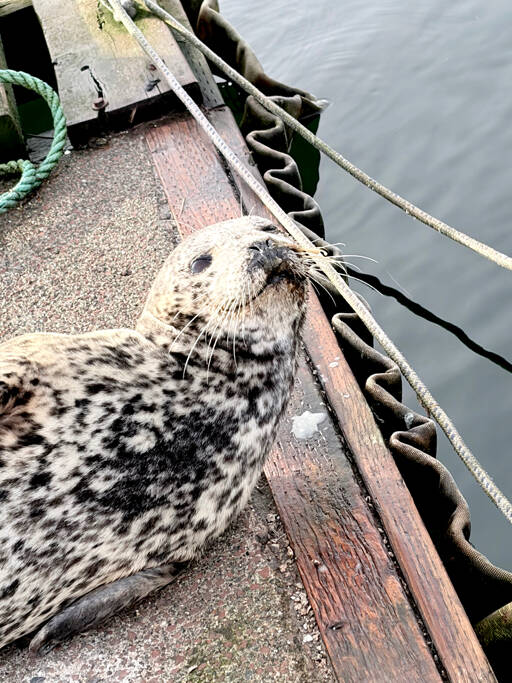
QUILCENE — An injured harbor seal discovered in Quilcene was found to have been shot in the face.
The seal is in the initial stages of stabilization at Sealife Response, Rehab, and Research (SR3) in Des Moines, said Casey Mclean, executive director and veterinary nurse.
She is enthusiastically eating, has regained hydration levels, is swimming, and she is on antibiotics and pain medication, Mclean said.
The bullet was discovered through a radiograph, Mclean added.
“She’s extremely emaciated for an adult female harbor seal. She should be about twice her body size,” Mclean said. “We can see her spine and her hips and her ribs. She’s very, very skinny. She had quite a lot of nasal discharge that was infected. Her left eye appeared to be injured. She can still see, but there’s something going on there.”
SR3 staff will take a closer look at her eye when the seal is fully under anesthesia, Mclean said.
A CT scan will give the care team a sense of what degree of recovery is possible.
“Is (the wound) going to prevent her from hunting? From diving? From doing all of the normal seal behaviors?” Mclean said. “We just want to make sure that there’s not anything in there that’s going to lead to issues further down the line.”
Port Townsend Marine Science Center (PTMSC) was contacted by the National Oceanic and Atmospheric Administration’s (NOAA) West Coast Marine Mammal Stranding Network early in the morning of Feb. 19. PTMSC is a member of the network through an agreement with the agency.
The seal had been found and reported by staff members at Herb Beck Marina in Quilcene.
“An employee down there called with concerns about the seal looking sick and not moving for a long period of time,” said Hillary Sanders, PTMSC marine science programs coordinator.
After receiving photos and more information, Sanders called Center Valley Animal Rescue (CVAR) to see if they could assess the seal.
Sara Penhallegon, CVAR’s executive director, is part of a veterinary response team that helps determine if an animal needs help or not.
“It was obvious from the photos that this animal needed urgent help,” Penhallegon said.
After making arrangements with SR3 to receive the seal if captured, Penhallegon and two interns went to the marina to capture the seal.
“We captured it without incident,” she said. “It was obviously in rough shape and our interns drove it to SR3.”
Penhallegon said the issue is underreported. Another seal was found shot in Port Ludlow last October. Also transported to SR3 by CVAR staff, the animal was euthanized due to its injuries after several weeks of care.
“(SR3) put a lot of work into it, and it took a turn for the worse,” Penhallegon said. “It was a valiant effort by everyone, but it was pretty bad.”
In the case of seals, deaths due to gunshot wounds may never be discovered, Penhallegon said. Some of them will be scavenged, others wash up dead but show no signs of entry or exit wounds, as their fur and blubber conceal the injuries, she said.
“Quite a few marine mammals are found shot every year throughout Washington,” Mclean said. “The vast majority of them have washed up dead.”
NOAA Fisheries’ Office of Law Enforcement, which is in charge of the investigation, is seeking information.
“We urge anyone with direct information to contact us so we can investigate the matter,” wrote communications specialist Cierra Jefferson.
Those who have information relating to the incident can contact NOAA Fisheries Office of Law Enforcement’s West Coast Division at contact.nmfs.ole.wcd@noaa.gov or 1-800-853-1964.
It is illegal to feed or harass wild marine mammals. Penalties can include civil penalties up to $36,498 and up to one year in prison, plus criminal fines, according to a NOAA webpage.
Mclean noted that four measures introduced in the state Legislature — three of which have died this session — sought to expand the lethal removal of seals and sea lions to protect salmon.
As of Thursday, House Joint Memorial 4004 had passed the House and is in committee in the Senate.
“That is not the answer to our salmon problem,” Mclean said.
While seals and sea lions are opportunistic feeders, they are not the primary factor contributing to the decline of salmon populations, she said.
People who find injured or stranded marine mammals can contact the West Coast Marine Mammal Stranding Network at 1-866-767-6114. Further contacts for entangled animals, harassment or other violations, as well as information on what to report can be found at tinyurl.com/4t7a2x8t.
________
Reporter Elijah Sussman can be reached by email at elijah.sussman@peninsuladailynews.com.