
Weather hampers start of tsunami dock cleanup
Published 12:01 am Sunday, March 17, 2013
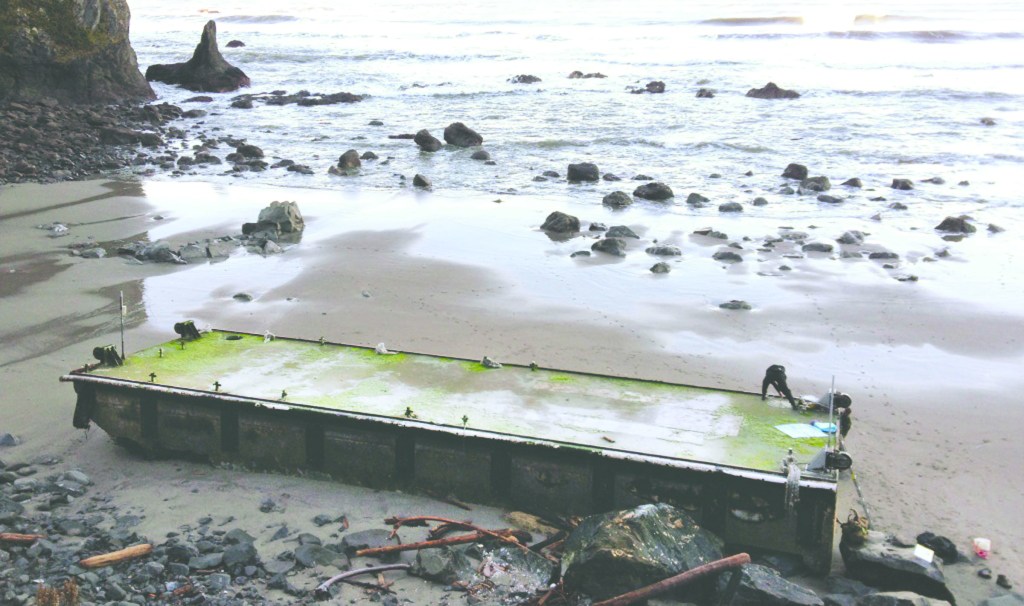
OLYMPIC NATIONAL PARK — Workers were awaiting better weather on Friday before starting the removal of a 65-foot long dock that washed ashore from Japan, and had planned to start work Saturday, a National Oceanic and Atmospheric Administration spokeswoman said.
“That was the plan, if conditions allowed, and I haven’t heard otherwise,” NOAA spokeswoman Keeley Belva said in an email, adding that she had no confirmation whether or not work began Saturday.
Blustery and rainy weather fell on the West End most of the day.
Undersea Co. of Port Townsend, the contractor that will remove the dock, declined to comment, referring inquiries to NOAA.
Belva had said Friday that work could begin Saturday to remove the dock from a narrow beach between the Hoh River and LaPush — if the weather cooperated and it was safe for crew members to work.
The cold front that blew in Saturday will probably remain in the region through Monday night, the National Weather Service said.
The Undersea Co. of Port Townsend is in charge of dismantling the 185-ton dock into pieces that can be carried away by a helicopter.
Those pieces will be carried to a landing site on private land, and trucked out from there, said Belva, who added that she did not know where the site is.
Removal is expected to be complete by the end of this month.
The 20-foot-wide, 7½-foot-tall dock landed on a beach within Olympic National Park and the Olympic Coast National Marine Sanctuary in December.
The Japanese government has confirmed that it is a remnant of the estimated 5 million tons of debris swept into the ocean by the March 2011 Japanese tsunami.
The dock cannot be towed off the beach at high tide because it has been damaged by waves and rocks since washed ashore near the mouth of Mosquito Creek, and it cannot be sunk to be used as an artificial reef since it is made of plastic foam encased in concrete, NOAA has said.
Work had been delayed because of the tides. The remote beach is so narrow that work must be done during low tide.
Daylight low tides had not been available since March 10 until last week, when work was put on hold because of the weather.
Weather could remain iffy through much of next week.
The weather service predicts a brief dry spell during part of Monday before another weather system arrives late Tuesday with wet and windy weather into Wednesday.
The Japanese government identified the dock, which is made of plastic foam encased in concrete, through a serial number as coming from Misawa, a city of about 40,000 on the northern tip of the island.
Japan is paying most of the $628,000 removal cost, providing $478,000.
NOAA’s Office of National Marine Sanctuaries and the National Park Service each will pay $75,000.
In early January, staff members from state and federal agencies hiked in and removed more than 400 pounds of non-native plant and animal life found clinging to the dock and then used a diluted bleach solution to wash the structure to prevent spread of the invasive species.
The state Department of Ecology said that between 30 and 50 species of marine plants and animals not found in the United States but native to Japan had attached themselves to it.
For updates on the beached dock removal efforts, see http://tinyurl.com/ForksDock.
Anyone sighting other significant debris that may be from the tsunami is asked to report it to DisasterDebris@noaa.gov.
There are two government websites with information on tsunami debris: www.marinedebris.noaa.gov/tsunamidebris and http://marinedebris.wa.gov.

Best of Olympic Peninsula