Work at Sequim’s Battelle lab ‘critical,’ director tells chamber of commerce
Published 12:01 am Saturday, July 26, 2014
SEQUIM –– While researchers at Battelle’s Pacific Northwest National Laboratory work on projects to protect and study the natural environment around Sequim, their focus, the laboratory’s director says, is on finding ways to mesh industry and protection.
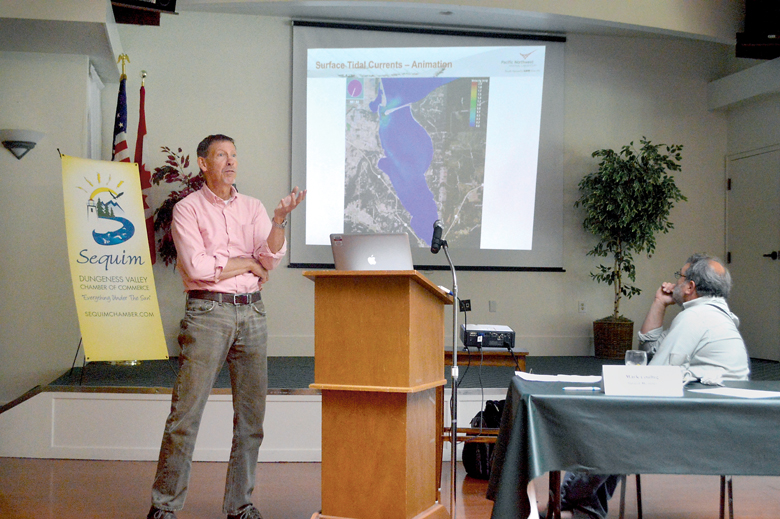
“We’re not the people who look out for the trees. We’re not the people who are looking to list the next endangered species,” said Dr. Charles Brandt, director of Pacific Northwest National Laboratory’s coastal sciences division in Sequim.
“We’re the ones who are trying to figure out how to accomplish sustainability.”
The national laboratory’s Sequim center is researching, among many other things, the effects of tidal turbines on fish, methods for developing offshore wind power, turning algae into biofuels, even mining uranium waste from the ocean.
Brandt spoke about the laboratory, primarily funded by the federal Department of Energy and operated by the nonprofit Battelle Corp., to a Sequim-Dungeness Valley Chamber of Commerce crowd of some two dozen at the chamber’s regular luncheon meeting at SunLand Golf & Country Club on Tuesday.
Built originally on the site of the Bugge family clam cannery in 1964, the national laboratory’s Sequim facility employs about 100 of the laboratory’s 4,000 employees, Brandt said.
Their work is critical, he said.
The Sequim facility is the national laboratory system’s only lab to focus solely on the coastal communities that are home to 37 percent of the U.S. population and which produce 42 percent of the national gross domestic product on 17 percent of the country’s land.
“We’re centered on a set of research that really can’t be done anywhere else,” Brandt said.
“So the work that we do is totally unique.”
The Sequim Bay location lends a unique asset to the laboratory, as well, he added, since it does not have salmonid-bearing freshwater streams feeding it.
“Sequim Bay hasn’t a large watershed associated with it, so there’s no freshwater streams,” he said.
“The chemistry of Sequim Bay is exactly like the chemistry of the [Strait of Juan de Fuca], which is very close to the chemistry of the ocean.”
The bay also doesn’t contain species of fish listed under the national Endangered Species Act that many other estuary bays do.
Tidal power
The bay’s narrow entrance to the Strait also allows the national laboratory to help develop and test wave energy systems.
“Sequim Bay is a large bag of water that has to go through a very small orifice,” he said.
Tides flow in and out of the bay at speeds of 3.2 to 3.5 meters per second, he said, well above the 1.5 to 2 meters per second needed to develop commercially viable tidal power systems.
Researchers at Sequim also have been researching the effect tidal power has on different fish species.
By playing recordings from British tidal turbine for fish and monitoring their brain activities, they found little effect from the turbines on salmon, though it was a little more deleterious to largemouth bass, or rockfish.
Oceanic wind farms
Potential offshore wind farm sites were identified by researchers at Sequim, allowing a Seattle wind turbine company to sell products to Principle Power’s 30 megawatt wind farm being developed off the coast of Oregon’s Coos Bay.
Sequim researchers also are working on buoyed sentinels that would help wind power developers gauge the wind speeds of potential offshore wind farm sites.
Those sentinels will initially be tested out of Sequim Bay before further testing around the nation.
Laboratory workers found there would have been a 12 percent increase in vessel collisions if proposed offshore wind farms were developed in the shipping lanes off the American east coast, he said.
Uranium from the sea
The laboratory is also looking to find ways to mine uranium from the sea, since the United States has banned uranium mining on land.
“We spent something on the order of $18 [billion] to $20 billion cleaning up uranium mining sites,” he said.
But Chinese development of nuclear reactors is producing more waste in coastal waters.
So the laboratory is trying to develop ways to extract that uranium from sea water in a way that it could be affordably purchased by nuclear power plants and used as an alternative to ground-mined uranium, he said.
________
Sequim-Dungeness Valley Editor Joe Smillie can be reached at 360-681-2390, ext. 5052, or at jsmillie@peninsuladailynews.com.