
Study: Tsunamis battered tribal village
Published 1:30 am Wednesday, May 1, 2019


PORT ANGELES — Archaeologists analyzing the remains of the Lower Elwha Klallam Tribe’s ancient Tse-whit-zen village in present-day Port Angeles have learned that up to five tsunamis had struck the 2,700-year-old Klallam village.
It is research that Virginia Butler, a professor of anthropology at Portland State University, said clearly illustrates the danger that comes with living on the coast and shows the strength of the Lower Elwha Klallam Tribe, which rebuilt the village after each tsunami.
“There is the story here of resilience and long-term connections of people to a place,” Butler said. “It provides both the acknowledgement of the reality of [tsunamis] and the optimism that the community will carry on.”
Researchers will present their findings in Port Angeles on Friday. The presentation, free to the public, will start at 7 p.m. in Peninsula College’s Little Theater at the Port Angeles campus, 1502 E. Lauridsen Blvd.
Tse-whit-zen, a Klallam village dating back some 2,700 years, was discovered in 2003 at a Marine Drive site earmarked for a $100 million state graving yard connected with work planned on the Hood Canal Bridge.
After artifacts and human remains were discovered, construction was halted and many artifacts were stored at the Burke Museum in Seattle.
Some of those artifacts are now on display at the Carnegie Library and the tribe is continuing work on a planned curation facility.
Butler said researchers have worked closely with the tribe and received the tribe’s blessing before moving forward.
“We were sensitive to the trauma the tribe experienced in the original project,” Butler said. “There was a lot of clear hurt associated with that original project.”
Tribal archaeologist Bill White said the ongoing research at Tse-whit-zen has shown the archaeological richness of the village.
“This was a very, very major village on the Strait of Juan de Fuca,” White said. “What’s fascinating about Tse-whit-zen is that throughout British Columbia and Vancouver Island, all of the native First Nation peoples knew if you came from Tse-whit-zen because Tse-whit-zen was known to be a major trading center for the Klallam People.”
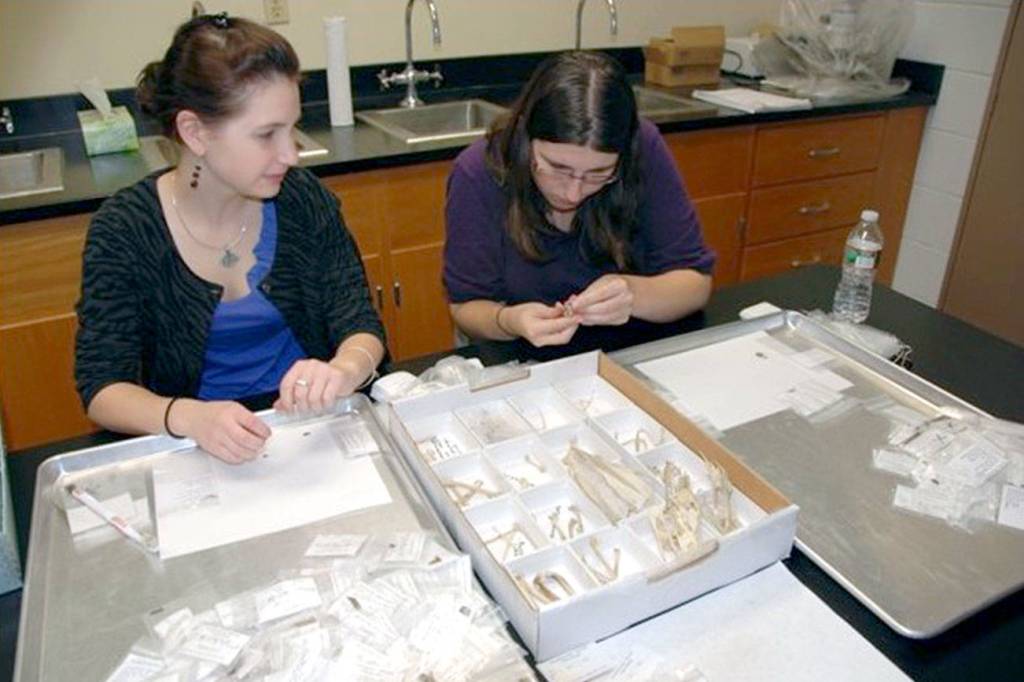
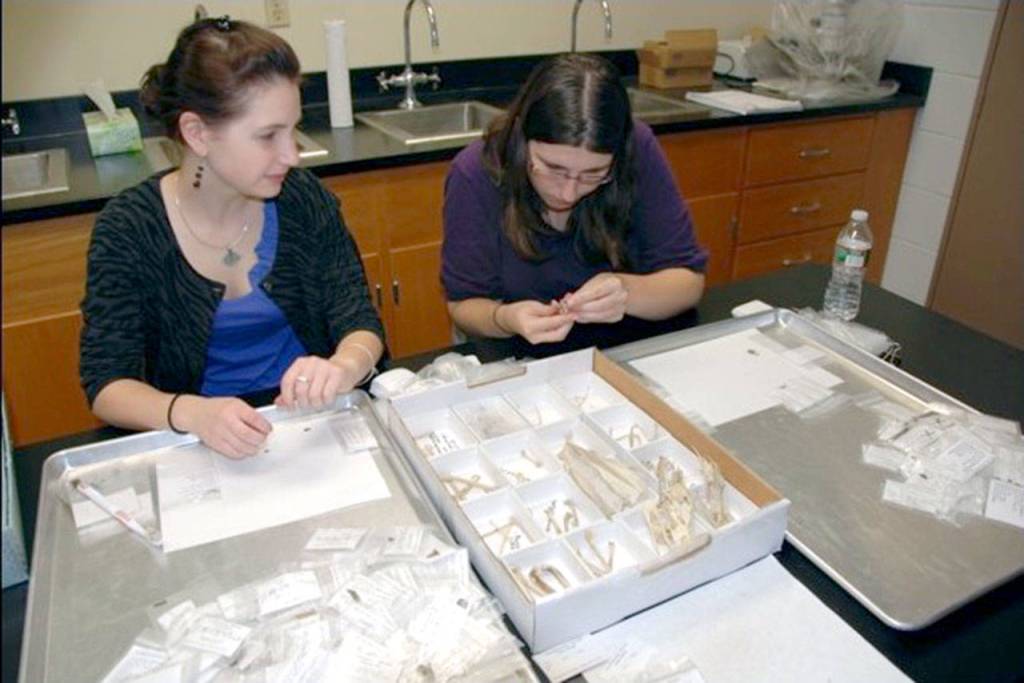
The team from Portland State University, Western Washington University and the University of Rhode Island have examined more than 1.2 million remains from shell, fish, bird and mammals since 2012. Those remains represent more than 100 animal species, such as herring, butter clams, ducks, deer and dog.
Butler said the team used radio carbon dating and found sand deposits that confirmed the village was struck by tsunamis about once every 300 years.
While people occupied the site, organic materials — such as animal remains — would accumulate, she said. But when a tsunami hit, there would be a gap in that accumulation, she said.
“If there was an event and it overtopped the site, people might have gone away for a short time,” she said. “As soon as the landscape stabilized again, people came back and rebuilt and reoccupied the same place on the landscape.”
She noted that the tribe likely continued to rebuild at the site because it is one of just two protected harbors on the North Olympic Peninsula. It was a site that gave people great access to resources both on land and at sea, she said.
“If you look at the actual language, the Klallam language, the name Tse-whit-zen is referred to as the peaceful harbor,” White said. “The name can be translated to the ‘protected harbor’ or the ‘tranquil harbor.’ ”
Butler said the research was able to show that while the tribal community was resilient to the tsunamis, so were the individual households.
People living in different houses had different gathering habits and used different resources.
“Not only did the community show resilience in coming back, but these households maintained some resilience in what kinds of resources they went and got,” she said. “What that says is that households had certain ways of doing things and they had access and local knowledge of where they would get certain foods.”
As an example, she cited two households that used the resources of different types of birds. One household used off-shore birds while another primarily gathered ducks, she said.
Those habits in individual households remained the same both before and after tsunamis while the habits of other households would change, she said.
Butler said the research could also be used to influence restoration efforts because of the focus on marine life in the harbor.
“Records like ours paint a picture of what the world was like,” she said. “We’re connecting with tribal biologists and researchers interested in our data for the specific records for the animal.”
________
Reporter Jesse Major can be reached at 360-452-2345, ext. 56250, or at jmajor@peninsuladailynews.com.