
BACK WHEN: Blueprint of a disaster: The Tacoma Narrows Bridge
Published 1:30 am Saturday, March 7, 2026
I DECIDED TO go a little bit outside the North Olympic Peninsula for this month’s column.
In the early years of the 20th century, there were great advancements in structural engineering. Advances in steel manufacturing and improvements in cement concrete opened the doors to innovative designs, stretching the limits of what seemed possible.
In that context, the vision of a bridge across the Narrows at Tacoma became possible.
Clash of the Titans
Washington State Engineer Clark Eldridge proposed a conventional suspension bridge design. His deck would be 25 feet deep and stiff. The estimated cost was $11 million ($256.4 million today).
Enter Leon Moisseiff. He was a noted New York bridge engineer who served as designer and consultant for the Golden Gate Bridge. Moisseiff petitioned the Federal Public Works Administration (PWA), claiming he could build the bridge for less. His estimate was $7 million ($163.2 million today). His design would cost less because his deck design would be only 8 feet deep. Besides costing less, he considered his design to be more elegant.
Since the PWA held the purse strings, they only approved $7 million for construction, assuring approval of Moisseiff’s design.
Engineer Dexter R. Smith was a bridge designer for the state of Oregon. In spring 1940, Smith presented a paper on the Tacoma Narrow Bridge design at a national engineering conference. This was six months before the bridge collapsed. Smith predicted that, under specific conditions (winds at 40 mph), the bridge would collapse. The audience was stunned and hollered for Smith to “get out.”
In 1941, Smith was hired by Washington state to design the Tacoma Narrows Bridge replacement.
Opening Day
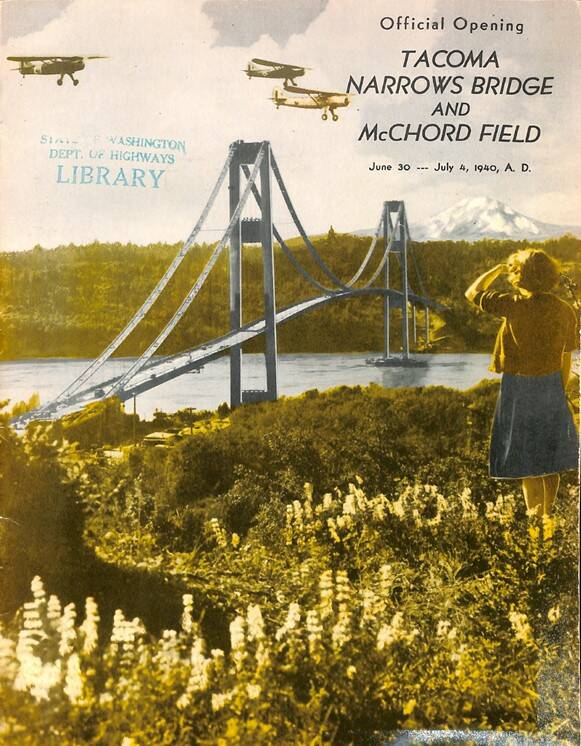
The Tacoma Narrows Bridge was officially opened on July 1, 1940. Of course, there was great pride and celebration. It only took 19 months to build, and no workers lost their lives.
It did not take long for concerns to develop. The very thing that made Moisseiff’s design “elegant” made it vulnerable to the gusty winds in the Narrows, as Dexter Smith had predicted. Even before it was finished, it was vibrating in even light winds.
After it was opened to traffic, the deck would ripple up and down as much as 50 inches. Drivers could see cars in front of them disappear, then reappear. My uncle, Dr. Harlan McNutt, recalled driving across the bridge when it was doing that. Soon, the bridge acquired the nickname “Galloping Gertie.”
Many people were not thrill seekers. They avoided using the bridge on windy days. When I consider public safety demands in today’s society, a bridge doing that today would not have been opened to traffic.
Professor F. B. Farquharson of the University of Washington studied this behavior and developed a possible structural fix using diagonal stays. Those modifications could not be completed before the bridge’s collapse.
On Nov. 7, 1940, the wind in the Narrows was at 42 mph. Some of professor Farquharson’s repairs broke. Soon, the bridge began not only to ripple up and down but twist side to side in a corkscrew motion. The bridge had to be closed.
The car and the dog
Leonard Coatsworth was the last driver permitted to cross the bridge. Traveling with him was his daughter’s black spaniel dog, Tubby. When Coatsworth was halfway across the bridge, it tilted violently and he lost control of his car. To Coatsworth, it felt like his car could be tossed over the side. So, he abandoned the car. Tubby would not leave the car. Tubby bit Coatsworth when he tried to grab the dog.
At times, the undulation of the deck made it impossible for Coatsworth to walk. So, he crawled much of the way. Other people attempted to go out and save Tubby, but to no avail. In the end, Tubby was the only casualty in the collapse.
Collapse
The deck was twisting up to 45 degrees. It was not long before the 2,800-foot center span began to break up. The vertical cables holding the roadway began to snap. Pieces of the bridge and Coatsworth’s car plunged into the water 200 feet below. When the wind finally subsided, most of the center span was gone.
Principal Engineer Charles E. Andrew dryly stated the obvious, that the bridge had been “rendered useless as a traffic carrying unit.” The bridge had only been in service for 129 days. The public was quick to cast blame on Andrew while failing to remember he had also opposed the design from the start.
Of course, people were soon demanding a new bridge. That effort had to be delayed since money, workforce and materials were being redirected to the World War II effort.
Crime
The bridge was gone. At least the bridge had been well insured. Twenty-two different insurance agencies were used to spread out the $5 million risk ($111.5 million today). All was fine except at the offices of Merchant’s Fire Assurance Company of New York.
Their agent, Hallett R. French, had written an $800,000 policy on the bridge. French did not believe there was any chance of the bridge collapsing. So, French deposited the state’s $8,000 policy premium ($178,500 today) into his own bank account and did not report the transaction to his employer.
French was vacationing in Idaho when he got word of the bridge’s collapse. On Dec. 2, 1940, French was arrested for grand larceny. French pleaded guilty to his crime. He was sentenced to 15 years in the state penitentiary in Walla Walla. He was released in two years for “good behavior.”
Cause
The cause of the collapse was an issue of aerodynamics. The effects of wind were not always considered. Today, even skyscrapers are expected to sway 6 or more inches in the wind.
Consulting Engineer Russell G. Cone described the cause this way: “The collapse resulted from aero-dynamic forces previously ignored or considered unimportant. These forces caused actions in this extremely flexible structure that became dominant. In our opinion the deck of the bridge acted like an airplane wing with a flutter generated by the turbulent and irregular wind currents in the Narrows.”
The blame game
It was easy to blame the people who held the purse strings. A less expensive design was approved over the objections of many engineers. In January 1941, it was found that the field engineer for the PWA, David L. Glenn, warned of faults in the design and refused to recommend acceptance of the bridge. He was overruled and, within two weeks, he was fired.
After the collapse, Moisseiff’s services were no longer sought after.
If I may modify Proverbs 11:14, “Without wise leadership a nation (or bridge) falls; there is safety in having many advisers.”
________
John McNutt is a descendant of Clallam County pioneers and treasurer of the North Olympic History Center Board of Directors. He can be reached at woodrowsilly@gmail.com.
McNutt’s Clallam history column appears the first Saturday of every month.