
SHOOTING STARS! Perseid meteor shower peaks in North Olympic Peninsula skies — here’s how to watch
Published 12:01 am Wednesday, August 12, 2015
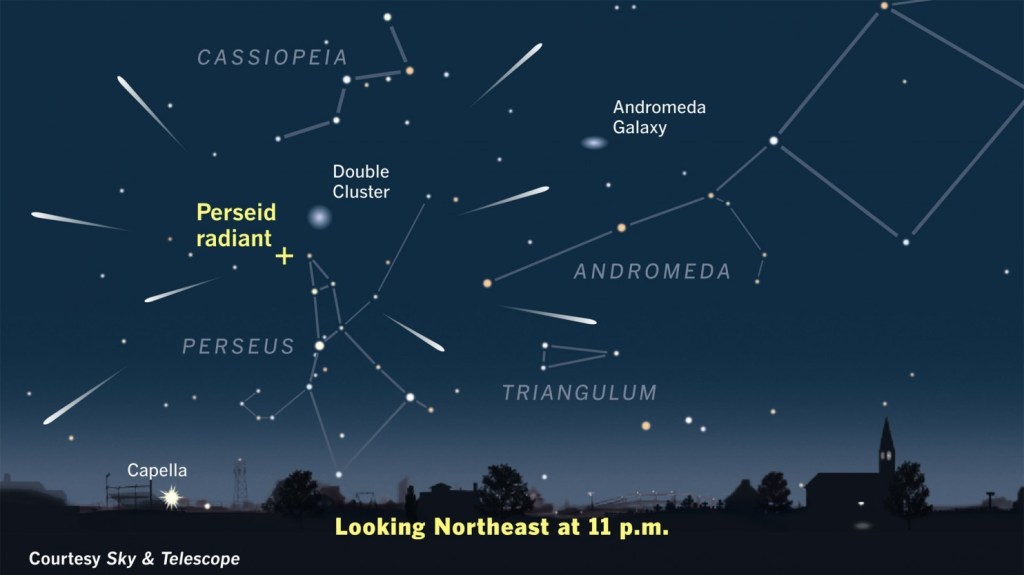
One of the biggest meteor displays of the year, the Perseids, is lighting up the North Olympic Peninsula sky.
The show has been going on since early Monday morning, but the shooting star spectacle peaks at 1 a.m. Thursday — with as many as 90 to 100 shooting stars an hour, according to NASA.
Look for them tonight in the northeast sky beginning around 11 p.m.; they will last until dawn Thursday, with plenty of action continuing Thursday night and early Friday morning.
The meteor shower will taper off but remain active evenings and pre-dawn mornings through Aug. 24.
Good weather forecast
The forecast for tonight is for good viewing weather, with partly cloudy skies.
The moon will be a sliver and below the horizon for much of tonight, creating dark heavens.
The Perseid shower is generally one of the brightest and most reliable displays of shooting stars.
It has been visible every August for about 2,000 years as the Earth passes through the debris trail of the Swift-Tuttle comet.
Because you don’t need special equipment to observe meteors, it can be a good activity for families and friends.
Find a dark spot
Get away to the darkest spot you can find away from bright city lights — like the turnouts on the highway to Hurricane Ridge, coastal beaches or a dark corner of your backyard — lie on a blanket or recline on a lawn chair and make sure you have a clear view of the northeast sky (though the meteors can appear in all parts of the sky).
Pack a midnight snack and a favorite beverage.
No need for binoculars or a telescope — that will only limit the amount of sky you can see.
You’ll probably see a meteor or two every few minutes, spiced by a few spectacular fireballs blazing through night.
“With the Perseids in the sky, this coming weekend will be the perfect time to be camping in the back country of a national park,” according to National Parks Traveler magazine.
You can photograph the Perseids easily by setting your digital camera on a tripod and take several time exposures at the widest field of view setting.
Be sure to carefully review the images on a large screen afterward.
Perseids may show up photographically that weren’t apparent visually.
Hurricane Ridge
You can watch early-arriving meteors tonight with John Goar, Olympic National Park’s “astro-VIP.”
Goar leads a free one-hour astronomy program with telescopes at Hurricane Ridge, 17 miles up a paved road from Port Angeles.
Meet him at the Hurricane Ridge Visitor Center nightly at 10 p.m. tonight through Friday night, and at 9:45 p.m. nightly Saturday night through Tuesday night.
The viewing Saturday night includes a “star party” with members of the Bremerton-based Olympic Astronomical Society.
After Tuesday night, Goar will be off until early September. He will resume his programs nightly at 9 p.m. from Thursday, Sept. 3, through Sunday, Sept. 6, and Friday and Saturday nights, Sept. 11-12 .
If skies are cloudy, Goar’s program will be canceled.
For program status, phone the park phone recording at 360-565-3131 after 4 p.m.
For more information, visit www.olympictelescope.com.