
Pullers begin Power Paddle to Puyallup
Published 1:30 am Sunday, July 15, 2018
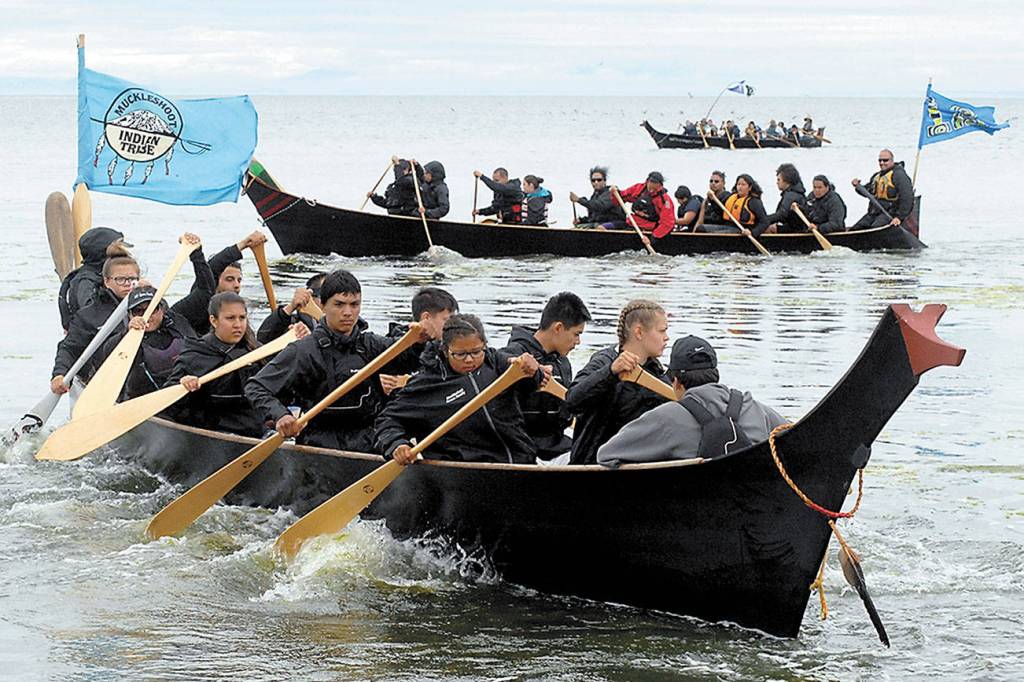



A pageant of canoes began making its way last week along the Pacific Northwest and Canadian coastlines.
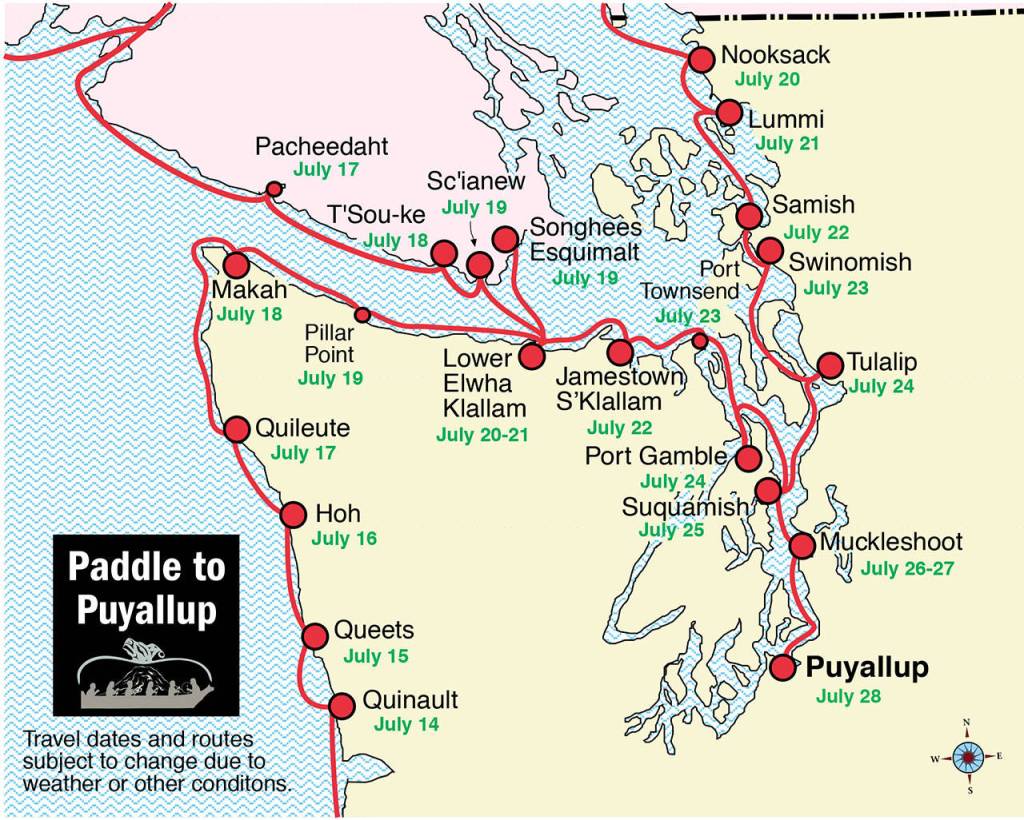
The Power Paddle to Puyallup 2018 Canoe Journey will include stops — with welcoming ceremonies of songs and dances and potlatches — on North Olympic Peninsula beaches.
Landings include Friday at Hollywood Beach in Port Angeles for a two-day visit greeted and hosted by the Lower Elwha Klallam Tribe, July 22 by the Jamestown S’Klallam Tribe at Jamestown Beach near Sequim, and July 23 by the area’s Klallam tribes at Fort Worden State Park in Port Townsend.
Tribal stops were to include the Quinault on Saturday, the Queets today, the Hoh on Monday, Quileute on Tuesday, Makah on Wednesday, all along the Washington coast; and along the Strait of Juan de Fuca, Pillar Point on Thursday before Hollywood Beach along Port Angeles’ downtown waterfront Friday.
Exact times of arrival are not possible, being determined by currents and tides.
At least 19 canoes from Beecher Bay and Esquimo in Canada are expected to come into Hollywood Beach, the third largest rally point among more than 40 landings.
The culminating final stop is July 28 at the Puyallup tribal reservation on South Puget Sound, the home of the Canoe Journey’s host tribe.
Puyallup Culture Director Connie McCloud said Friday that 102 participating canoes had registered as of Friday with 125 expected as the final count.
More than 70 tribes were listed as taking part at www.paddle topuyallup.org, not including several named with a collective inter-tribal moniker.
Their trek began Thursday, McCloud said.
The Chehalis Tribe, southwest of Olympia, and the Ahousaht, from Vancouver Island’s western coast, were among the first to depart for their final destinations, McCloud said.
Lower Elwha Klallam Tribal Chairwoman Frances Charles said the Elwha tribal canoe, Beautiful Sister, is named in remembrance of Vanna Francis, a tribal member who died in 2007 at age 17.
Participating in the Power Paddle to Puyallup from Clallam County are canoes from the Jamestown S’Klallam Tribe (Laxaynem), Makah Tribe (soots coo, or many hands), and Quileute Tribe (Putak57iti, or Wellbeing).
The Hoh Tribe is also participating. The name of their canoe was unavailable Saturday.
Small sections of the Quinault Tribe (Grandfathers Canoe), located in Grays Harbor County, extend into Jefferson County.
What for tribal members is a two-week physical and spiritual odyssey also strengthens ties between tribal communities in the U.S. and Canada.
They are linked by heritage deeper than the national boundaries that were drawn long after their ancestors plied these same waters, organizers said last week.
“It’s like a branch, like a tree,” Frances Charles, Lower Elwha Klallam tribal chairwoman, said Thursday.
“The activities, songs, dances are all intertwined.”
The Puyallup Tribe, on a largely urban reservation in Pierce County that embraces lower Puget Sound, first hosted the canoe journey 20 years ago.
The inter-tribal event — which travels to a different host tribe each year — began in 1989, organized by Quinault tribal member Emmett Oliver as the “Paddle to Seattle” to mark Washington state’s centennial.
“Many times, our family histories are connected through marriage, through travel, through relationships,” McCloud said.
“That’s how our people have always survived and connected with the world around us, is mainly those relationships.
“We travelled freely, and the relationships were between the communities.
“We didn’t have borders.”
Tribal members participate from Snuneymuxw First Nation and Ditidaht First Nations in the southern half of Vancouver Island to the Klamath Tribes in Southern Oregon.
McCloud estimated 5,000 paddlers, family members and support crew will gather on the Puyallup reservation at journey’s end.
During the greeting ceremony at Hollywood Beach, paddlers will begin coming ashore from the end of the line of canoes to the front before going to the Lower Elwha reservation.
There, dinner will be served to 1,500 Elwha tribal members and Canoe Journey families who leave early morning July 22 for Jamestown Beach east of Sequim-Dungeness Way,
“It’s an event that really rejuvenates and refreshes the spirit of the whole community as they get to observe old traditional practices that were done centuries ago,” Ron Allen, Jamestown S’Klallam tribal chairman, said last week.
“They just love the opportunity regardless of the weather.
“They just enjoy the opportunity to visit the different village sites that were visited so many years ago.”
McCloud said the theme for this year’s event is “Honoring Our Medicine.”
The intention is to explore medicine both spiritual and physical, McCloud said.
“During the welcoming ceremony, we’ll be asking people to share their expressions of what that means to their canoe family, whether that means bringing water, bringing plant medicine, what is their medicine that they want to share,” she said.
“It depends on what the canoe family themselves say is their medicine, that they want to share.
“We are reconnecting with our traditions, our culture our language.
“It’s all medicine.
“It’s a continuation of teaching and sharing and building our community.”
The Puyallup also call their place “our Puyallup Territory of the Medicine Creek Nation,” according to the tribe’s Canoe Journey website.
The Puyallup were among nine tribes who signed the Treaty of Medicine Creek of 1954.
It famously said “the right of taking fish, at all usual and accustomed grounds and stations, is further secured to said Indians in common with all citizens of the Territory.”
In signing the treaty, the tribes “relinquished 2.5 million acres of tribal land to the U.S. in exchange for three 1,280-acre reservations, $32,500 paid over 13 years, and other considerations that aimed to assimilate Indians into European–American culture,” according to historian Mark Hirsch of the National Museum of the American Indian.
“Our Treaty of Medicine Creek established the state of Washington,” McCloud said.
“The attempts by the government to get rid of the tribes really centered around that time.
“There were laws against gathering and having our potlatches.
“Until 1978, and the [American Indian Religious Freedom] Act, we couldn’t legally practice our culture and religion.
“Otherwise, you were still punished.”
For more on the Canoe Journey, see http://paddletopuyallup.org/.
________
Senior Staff Writer Paul Gottlieb can be reached at 360-452-2345, ext. 55650, or at pgottlieb@peninsuladailynews.com.


Best of Olympic Peninsula