Clallam commissioners update county wildfire protection plan
Published 1:30 am Wednesday, March 18, 2026
PORT ANGELES — The Clallam County commissioners have adopted an updated Clallam County Community Wildfire Protection Plan.
Commissioners approved the resolution during their regular meeting on Tuesday.
“I think this plan is really focused on what are the threats and what might we be able to do as a community to respond to those threats,” Commissioner Mike French said.
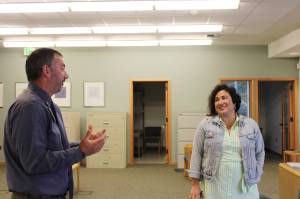
Before the resolution came up for a vote, the commissioners heard a presentation from SWCA Environmental Consultants project manager Matt Cook.
The county contracted with SWCA in 2024 to update the Community Wildfire Prevention Plan, which was written in 2009.
“I think this really turned out to be a good plan that I hope folks are able to kind of move forward once everything is signed and finalized,” Cook said during his presentation during the commissioners’ March 9 work session.
SWCA used the National Cohesive Wildland Management Strategy to write the plan, Cook said. The strategy focuses on three main goals: Resilient landscapes, fire-adapted communities, and safe and effective wildfire response.
That plan is to reduce threats to life and property from wildfire, Cook said.
Community Wildfire Prevention Plans (CWPPs) came from the Healthy Forest Restoration Act of 2003 and have three stipulations: Plans must be collaborative, must identify and prioritize hazardous fuel treatments, and must identify measures to reduce structural ignitability.
CWPPs do not mandate actions, Cook said. Instead, they make recommendations for mitigating wildfire risks.
The CWPP for Clallam County makes recommendations on fuel reduction, structural ignitability, public education and outreach, and fire response capabilities.
The plan also sets priorities for actions and is required for many grant funding sources, Cook said.
“CWPPs are really just a bridge between local communities and federal land management,” he said.
To update Clallam County’s CWPP, SWCA met with a steering committee five times between December 2024 and December 2025.
“Recommendations were developed based on the steering committee’s input,” Cook said.
The goals and objectives are to improve wildfire resilience and adaptation; develop actions to mitigate risks through identifying priority areas for prescribed fire and fuel reduction treatments, and identifying and assessing evacuation routes; build broad public and stakeholder input and support through relationships between county, state and federal stakeholders; gain access to grant funding; and track improvements in community resiliency, planned and completed projects, and county outreach success.
SWCA used what it calls a quantitative wildfire risk assessment to evaluate wildfire risk in 23 communities in Clallam County.
The results of that assessment showed that the highest risk for wildfire occurs in the eastern and central county where wildland fuels meet development; Highway 101 urban areas are largely low or moderate risk or are nonburnable; high-risk zones occur along the Wildland-Urban Interface (WUI) where development overlaps with wildland fuels; and the assessment helps prioritize mitigation efforts to protect structures and infrastructure.
For each of the 23 communities, SWCA created map figures showing areas of concern and recommended mitigation projects. Among those communities, 19 were given high-risk levels while four received moderate-risk levels.
Areas of concern included home ignition zone resilience, hazardous fuels reduction, evacuation route safety, critical infrastructure protection and strategic fuel breaks.
The CWPP recommendations are the “meat and potatoes of the plan,” Cook said.
Under resilient landscapes, those recommendations include protecting communities and homes, improving evacuation and access safety, protecting critical infrastructure and doing strategic landscape fuels management.
Under fire-adapted communities, the recommendations are to increase public awareness and education, provide homeowner preparedness and defensible space, do community engagements and demonstrations, and fix policy and program supports.
Under safe and effective wildfire response, the recommendations are to improve emergency communication and alerts, strengthen fire response capacity, enhance water and aviation resources, and improve interagency coordination.
To read the 407-page CWPP, go to tinyurl.com/PDN-Clallam-CWPP-2026.
________
Reporter Emily Hanson can be reached by email at emily.hanson@peninsuladailynews.com.