
Jefferson business betting buyers will purchase local lumber
Published 1:30 am Tuesday, June 30, 2026
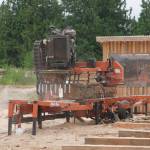
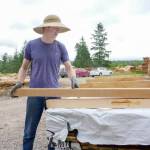
PORT TOWNSEND — Jefferson Timber Cooperative believes it’s important to know where your 2x4s come from — the health and location of the forest, who harvested the tree, and where and how the logs were milled.
Think of it as a farm-to-table enterprise, but for lumber.
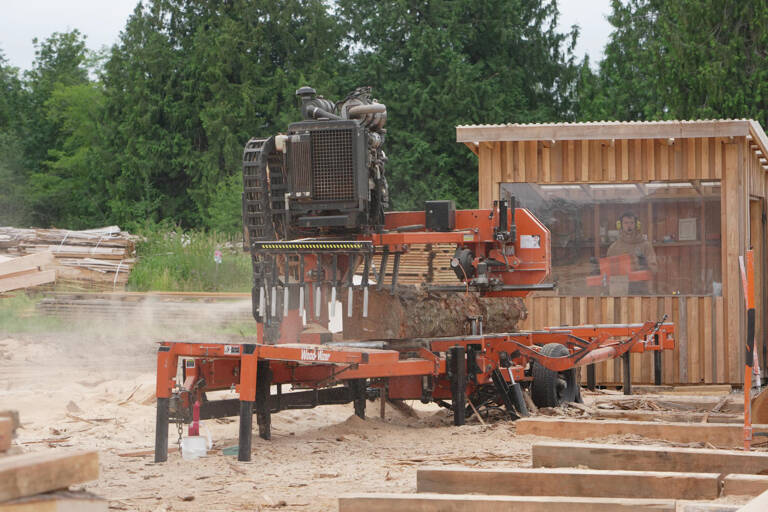
The co-op, which opened for business last fall on state Highway 20 between Jefferson County International Airport and the Four Corners intersection, brings together producers, who grow and harvest the trees, and processors who manufacture the end product.
Together, they are trying to rewrite an Olympic Peninsula timber history that for decades focused on exporting raw logs, leaving workers and a shattered economy behind.
Jefferson Timber Cooperative members span the supply chain, from forest to finished product: co-founders Scott Freeman of Leopold-Freeman Forests, Cory Smith of Trillium Timber Co. and Cody Wayland of Wayland Construction, along with Mike McGregor of Kilnworks, Paul Mahan of Mahan Log and Lumber, and Wild Harvest Woods.
Joining forces has allowed them to access services, supplies and funding that it would be difficult to obtain on their own.
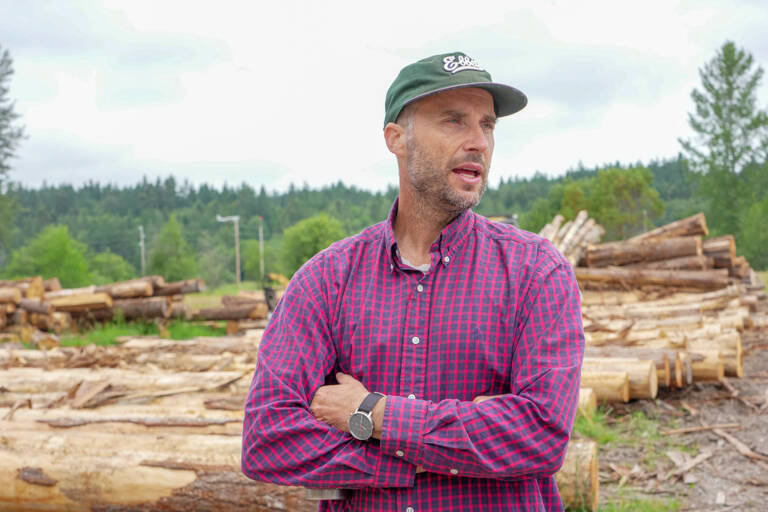
“Why we set up the co-op is, as six small operations, we have a lot more capital together than toughing it out alone,” Wayland said. “It’s a big bite and we know that.”
The co-op is rooted in the belief that a healthy environment and a healthy economy are not at odds — that sustainable forestry and a circular, no-waste approach can be the driver for well-paying jobs and a stronger community by keeping families and businesses on the Peninsula.
The co-op’s focus starts with harvesting from sustainably managed forests that are replanted to keep them healthy and productive into the future.
Wayland said the co-op recently finished a selective harvest at Chimacum Ridge Community Forest, a Jefferson Land Trust property — the kind of project that illustrates its keep-it-local approach.
Selective harvesting thins overstocked forests to keep them from becoming fire hazards, lets light onto the forest floor to allow plants like salal to thrive and improves habitat for wildlife.
The co-op primarily logs Douglas fir and western red cedar, along with big leaf, alder, madrona, black locust and black walnut.
While most of its supply comes from Jefferson County, the co-op also has sources in Kitsap and Clallam counties. It has worked with the Composite Recycling Technology Center in Port Angeles to acquire the coastal western hemlock the CRTC uses in its manufacturing
Sourcing is a priority. The co-op first looks to its members’ and FSC-certified forests. It also works with local small private property owners — the kind large logging outfits ignore because they can’t offer thousands of acres and who want harvesting done with minimal impact.
Wayland calls them, “People who just want to take care of their forests and sell logs.”
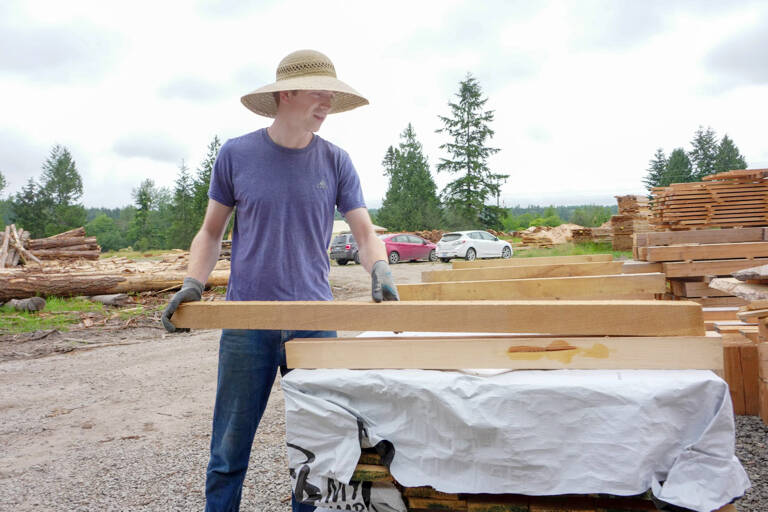
He is upfront that the co-op’s products that can be purchased on site cost more than what you’ll find at home improvement stores, but its practices — like not clear cutting — also are better for forests.
“It all goes back to what do you want to see in this community?” Wayland said. “Pay what you believe in.”
Importantly, to the co-op, keeping every step of the process local also keeps the economic benefits it creates in the community.
“The export price of Douglas fir for a log is 70 cents a board foot,” Wayland said. “The price of kiln-dried Douglas fir is $10 a board foot.”
The co-op’s goal is to minimize waste and squeeze every ounce of economic return out of each tree it processes. Off-cuts and jacket boards will fire the three wood-drying kilns it expects to have on site by year’s end. Sawdust and shavings will be pressed into fire logs.
A number of local residences already are being constructed using co-op lumber. It furnished the lumber for the community pavilion at Jefferson Land Trust’s Valley View Forest, and established relationships with the Northwest School of Wooden Boatbuilding and the Port Townsend School of Woodworking.
Critical to moving forward is the installation of badly needed infrastructure — electricity, water and septic — that will be funded by a state Department of Commerce Industrial Symbiosis Grant the port received.
The co-op also has received funding through a combination of state grants, private investment and a $262,862 USDA Forest Service Wood Innovations grant.
Wayland said the co-op plans to manufacture three to five standard products at scale to supply wholesalers and retailers, including 2×6 Douglas fir car decking, 1×4 Douglas fir flooring, 1×6 western red cedar siding and 1×4 western red cedar paneling.
In addition to its six members, the co-op has hired two employees and likely will hire more as its operations grow. It is on track to cut 400,000 board feet this year.
“Within two years, expect to double that,” Wayland said. “That will add another layer of decision-making on what we want to do. Is this the right scale or do we go bigger?”
Jefferson Timber Cooperative
Location: 6432 state Highway 20
Hours: From 8 a.m. to 4:30 p.m. Monday through Saturday.
Phone: 360-531-2524.
________
Reporter Paula Hunt can be reached by email at paula.hunt@peninsuladailynews.com.



Best of Olympic Peninsula