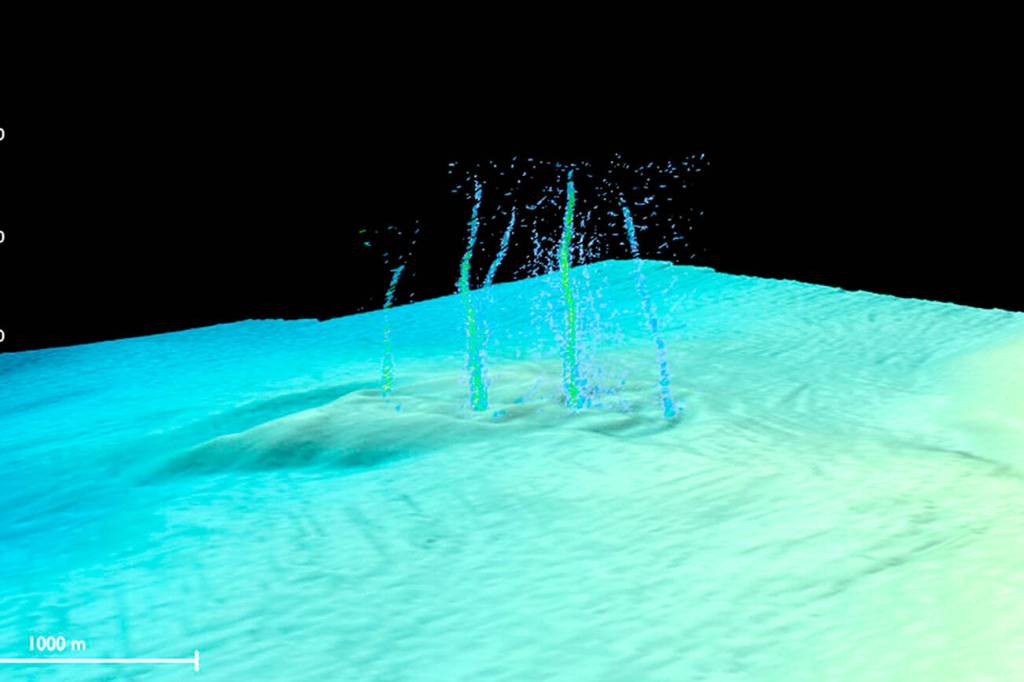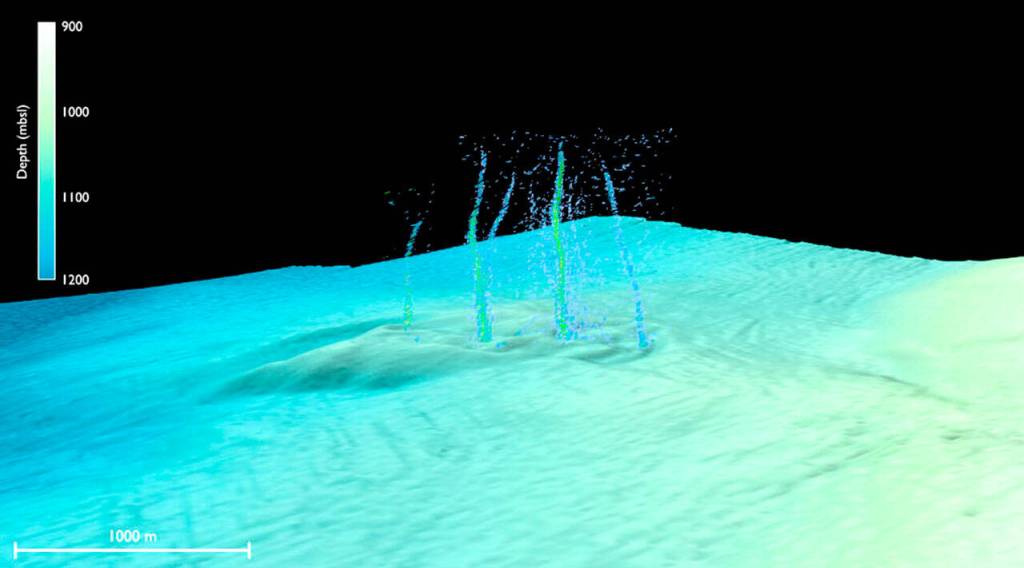
This sonar image of the Pythias Oasis site shows bubbles rising from the seafloor about two-thirds of a mile deep and 50 miles off Newport, Ore. These bubbles are a byproduct of a unique site where warm, chemically distinct fluid gushes from the seafloor. Researchers believe this fluid comes directly from the Cascadia megathrust zone, or plate boundary, and helps control stress buildup between the two plates.(Philip et al./Science Advances)

This sonar image of the Pythias Oasis site shows bubbles rising from the seafloor about two-thirds of a mile deep and 50 miles off Newport, Ore. These bubbles are a byproduct of a unique site where warm, chemically distinct fluid gushes from the seafloor. Researchers believe this fluid comes directly from the Cascadia megathrust zone, or plate boundary, and helps control stress buildup between the two plates.(Philip et al./Science Advances)

Undersea ‘oasis’ sheds new light on plate tectonics

Seepage doesn’t mean an earthquake is imminent

An underwater spring is gushing water into the ocean at unprecedented levels giving researchers additional insights into plate tectonics but not — despite some news reports — any indications of an impending earthquake.

A seep of warm water about 50 miles off the coast of Newport, Ore., is spouting chemically distinct water into the ocean at rates not seen anywhere else in the world, but that doesn’t mean an earthquake is imminent, according to Evan Solomon, University of Washington oceanography professor.

“We’re not alarmed by the discovery,” said Solomon in a later interview. “The interesting thing about this site is the seep that we discovered has the highest flow rates of any we’ve seen.”

Solomon recently co-authored a study on the vent, and he said some news organizations have sensationalized the report’s findings, portraying the discovery as evidence the Cascadia Subduction Zone — a 600-mile fault line off the coast of the Pacific Northwest running from northern California up to British Columbia — was ready to blow.

That’s not the case, according to Solomon, who said he’s been answering emails from concerned citizens worried about an imminent earthquake.

But the vent — which has been dubbed “Pythia’s Oasis,” does give researchers more information on plate tectonics and what’s known as “locking,” he said.

Tectonic plates are massive pieces of the earth’s surface that rub up against each other, albeit incredibly slowly.

Locking is the region of the plate boundaries that stick, Solomon said, and that causes a build-up of stress that eventually erupts in an earthquake.

This particular vent was discovered about seven years ago, but Solomon said researchers believe it’s been active for at least 1,500 years.

Knowing about it doesn’t change ideas about earthquake hazards in the zone.

“Don’t freak out,” Solomon said. “The big thing is the seep site is exciting because the water flow rates are so high. It’s shedding a lot of light on the processes that lead to locking behavior in the subduction zone.”

While other known seeps release water at rates that amount to several centimeters per year, Pythia’s Oasis is sprouting water at several kilometers a year, or roughly half a liter per second, which Solomon called “incredible.”

The seafloor at the oasis is about one kilometer deep, Solomon said, and it’s coming from the plate boundary which is estimated to be another four kilometers down.

What’s also unique about the seep is that what is flowing out is mostly water rather than mostly gas. The water, which is about 16 degrees Fahrenheit warmer than the surrounding water, is also chemically distinct.

Water flowing out of the oasis is partly freshwater, Solomon said, but not the kind that’s found on the surface. This freshwater is created by seawater becoming chemically dehydrated from minerals in the sediment.

The water in-between plates is important for regulating pressure and stress but the high volume of seepage doesn’t mean an earthquake is pending, Solomon said. However, the new data from the oasis can be used in models that will, one day, be able to predict earthquakes.

“We’re still a long way out from predicting an earthquake,” Solomon said. “Estimates of earthquake hazard come from the earthquake record.”

A 9.0-magniture quake on the Cascadia Subduction Zone, which runs from northern California to British Columbia is estimated by researchers to strike about every 600 years. The Pacific Northwest is in year 322 of that cycle. The last one hit Jan. 26, 1700.

There’s a 15 percent chance in the next 50 years of the Cascadia Subduction Zone erupting in an earthquake, Solomon said, but that prediction is unchanged by the discovery of Pythia’s Oasis.

“The utility of these models is that, eventually, they’ll be used (to predict earthquakes),” Solomon said. “That’s still a long way out.”

________

Reporter Peter Segall can be reached at peter.segall@peninsuladailynews.com.

More in News

Aaliyah Clark of Poulsbo (378) and Monica Castleberry of Lacey (21) lead a young runner at the start of the Jamestown S'Klallam Glow Run in Blyn late Saturday afternoon. The race had a record-breaking 900 participants this year. (Michael Dashiell/Jamestown S'Klallam Tribe)
RUN THE PENINSULA: Record-setting crowd at Jamestown Glow Run

A record-setting huge crowd of nearly 900 people ran in… Continue reading

U.S. Rep. Emily Randall.
US Rep. Randall speaks on House floor about insurance

Example of fictional family shows premium increase of more than 1,000 percent

Spending patterns led to pool audit

Office identifies $33K in unsupported payments

Comments oppose plan against Port Townsend zoning changes

Option would increase maximum limit on units per 40,000 square feet

x
Sequim program uses grant for utilities, rent

Community support through Peninsula Home Fund gives $10,000 to organization

Firefighters Tyler Gage and Tatiana Hyldahl check out the light connections on the 1956 fire truck that will travel the streets of Port Angeles during the 41st Operation Candy Cane beginning Monday. Santa and his helpers will pass out candy canes to those who donate food items or cash. The runs will begin at 5:30 p.m. and include the following areas: Monday, west of I street and M street; Tuesday, I and L streets to C street; Wednesday, C Street to Lincoln Street; Thursday, Chase Street to Chambers Street; Friday, Jones Street to Golf Course Road; Dec. 13, above Lauridsen Boulevard. It will be stationary from 5:30 p.m. to 7 p.m. on Dec. 14 at the Port Angeles Grocery Outlet and during the same time on Dec. 15 at Lower Elwha Food and Fuel. (Dave Logan/for Peninsula Daily News)
Operation Candy Cane

Firefighters Tyler Gage and Tatiana Hyldahl check out the light connections on… Continue reading

Online survey launched for Sequim parks access

The city of Sequim has launched an online survey to… Continue reading

Crews work to remove metal siding on the north side of Field Arts & Events Hall on Thursday in Port Angeles. The siding is being removed so it can be replaced. (Dave Logan/for Peninsula Daily News)
Siding to be replaced

Crews work to remove metal siding on the north side of Field… Continue reading

Tsunami study provides advice

Results to be discussed on Jan. 20 at Field Hall

Chef Arran Stark speaks with attendees as they eat ratatouille — mixed roasted vegetables and roasted delicata squash — that he prepared in his cooking with vegetables class. (Elijah Sussman/Peninsula Daily News)
Nonprofit school is cooking at fairgrounds

Remaining lectures to cover how to prepare salmon and chicken

Port Townsend Main Street Program volunteers, from left, Amy Jordan, Gillian Amas and Sue Authur, and Main Street employees, Sasha Landes, on the ladder, and marketing director Eryn Smith, spend a rainy morning decorating the community Christmas tree at the Haller Fountain on Wednesday. The tree will be lit at 4 p.m. Saturday following Santa’s arrival by the Kiwanis choo choo train. (Steve Mullensky/for Peninsula Daily News)
Decoration preparation

Port Townsend Main Street Program volunteers, from left, Amy Jordan, Gillian Amas… Continue reading