
Sequim site could include 600 homes
Published 1:30 am Tuesday, May 21, 2024
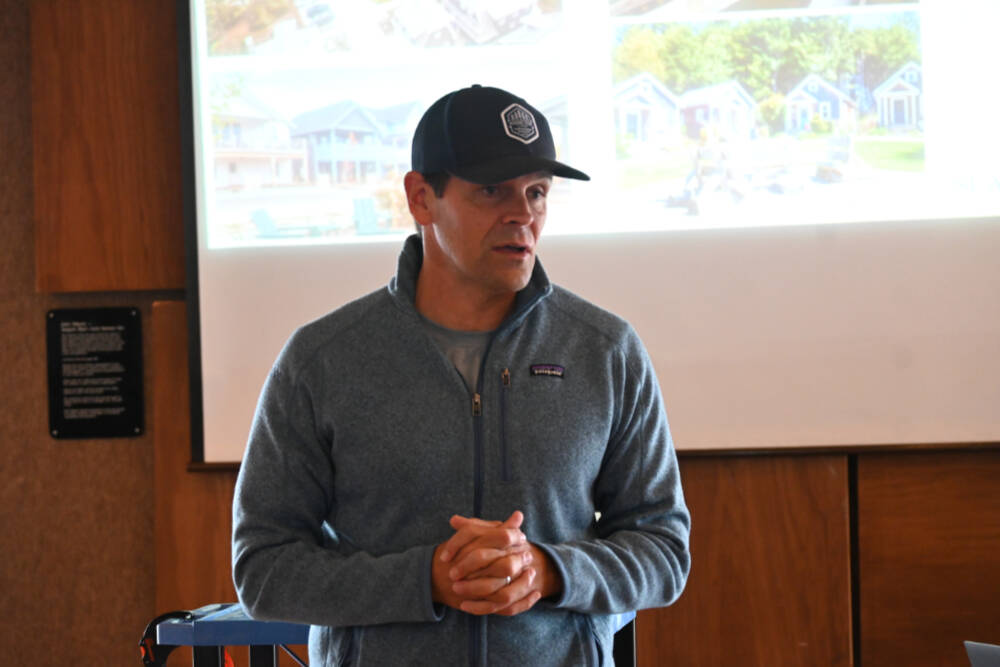


SEQUIM — Property long targeted for a large resort along Sequim Bay has drawn the interest of developers of a planned community in Grays Harbor County.
Casey Roloff, who, along with wife Laura created Seabrook, a resort startup on the bluffs of Washington’s Pacific Coast that’s grown to 600 homes in the past 20 years, has been meeting with local government agencies, economic agencies, community groups and the public in recent weeks to explain his plans for a resort community on property owned by John Wayne’s heirs near the marina that bears his name.
Roloff and his partners — including Seabrook CFO Jeff Gunderson and Sam Nielson, Seabrook’s vice president of engineering and entitlements — met with community members on April 22-23 and offered his vision of how he’d like to build as many as 500 to 600 homes of various size and densities, along with some small commercial structures, in a walkable, pedestrian-friendly development on about 160 acres adjacent to West Sequim Bay Road.
“We know everyone loves this property,” he said, “but it needs the right kind of development and the right kind of developer.”
Roloff, Seabrook’s CEO, said his company does not own the property but owns the rights to purchase if the development looks achievable. He said he’s spending about $1 million to go through a process to determine the viability of a resort before filing an application with the city of Sequim.
The property is within city limits, while the marina — which is not part of Roloff’s proposed development — is managed by the Port of Port Angeles.
In recent weeks, Roloff and his team have met with municipalities, the Jamestown S’Klallam Tribe, anglers groups, the Sequim Bay Yacht Club and others to create an “open line of communication” with the community and “make sure everyone has an opportunity to share.”
If developed, the site would go through a number of environmental studies by entities such as the state Department of Ecology, Army Corps of Engineers, Department of Natural Resources and specialists from the Jamestown S’Klallam Tribe, Roloff said.
“It’s a very rigorous process; the last one we did was about 1,000 pages,” Roloff said.
Roloff said John Wayne Enterprises president, Ethan, the son of the late actor John Wayne, reached out to his company about 10 years ago about a deal for the site.
Now, Roloff is hoping to create something similar to Seabrook on the Olympic Peninsula — with some significant differences.
While Seabrook is a town unto itself, with amenities such as a full grocery store and soon an urgent care center, which is necessitated by its relative geographic isolation, the Sequim development would be more like a village, Roloff said, because of its proximity to the city.
The development would feature 1,000- to 2,000-square-foot commercial sites surrounded by relatively dense residential properties such as apartments and smaller townhouses that Roloff likened to “multi-generational properties.”
Those properties would be surrounded by more traditional homes with more space between residences.
“We don’t use anything that looks cookie-cutter or ugly,” he said.
The average cost per home would be about $500,000, Roloff said, although there would be other housing options from 450-square-foot “cabins” to accessory dwelling units (ADU) and apartments above garages.
Roloff’s Seabrook took 20 years to develop at about 30 homes per year.
“We expect a similar pace out here,” he told community members.
Although there is no set timeline yet, Roloff said the first part of the Wayne property to see development would likely be the northern end because it is less geographically complex and a portion has been cleared.
Following that, some small commercial features would be added such as food trucks, a farmers’ market-style venue and potentially a fishers’ market.
The property has seen its share of potential developers, most recently seeing a six-month marketing effort to sell the 160 acres in 2020 draw national interest; the asking price then was $9 million.
It is zoned for a planned resort community development that allows housing, transient lodging and commercial uses.
Roloff said he expects the property to see some development sooner or later.
“Someone is going to develop it,” he said, adding that he and Gunderson are Washington state residents who live in Seabrook.
“We’re all in,” Roloff said.
Concerns
Some of those attending the April 23 community meeting were concerned about the percentage of short-term rentals (STRs). Roloff said that, at a previous development he oversaw at Bella Beach in Oregon, “We were worried [that if] short-term rentals took over, our community wouldn’t work,” so they purposefully built in short-term rentals and managed them.
A little more than half of the homes at Seabrook are STRs, although Roloff said he does not expect to see the Sequim site have that heavy a percentage because of its proximity to the city.
“The shared economy is here to stay, [but] we don’t see that happening here,” he said, estimating about 70 percent of the projected 500 to 600 homes to be full-time Sequim residents.
“We don’t see this as a town; we see this as more of a village,” he said.
At Seabrook, he said, managers check in every guest face to face rather than vacationers checking in by punching a number on a security panel.
Attendees also voiced concerns over traffic and the area’s water supply.
Roloff said this development would hook up to Sequim’s water and sewer utilities, although he did not have information about whether nearby residents would be forced to hook up to those utilities as well.
The nearby park — John Wayne’s Waterfront Resort for recreational vehicles, part of the overall land purchased — would be phased out and go away, Roloff said.
Developers will not be taking control of John Wayne Marina, which is managed by the Port of Port Angeles, nor are developers interested in proposing any shellfish operations on Sequim Bay.
Roloff said this property would be designed to encourage traffic to use Whitefeather Way as the main egress point. He said developers hope to see a roundabout to ease any congestion.
“[It’d be] way safer to get across that road,” he said.
A stop sign on West Sequim Bay Road would likely be part of the traffic alterations, Roloff said.
“We want to calm traffic down [there],” he said. “If anything, this [area] is going to be more walkable.”
Bryan Berreth heard the developers’ presentation on April 23 along with other Sequim Bay Yacht Club members in late April.
“I think it’s a positive thing — it’s going to get developed — but it’s going to be a process,” he said.
“It seems like they want to do a great job for the community.”
Berreth had a 40-year career as an appraiser in commercial real estate projects and is “very familiar with the process.”
He said the biggest issue will be access.
“It’s a nice piece of property … [but] it’s going to throw a lot of people on the roads,” Berreth said.
“Can you imagine putting 500 to 600 homes there and trying to make a left (to get back on U.S. Highway 101) with all the traffic there?
“That’s something they’re going to have to address with the city.”
Berreth noted he’s seen the area develop since the 1950s and that, as a Pacific Northwest native, he’s a bit in the minority in the yacht club.
“No one wanted to live in the Pacific Northwest because all it does is rain,” he said.
It’s a little different now, Berreth added.
As for the development, he said, “This is one of the growing pains everyone is going to have to work through.”
________
Michael Dashiell is the editor of the Sequim Gazette of the Olympic Peninsula News Group, which also is composed of other Sound Publishing newspapers Peninsula Daily News and Forks Forum. Reach him at editor@sequimgazette.com.