
Manis mastodon remnants donated to Washington State Historical Society
Published 1:30 am Sunday, June 30, 2019


SEQUIM — More than four decades ago, a couple’s discovery on their Sequim property changed the way archaeologists viewed North American human history — and, along the way, put their small town in the international spotlight.
Nearly 14,000 years after its death and another 40 years since it discovery, the Manis mastodon is once again making headlines.
Clare Manis Hatler recently donated a collection of artifacts and decades of research related to remains of the mastodon to the Washington State Historical Society, the Tacoma-based organization announced last week.
Hatler, whose late husband Emanuel “Manny” Manis discovered mastodon tusks while digging a pond on their Sequim farm, said she’s pleased that the items — more than 50 cartons of bones, ivory, teeth, soil samples, stone tools, photographs, field notes and more — are now safe and available for scientific research.
“I’ve been meaning to do it for a while … and I’m not getting any younger,” Hatler said.
“It’s exciting — this is where Dr. [Carl] Gustafson and Manny and I wanted it to belong to be — for everybody, of course — in a place where it could be researched,” she said.
Hatler said the donation became official with a deed on March 26, though it had been a year-long process to make the donation official.
Washington State University researcher Carl Gustafson started investigating the Happy Valley area find in August 1977 and spent 30 years researching the so-called Manis Mastodon. His claims that the mastodon — initially thought to be a mammoth — was struck by a spear was met with skepticism.
His assertion placed human civilization in North America nearly 14,000 years ago; previous research had established the Clovis people as the earliest established human culture on the continent.
It wasn’t until 2011 that Mike Waters confirmed Gustafson’s research — that the bones were 13,800 years old and that the spear had been crafted by human hands (it was made from another mastodon bone). The find demonstrated that humans were hunting in the Americas about 800 years earlier than was previously believed.
“I am thrilled to hear that the Manis mastodon collection is now permanently archived with the Washington State Historical Society where it will be preserved and available for study,” Waters said.
“This is an important collection that can be studied for many years to come and still has many stories to tell.”
Lynette Miller, head of Collections for Washington State Historical Society, called the Manis mastodon collection one of the three most important archaeological finds in Washington State history — the others being the East Wenatchee Clovis site and the Ancient One (Kennewick man).
“It establishes the timeline of human habitation on this continent, and documents their interaction with large animals in the Northwest,” Miller said. “We are honored to have this collection entrusted to our care.”
Hatler said she had the cartons of materials in her possession — much of the initial archaeological find minus some tusks and bone that were donated to what’s now known as Sequim Museum & Arts — and that she dedicates this donation to her late husband, who died in 2000, and Gustafson, who died in 2016.
“I dedicate this gift to two great men,” Hatler said. “This gift would not have happened without Emanuel Manis, who made the effort to share the site with the public. He wanted everyone to participate in and learn about the wonderful discoveries made daily during the dig.
“Secondly, to Dr. Carl E. Gustafson, a dedicated professional, investing over 30 years of his life into revealing the site’s mysteries, without expectation of accolades or financial gain.”
Unearthing history
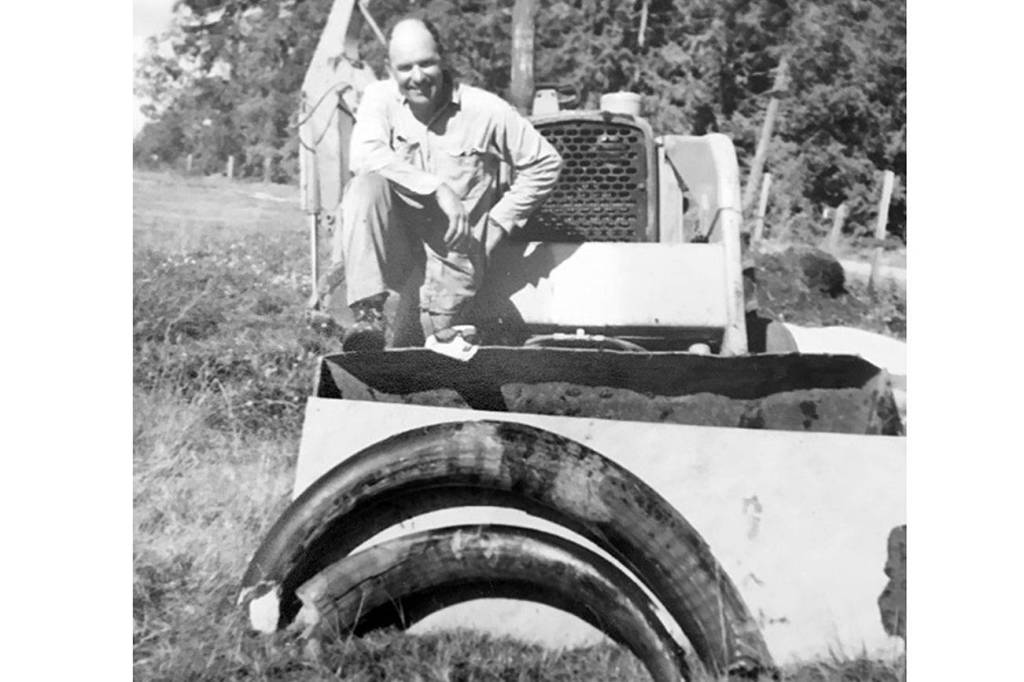
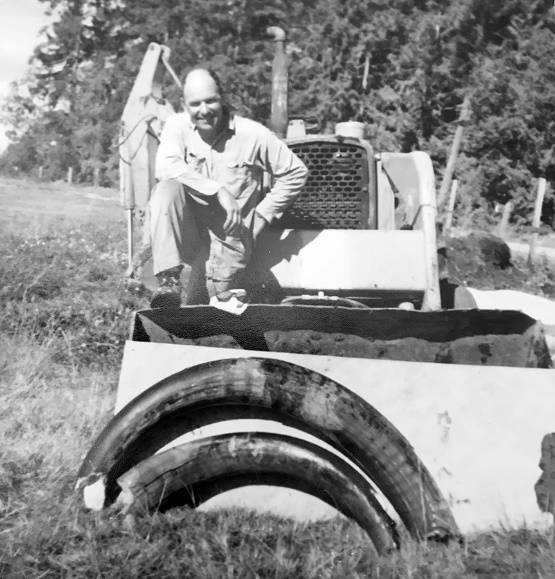
On a sweltering Monday in early August 1977, Emanuel Manis, who also owned Sequim Bowling Lanes at the time, dug into the earth with a backhoe on the marshy, lower pasture of what was then a 16-acre farm.
Manis began digging trench around what would be a stock pond when he literally unearthed two massive tusks.
“(The first) looked like a big log lying across the bucket,” Hatler recalled, in a recording for Columbia Conversations, a podcast that highlights those working to preserve and share the history of Washington state and the Pacific Northwest.
Manis set the object aside, but not long after restarting his dig unearthed a second curved object.
“He assumed they were mammoth tusks,” Hatler said. “I took one look and came unglued and told him, ‘Don’t you dig another inch. Get off the backhoe and get out of there.’ And I ran for the phone.”
Clare immediately began a chain of phone calls leading her to Richard Dougherty, who was working on the Ozette archaeological site near Neah Bay.
Within 24 hours, Dougherty was on site along with an archaeologist, a graduate student from Washington State University, a reporter from the local paper and, soon after Gustafson, a WSU professor with a crew and equipment.
Later, Daugherty told the Manis couple, “This is the most important archaeological discovery in the world today.”
Interest grew substantially, state historians note, when Gustafson wiped the mud from a rib bone and exposed what appeared to be an embedded spear point. Then a sizeable, severely worn tooth came up. After initially believing it to be mammoth remains, the archaeology team recognized this belonged to an American mastodon — a far more significant find.
“It was not a mammoth tooth — it was a mastodon tooth,” Hatler recalled.
Ancestors
Mastodon is the common name for any of the large, extinct elephant-like mammals characterized by long tusks, large legs and a flexible trunk. Unlike the grass-eating mammoth, whose teeth were closer to grazers like cows, mastodons ate brush and had tooth characteristics closer to humans.
Compared to mammoths, the mastodon had shorter legs, a longer body and was more heavily muscled — a build similar to that of the current Asian elephants, I.M. Lange notes in “Ice Age Mammals of North America: A Guide to the Big, the Hairy, and the Bizarre” (2002).
While rare, mammoth remains have been found in and around Sequim; most recently, local residents discovered a partial skull of a Columbian mammoth while walking state Department of Natural Resources-owned tidelands east of Sequim in January 2016.
“The archaeologists, they don’t jump up and down much but they were really excited,” Hatler recalled in a podcast by Columbia Conversations, which can be heard at www.columbiaconversations.org..
“They said, ‘This (became) a very important archaeological site — probably the most important at that particular time in the world. What we have found here is the first direct evidence of man hunting mastodon on the North American continent.’”
Gustafson asserted that the way the bones were scattered and skull was rotated indicated further evidence of human interaction.
“It was worldwide news, in newspapers all over the world, at the time,” Hatler recalled.
Though Gustafson told newspapers at the time he expected to be there just a few days, he spent nine summers (1977-1985) at the site as director.
Justification, deferred
The WSU professor’s conclusions weren’t readily accepted for years, in part based on a lack of proof that material embedded in the rib bone was created by humans (as he’d proposed), as some suggested it may have been the tip of an antler from another animal.
Additionally, Gustafson’s team dated the site based on analysis of organic material instead of testing of the mastodon bones.
But 30 years later, Waters and his team at Texas A&M dispelled those skepticisms.
When Gustafson researched the find in the late 1970s, “they didn’t have all the CT scans and the DNA,” Hatler said in 2011, so Gustafson had to rely on more primitive techniques.
Gustafson sent pieces of the skeleton to labs around the country for radiocarbon dating, which confirmed it was 13,800 years old. He couldn’t similarly test the all-important projectile, however, as the more primitive methods of the time would have “destroyed” it, Hatler said.
She said Waters approached Gustafson in about 2008 and that Waters promised he would “take that rib bone and give it all the tests that modern man knows about.”
In that 2011 interview, Hatler noted, “The last three years it’s been tested by the top scientists. It’s way beyond what they had in the 1970s”
“And they found out Gustafson was right.”
A new article released in October 2011 in the scientific journal “Science” detailed a study that overturned a theory that “Clovis man” was a kind of cultural father to all ensuing generations of Native Americans. Waters’ Texas A&M team, in collaboration with professor Eske Willerslev’s team from the Centre for GeoGenetics at the University of Copenhagen, produced the study.
Waters said he was particularly interested in revisiting the Manis mastodon because “we had new technologies that weren’t available to Gus (Gustafson),” he said in a Dec. 21, 2011 Sequim Gazette article.
There are older human settlements in the Americas than the Manis site, Waters noted, but the Sequim dig “provides another solid archaeological site that dates older than Clovis, and we don’t have too many of those.”
Gustafson’s further finding — that the bone weapon was from another mastodon — was also confirmed through DNA testing.
Gustafson conducted additional research at the site, finding more bones and bone tools. In fact, he brought up evidence of continual human habitation of the area until 8,000 years ago.
Preservation
In 1978, the Manis Mastodon Site was placed on the National Register of Historic Places.
For seven years, through until 1985, the Manises welcomed visitors to the archaeological site, offering informational presentations to visitors, as the WSU researchers worked on site.
“We had 50,000 people come through our front yard,” Hatler said.
In 2002, on the 25th anniversary of the discovery, Hatler donated the 2-acre Manis mastodon site — on the same property she and her husband Don Hatler live today — to The Archaeological Conservancy, a national nonprofit.
“It’s protected from being sold or anything else,” Hatler said.
In 2016, following Gustafson’s death, his remaining Manis mastodon site research went to Hatler, who kept the boxes of bones, stone tools, notes and more on her property until she could find a safe place to send it.
Hatler said last year she contacted U.S. Rep. Derek Kilmer about making the significant Manis artifact donation to the state. That proved serendipitous, as Kilmer’s wife Jennifer is the Washington State Historical Society’s director.
Much of the collection Hatler donated wouldn’t catch the eye of non-scientists, she said, but the bit of bone and ample research and more could prove useful.
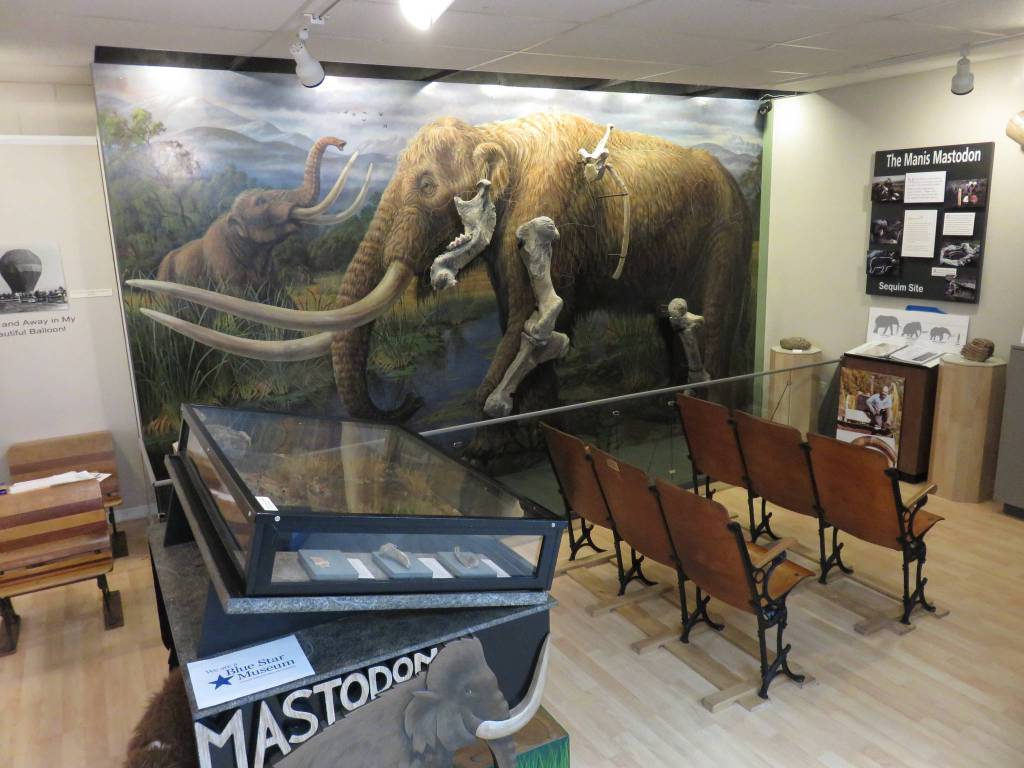
The society’s museum on Pacific Avenue in downtown Tacoma will eventually display some of the artifacts, but no dates have been chosen, spokeswoman Julianna Verboort told the Tacoma News Tribune.
“Some of the pieces are still with a scientist who is conducting research,” she said.
The Washington State History Museum is at 1911 Pacific Ave., in Tacoma’s downtown Hours are from 10 a.m. to 5 p.m. Tuesday through Sunday. See www.washingtonhistory.org.
________
Michael Dashiell is the editor of the Sequim Gazette of the Olympic Peninsula News Group, which also is composed of other Sound Publishing newspapers Peninsula Daily News and Forks Forum. Reach him at editor@sequimgazette.com.