
HORSEPLAY: Dr. Board teaches emergency equestrian care
Published 1:30 am Saturday, July 18, 2026
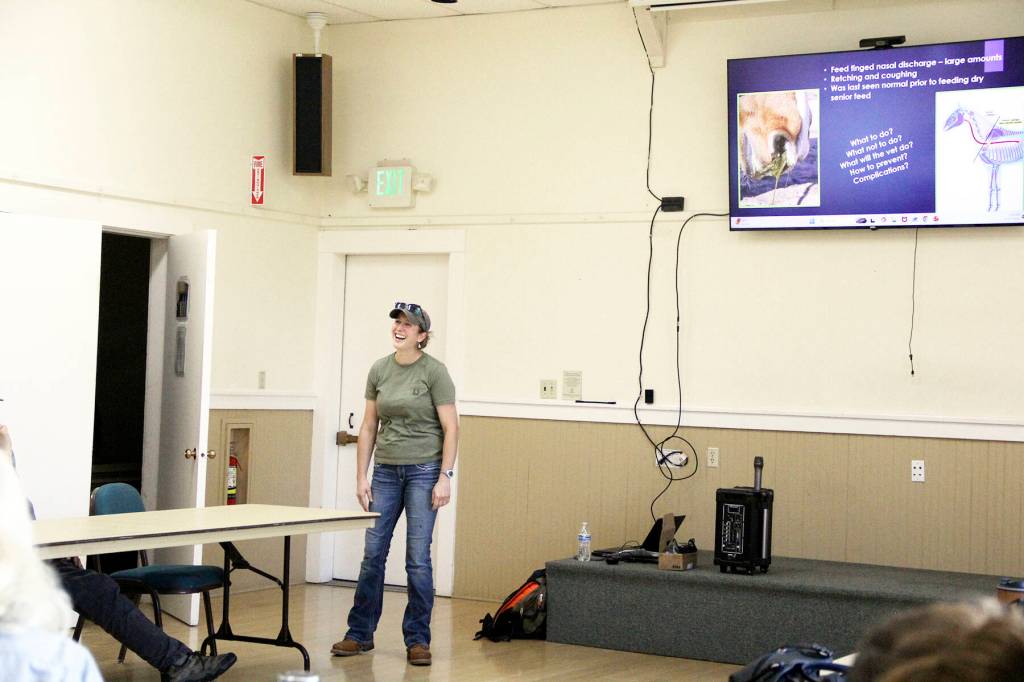
DO YOU KNOW how to measure your horse’s vital signs? Most owners don’t. According to equine veterinarian Dr. Melissa Board, in times of emergencies, knowing if your horse’s vital signs are off — temperature, pulse and respiration rate, referred to as TPR — could point to some pretty serious health issues.
As the featured speaker at this month’s meeting of the Buckhorn Range Chapter of Back Country Horsemen, Board, knowing her presentation on equine emergencies was to a group of horse-savvy owners, added some entertaining quizzes to encourage audience participation.
Topics covered included colic, choke and the use of physical exams and diagnostic tests to help determine possible causes of the horse’s condition.
It was fun listening to audience members shout out what each hoped were the correct answers. Along the way, personal experiences were shared, and with Board’s help, enabled all to learn.
Did you know the heart rate is it an indicator of pain and distress in horses? In horses, a resting heart rate of about 28-44 bpm is typical for an adult, but elevated resting rates —especially above 60 bpm — can be a sign of stress, discomfort or illness.
A rectal digital thermometer and stethoscope are important tools to aid in measuring TPR. Normal adult temperature is from 99-101.0.
To measure a horse’s pulse (or heart rate), use a stethoscope on the left side of the horse’s body and the heart girth area behind their elbow, or use your fingers on the artery underneath their jaw, or find the digital pulse lower down the leg at the fetlock or pastern.
Press two fingertips firmly over the artery and experiment with the pressure you apply. If the area is hot and inflamed, you know there’s a problem.
It is standard practice to measure for 15 seconds and multiply by four to get the beats per minute. In addition, two beats or sounds are equivalent to one counted beat. In other words, the lub and the dub equals one of your counted beats.
Respiration should be eight to 16 breaths a minute. Check by watching the flank, nostrils, or use a stethoscope on the trachea. It is easiest to watch the flank while they are at rest.
One counted respiration is equal to one inhalation and exhalation. That means you will watch the flank rise and fall for one counted breath. Count respiration for 30 seconds and multiply by two.
Practice TPR examinations with your horses to get an idea of what’s normal, and keep that information written down in his or her file.
Choke
When a horse chokes, the esophagus is blocked. Adding to the danger is, unlike humans, horses can’t throw up. Choke symptoms are described as retching, coughing and discharging food. Board advises against attempting to remove choke material from the mouth or treating a choking horse oneself as it can be dangerous and potentially fatal.
“Some horses do weird things when they choke, like frantically running around and panicking when they have trouble breathing,” Board said. “The old adage is you run to a colic and walk to a choke, because sometimes saliva over time can moisten things, and they’ll pass it on their own.
“When your horse is choking, keep their nose to the ground as much as possible, let them relax, let them work it out, because a potential serious complication is aspiration pneumonia.”
She strongly advises against feeding dry pellets to horses, as she’s seen horses choke from it too many times. Always soak pellets in water to make them easier to swallow. Good dental care can help prevent choke as well.
Colic
Colic in horses refers to abdominal pain that ranges from mild discomfort to life-threatening emergencies.
Recognizing the signs of colic in horses can significantly impact treatment and recovery. Horses may exhibit restlessness, pawing, flank watching, bloating and elevated heart rate.
If possible, get the horse walking and trotting to help move feces stuck or impacted through the GI tract and relieve gas. Use a stethoscope on the horse’s flanks and lower abdomen to listen. Be sure to check gut sounds from both sides. Normal is 34 gurgling sounds per minute. No sounds? Contact a veterinarian.
Banamine may be used for pain relief.
She emphasized the use of the osmotic laxative epsom salts and Miralax over mineral oil, which is ineffective, to help loosen intestinal blockage.
Do not feed until hours after symptoms subside.
If the horse’s surrounding is sandy, prevent and treat sand colic using psyllium and magnesium sulfate, with dosage recommendations. Use a sand sediment test to ensure the sand is being expelled.
Silver Sulfadiazine cream (SSD) is effective in treating eye infections. The importance of timely veterinary intervention for eye injuries was stressed, and potential complications in treatment options were discussed.
Nails
A nail or screw driven into a horse’s hoof is a true veterinary emergency. Even if the horse appears to be fine, the injury can damage critical internal structures and lead to infection, laminitis or even death. A puncture can introduce bacteria deep into those areas, causing infection, abscesses or sepsis.
Challenges in removing it include the risks of driving the nail farther, thus it’s very important to try to keep the horse calm and still. While waiting for a veterinarian to arrive, Vet Wrap can be used to stabilize nail injuries and prevent further damage.
Board shared one last antidote for the evening:
“It’s Friday morning. You’ve been watching and worrying about your horse since last night. Come afternoon, you think, ‘I should probably call my veterinarian to ask what she thinks.’ But you don’t, because you’re still hoping your horse will get better.”
A ripple of nervous laughter goes through the audience. Most of us, I think, have done that at some point with our animals. Mostly because — as much as we love our pets — we’d like to avoid having to pay the vet’s bill.
She continues, “At 7 p.m., you’re still thinking the same thing. But you don’t call. Then I’m the one you’re waking up at midnight, because the situation is now urgent. Please, just call right away at the first sign of trouble. I can help walk you through initial assessments, like vital signs. Plus, it gives me a head’s up you might have an urgent situation.”
That’s sound advice, Board. After all, advice over the phone is free, isn’t it?
Fire prevention
It’s hot, and you just want to get some air flowing in the box stall your horse is standing it.
Head’s up: I just learned fans with an open motor have caused some horrific barn fires.
When dry hay, wood shavings, straw and a build-up of dust get on the running motor, it can get hot enough to ignite a fire.
Sadly, this has proved to be deadly to many horses.
If you can see the motor in your fan, it’s an open motor fan. Purchase closed-motor fans.
Barn dance
Saturday, Aug. 29, from 4 p.m. to 8 p.m. will be OPEN’s barn dance and fundraiser.
Join in on what promises to be a fun evening of dinner, dancing and silent auction with dance band The Royals.
Olympic Peninsula Equine Network (OPEN) is reaching its 20th year of rescuing, rehabilitating and rehoming neglected, abused and abandoned horses.
Please support this wonderful nonprofit organization. Tickets are $55 per person.
For more information or to purchase tickets, phone 360-460-7750 or email olympicequinenet@gmail.com.
The dance will be held at 251 Roupe Road, Sequim.
________
Karen Griffiths’ column, Peninsula Horseplay, appears the second and fourth Saturday of each month.
If you have a horse event, clinic or seminar you would like listed, email Griffiths at kbg@olympus.net at least two weeks in advance. You can also call her at 360-460-6299.



Best of Olympic Peninsula