
Jefferson Land Trust director to retire
Published 4:30 pm Tuesday, February 24, 2026
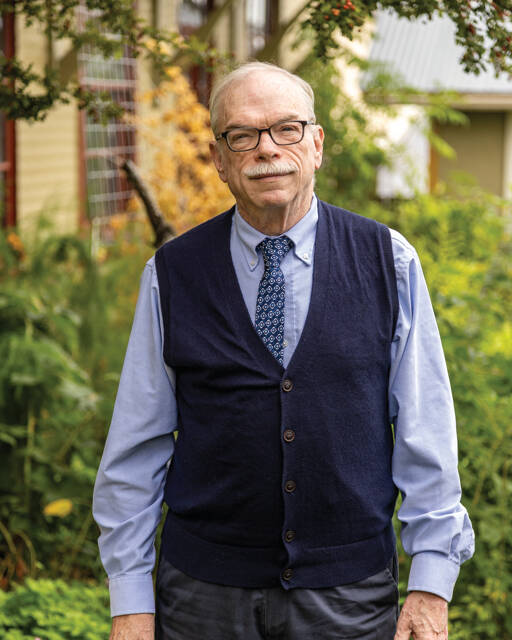
PORT TOWNSEND — After 11 years at the helm, Richard Tucker will retire from Jefferson Land Trust.
“This is the best job I’ve ever had, in the best community,” Tucker said. “I’m so fortunate to work with some of the most incredible colleagues that I’ve ever worked with.”
After spending a full career in conservation and resource management from Florida to Jefferson County and a number of places in between, Tucker is effusive in his gratitude for the time he spent in Port Townsend.
Tucker said the job has been a dream, as was being hired for the position 10½ years ago.
“(I was) overwhelmed, totally thrilled,” Tucker said. “To this day, I still pinch myself and ask, ‘How did I get this?’ Because it has truly been a wonderful experience.”
The land trust partnered with Potrero Group — an executive search firm specializing in conservation and social impact organizations — to launch a nationwide search for its next director. Those interested in the position can contact Potrero Group’s Managing Director Daniel Student at dstudent@potrerogroup.com.
“The new Executive Director will lead a dedicated team of staff and board members passionate about permanently protecting Jefferson County’s land, water, wildlife, and natural resources for future generations,” a land trust news release said. “The ideal candidate will foster internal cohesion; build key relationships with partners, donors, and landowners; and drive conservation momentum and impact.”
Tucker, who will remain onboard until the role is filled, said the next director will inherit a financially strong and well-functioning organization.
Tucker’s time at the trust saw protected acreage jump from 11,000 to 19,000 acres in Jefferson County. Finances were stabilized. Community engagement and resources were established and expanded.
Efforts to restore the salmon run to Chimacum Creek, connecting the Quimper Wildlife Corridor and opening Chimacum Ridge Community Forest are career highlights, Tucker said.
“(Chimacum Forest) is a once-in-a-career-type project, because of the magnitude, it’s 900-plus acres” he said. “That whole project preceded my tenure here. It’s one of those projects where you look back and go, ‘Wow, that’s amazing.’”
Now open to the public, people are thoroughly enjoying the community asset, he added.
Tucker claims limited credit for the growth and success of the organization, which he said is full of talent, shared vision, and mutual respect and appreciation. He praised the board of directors, community partners and the staff.
“I’m very proud of the fact that we have a very good culture here,” Tucker said. “We don’t have the traditional silos that you have in other organizations. People like working with each other.”
An example of the collaborative culture at the land trust came when the opportunity to expand from the cramped main office space was abandoned because everyone wanted to continue seeing each other regularly, Tucker said.
Tucker felt personally supported by the organization when, about a year and a half into his role, he lost much of his eyesight overnight.
“I have very low vision; I don’t recognize faces anymore,” he said. “It’s not treatable and it’s not curable. I’ve been living one day at a time.”
The organization has been very understanding.
“They realize that I may walk in and talk to an empty chair,” Tucker said.
Tucker lost his ability to safely work in the field, but, through state support, he was able to adapt his computer and has maintained his capacity for administrative work.
He felt the quality of his community again when it supported him through the loss of his partner five years ago, he said.
Tucker was born and raised in Camden, N.J. His early exposures to nature were unlike those of many growing up in Jefferson County.
“My father worked three jobs,” he said. “We never went hiking, we never went camping, I never went to summer camp, I never went fishing. My parents didn’t have the time or the money to do that.”
Instead, his love of nature came from his public library, where he was an avid reader of National Geographic and where librarians would supply him with additional natural world literature as he poured over books for hours.
His childhood experience is part of why he has strongly supported the land trust’s education initiatives, which offer free exposures to outdoor experiences to youths in Jefferson County public schools. One newly developed program gives kids the opportunity to observe the chain of events from a standing tree, to its milling, to building something with the wood product.
Following graduate school, Tucker started his career as a city planner in Pensacola, Fla. He touched on environmental planning as the city underwent a comprehensive plan.
“Airport noise, flood-prone areas,” he said. “I just got fascinated with it.”
When the city attorney was recurrently unable to answer his land-use and environmental law questions, Tucker decided he should go to law school.
“Atticus Finch (of “To Kill A Mockingbird”) was always my childhood hero,” he said.
Tucker worked on coastal management issues for the state of Florida. After graduating from law school, he spent almost a year in Savannah, Ga., working for the bankruptcy court. He then moved to Seattle, where he eventually landed a job at King County.
Tucker spent 17 years at King County, where he developed legislation to incentivize landowners to conserve environmentally valuable aspects of their properties, protected salmon through watershed conservation, and protected forests and farmland, among other things.
Tucker returned to the south to be closer to his Florida-based father. In that time, he worked on the Atlanta Beltline — a 23-mile loop of parks and greenspace in central Atlanta — for the Trust for Public Land, and he worked for the Nature Conservancy in Birmingham, Ala.
Always hoping to return to the Pacific Northwest,
Choosing to retire was a difficult choice for Tucker, one he agonized over. He loves the work so much that he continues to work on Saturdays, he said.
Tucker, who has dual Irish-American citizenship, purchased an apartment in Cork last year. It will be his primary base, although he plans to continue traveling and will likely establish a base somewhere in the United States.
________
Reporter Elijah Sussman can be reached by email at elijah.sussman@peninsuladailynews.com.


Best of Olympic Peninsula