
State Supreme Court justices hear arguments at Little Theater
Published 1:30 am Friday, May 29, 2026
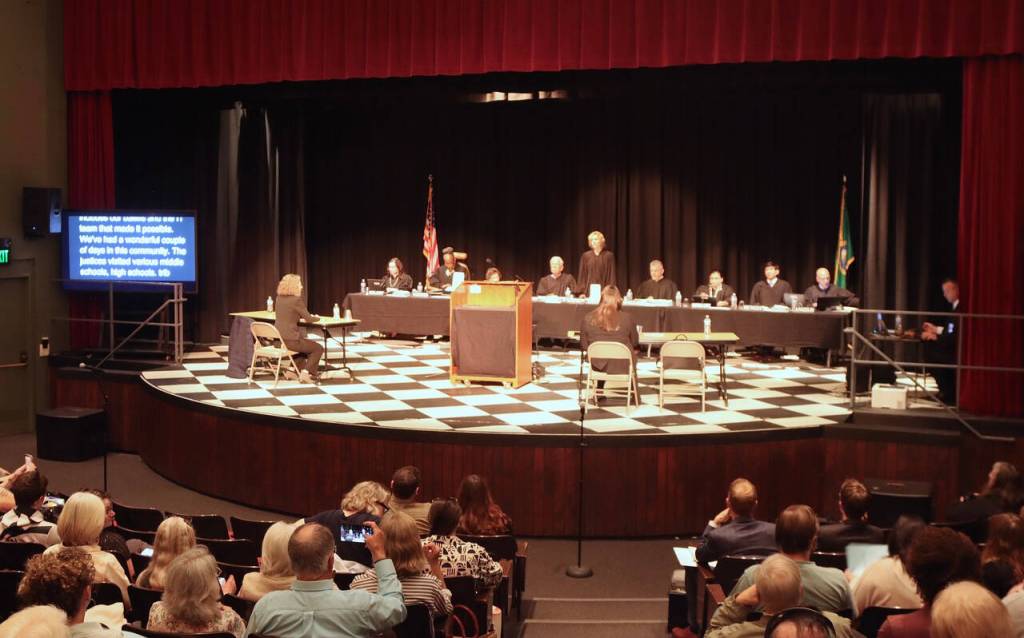
PORT ANGELES — The nine justices of the state Supreme Court had just finished wrestling with weighty matters about privacy in the digital age and the role of bias in the justice system.
Then a student asked why there were so many of them — part of a public question-and-answer session that followed oral arguments on Thursday at Peninsula College, where the justices had convened as part of the Traveling Court.
The program allows justices to hear cases from their docket before live audiences across the state.
The audience who watched the state’s highest court in action nearly filled Peninsula College’s 250-seat Little Theater. It included more than 50 second- through sixth-graders from Dry Creek Elementary School, and middle and high school students from the Crescent School District.
In the first case, State of Washington v. Martinez-Loyola, attorney Erin Moody argued that a juror’s post-verdict remarks — that defendant Adrian Martinez Loyola looked like one of “the immigrants coming across the border and costing us so much money” — had tainted his criminal conviction and warranted a new trial.
Deputy Skagit County Prosecuting Attorney Hazel Petrino argued that the trial judge had questioned all nine jurors, found the juror credible and that the juror’s views had not affected the verdict.
In the second case, attorney Ryan Ellersick argued on behalf of the plaintiffs in Baker, et al. v. Seattle Children’s Hospital, arguing that when patients visited the hospital’s website to search for information about their children’s medical condition, a tracking tool captured those search terms and transmitted them to Meta, which incorporated them into its algorithms — all without the patients’ knowledge or consent, in violation of the Washington Privacy Act.
Attorney James Sigel argued for Seattle Children’s, contending that the privacy act is an anti-eavesdropping statute that covers private communications between individuals, and that searching a hospital website is no more a private communication than looking something up in an encyclopedia.
When the arguments were finished, the justices became the ones who fielded questions — among them, why there were nine of them? — ranging from how judges are appointed to how long it takes to decide a case, how the court weighs precedent and whether any of them had faced a case so difficult it made them consider leaving the bench.
Associate Chief Justice Charles Johnson, the longest-serving justice, said no case had ever made him want to quit. Chief Justice Debra Stephens said the work can be draining, but it’s worth it.
“Sometimes things are really hard,” she said. “Sometimes days are bad, sometimes it’s emotionally draining, physically exhausting. But you stick with it.”
Justice G. Helen Whitener said the toughest cases stay with her.
“It did not make me want to quit,” she said, “but it did give me heartburn. Because you make a decision, and you always wonder — did I do the right thing? And that’s always something that will weigh on you if you’re responsible.”
State Supreme Court justices
Chief Justice Debra Stephens
Associate Chief Justice Charles Johnson
Justice Theodore Angelis
Justice Steven Gonzalez
Justice Sheryl Gordon McCloud
Justice Colleen Melody
Justice Raquel Montoya-Lewis
Justice Salvador Mungia
Justice G. Helen Whitener
________
Reporter Paula Hunt can be reached by email at paula.hunt@peninsuladailynews.com.


Best of Olympic Peninsula