Red Dog is gearing up for summer season
Published 1:30 am Tuesday, March 24, 2026
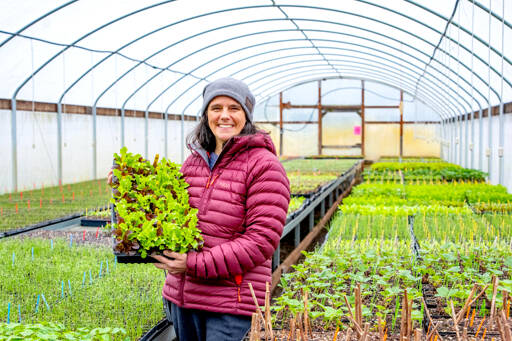
CHIMACUM — Spring is a time of slow warming at Red Dog Farm in Chimacum, both for the land and the workers who farm it.
In mid-March, production manager Lane White described the farm as awakening.
“There’s some days that feel a lot warmer,” White said. “You’ll hear the frogs, you’ll see the trumpeter swans become more active, flying up and down the valley, getting ready to get out of here.”
“There’s some excitement. You can’t help but see the greenhouse filling up with plants and know that, like, ‘Oh, it’s almost time to get going.’”
The farm also becomes more social in the spring, he said. By March, the crew size increases significantly as returning and new staff begin field prep, bulk harvesting of overwintered crops like carrots, and transplanting into the four unheated greenhouses.
The preparation for spring begins in December and January as the farm starts hiring workers for the coming season, said Karyn Williams, the owner and operator who founded the farm in 2008.
By April, the farm will have 20-25 employees on board.
Williams said she loves hiring experienced farmers, but there are so many types of farming that there may still be some learning involved.
“We definitely do also hire people that don’t have any farming experience, if we think they have an aptitude for learning, especially if they have some physical labor experience and seem like they have some pretty realistic view expectations,” Williams said. “It’s a pretty challenging, physical and really rigorous job.”
Something about the idea of farming gets people into a very idealistic head space, she added.
“So we’re always trying to make sure, ‘Like, you know what you’re getting yourself into,’” she said.
In December, the farm is quiet with a skeleton crew of staff. Since December and January are the slowest months, staff focus on office work, maintenance, offseason projects and the year-round farmstand.
Most of the year-round staff take several weeks off around the holidays, Williams said.
In February, the propagation and growhouse wake up as seeding begins for both farm crops and retail plant starts. Also, some returning crew members start for the season.
Buzzing with music and new plant life, the propagation house and the growhouse signal the coming of the busier season.
Before the seasonal crew is hired, greenhouse manager Hailey Gibson seeds starts in a warm and brightly lit propagation house. Gibson drops seeds into one of many trays.
Gibson uses vacuum seeding to speed up the process. Scattered seeds are spread loosely on a plate before Gibson attaches it to a vacuum. The vacuum pulls each seed tightly into place. Gibson then places the tray above flats of soil and turns off the vacuum. The seeds fall gently into place.
“Once we seed a flat, we’re going to put more dirt on top and cover the seeds,” Gibson said.
The seeded trays sit on heated tables which have hoses with warm water cycling below them. That method is more efficient than heating the air, Williams said.
Roughly half of the starts grown in the propagation house will be sold as starts at Jefferson County Farmers Markets’ Port Townsend and Chimacum markets, the Port Townsend Food Co-op and the Chimacum Corner Store.
Now in her fourth season, and her first managing the starts, Gibson spoke about the revelation of the complex and beautiful process entailed in her part of the food system.
“I think a lot of people who don’t work in agriculture or inside food systems don’t really think about where food comes from or how it’s grown,” Gibson said. “This was my first farm job, and when I first got here, I realized very quickly how little I actually knew or how little I even thought where my food comes from and how it’s grown and all the work that goes into it and all that there is to know.”
Farming is a huge process. Being on the farm for three years has given Gibson only a fraction of the insight that Williams holds.
White, now in his 11th season at Red Dog, said spending so much time on the land connects him to the rhythms of changing seasons.
“You start to look up at the sky at a certain time in the spring like, ‘Oh, it’s going to get warmer,’” he said.
White’s work includes preparing the soil, which includes mowing, tilling and disking, and a lot of tractor work.
“Our job is not only to prepare the fields but also to maintain the crops after they get planted,” White said. “We have a tractor that most of the time does the weeding for us.”
White’s work also includes soil amendment and transplanting.
“We’re taking the crops that the greenhouse is sending out and we’re finding a place in the ground to actually plant them,” he said.
Along with planting by hand, the farm has a tractor implement for transplanting crops.
He’s not sure if he has the title yet, but White said he’s definitely lead greenhouse builder too.
“Seems like we build one every winter,” he said.
White, whose grandparents were ranchers, moved to the area for the job. Previously, he worked on farms in central Oregon.
“Once I found out that people wanted to do that, I thought, ‘I want to do that,’” he said.
White also likes the pace of the work. It moves from sleepy in the winter to a full sprint in the summer.
In March, White led the construction of a greenhouse to house the starts for retail. The new addition is directly next to the farm’s new stand, which opened last August.
The farm stand was built by Andy Dalrymple, an East Jefferson Fire Rescue firefighter who is Williams’ husband. His contributions to the farm generally involve carpentry, she said.
The farmstand is open daily from 8 a.m. to 8 p.m., year round. Updated lists of stocked produce can be found at reddogfarm.net/farmstand.
In April, the farm will launch its community supported agriculture (CSA) program, the reopening of the Saturday farmers markets and the blooming of the spring tulip crop.
The farm supplies food through community supported agriculture (CSA) subscriptions. Subscribers can choose from pickup locations in Port Townsend, Port Ludlow or Chimacum. The CSA program runs from April through December.
There is a minimum commitment of one month, and subscribers are supplied with produce for one to three people, depending on eating habits.
Members also receive a weekly newsletter with recipes and farm articles, plus a discount on additional produce at the farm stand and markets.
For those who seek more flexibility, the farm offers what it calls Dog Bucks. They function like gift certificates for the farm stand and farmers markets; they never expire and provide a discount when ordering $100 or more.
The farm, located across Center Road from Chimacum Ridge at 406 Center Road, is a community fixture. Set in Center Valley, it has wide-open views, salmon-bearing creek frontage and prime growing conditions.
The farm’s 23 acres are protected by conservation easements. Williams worked with the Jefferson Land Trust to preserve it as farmland forever when she bought the land in 2008.
Today, the farm is certified organic and Salmon Safe certified. More than 150 different varieties of vegetables, berries, cut flowers and plant starts are grown on the land.
Diners in Jefferson County restaurants likely have eaten the farm’s vegetables as well. Its wholesale accounts include local restaurants, grocery stores, the Jefferson Food Bank Association, caterers and food trucks.
The farm also has accounts in local school districts and with Jefferson Healthcare.
________
Reporter Elijah Sussman can be reached by email at elijah.sussman@peninsuladailynews.com.