
Vessels now required to plug into shore power
Published 1:30 am Wednesday, February 25, 2026


PORT TOWNSEND — The electrocution of his 8-year-old son, Lucas, on July 4, 1999, while swimming near a dock on the Willamette River in Oregon transformed Kevin Ritz from a boating father into a tireless advocate for marine electrical safety, determined that no other family would experience the same loss.
Although authorities initially ruled Lucas’ death a drowning, Ritz wasn’t convinced.
“His face never went under the water,” he said.
Investigators later concluded that a wiring fault on a nearby powerboat allowed 120-volt alternating current to leak into the water around the dock. A melted wire contacted a live line and, without a proper safety ground, the current flowed into the water, paralyzing his son.
The episode led Ritz to become an expert in marine electrical systems. He earned multiple American Boat & Yacht Council certifications, assisted the U.S. Coast Guard in investigating electrical fatalities in and around the water and served as marine systems lead instructor at the Northwest School of Wooden Boatbuilding.
More than 25 years later, people are still dying from the kind of stray current that killed Ritz’s son. But he is finally seeing change.
The Centers for Disease Control and Prevention does not separately track electric shock drownings. The Electric Shock Drowning Prevention Association, which Ritz co-founded, has documented about 75 deaths since 1981, though the true number is likely higher because many victims are classified as drowning cases.
Concerns about electrical current in and around marinas, docks and other water infrastructure are prompting changes nationally and locally, including in Clallam and Jefferson counties, for requiring vessels to be able to plug into shore power without tripping ground-breakers.
The National Electrical Code — specifically Article 555 — requires marina power pedestals to have ground-fault protection that shuts off electricity if current leaks into the water, and Washington has adopted that rule into state law through WAC 296-46B-555, making the NEC 555 requirements enforceable statewide.
The reason for heightened scrutiny is pretty straightforward, said Larry Vance, a technical analyst with the state Department of Labor and Industries: “Anywhere you mix water and electricity, you’ve got a great potential for problems”
Vance said many boat owners misunderstand the difference between standard breakers and ground-fault systems.
A standard breaker trips only when too much current flows, he explained. It doesn’t detect electricity leaking into the water.
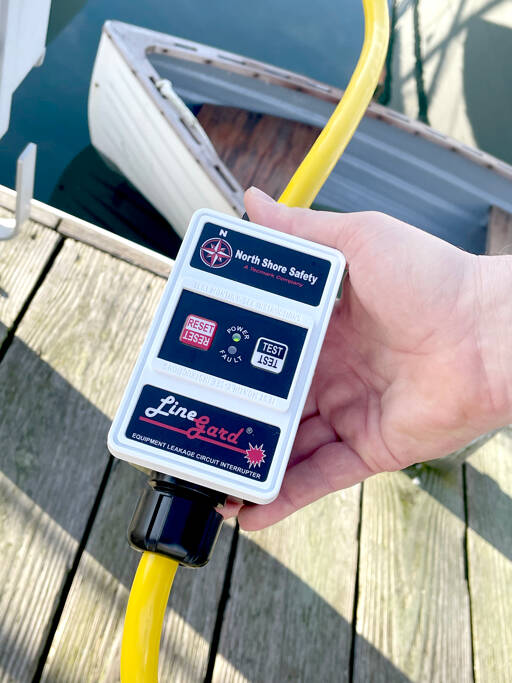
Ground-fault protection works differently. It monitors the electricity leaving on the hot conductor and compares it to what returns on the neutral. If there is an imbalance, the device trips and cuts power.
“Essentially what goes in has to come back out,” Vance said. “If the same amount doesn’t come through, it’s going somewhere else.”
That “somewhere else” could be a dock, another boat or a person in the water.
Vance said LNI has jurisdiction over most marina electrical systems in Washington. However, some cities — like Port Angeles — operate their own electrical inspection programs and enforce code locally.
Under state rules, electrical systems that were lawfully installed remain compliant until they are altered, repaired or replaced. Major upgrades, however, trigger requirements to meet current standards.
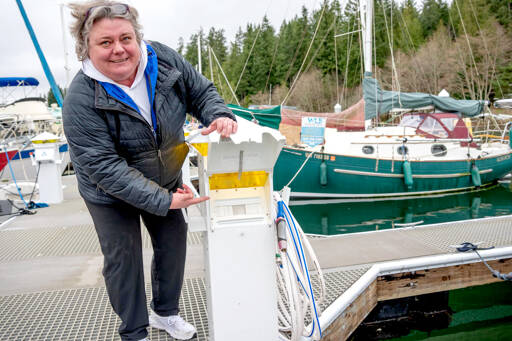
At Port Ludlow, marina director Kori Ward said the private facility already has begun upgrading its shore-power infrastructure as docks are replaced.
The marina installed new electrical pedestals serving 48 slips on Oct. 25 as part of a broader phased dock replacement project. Another section is scheduled to be installed in September.
Each of the new pedestals includes 30-milliamp ground-fault protection designed to shut off power if leakage is detected. Feeder lines serving groups of boats also provide cumulative protection.
“When those breakers go in, you find out pretty quickly which boats have issues,” Ward said. “The breaker’s doing exactly what it’s designed to do.”
When the new dock was first energized, two vessels immediately tripped their breakers. In both cases, owners were unaware their boats were leaking current.
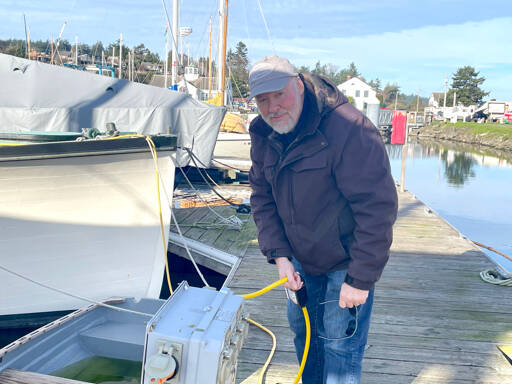
Beginning this year, annual testing of shore power connections is required. Port Ludlow has been conducting annual testing of permanent moorage tenants using clamp meters to measure leakage around power cords.
“Our main goal is to protect our guests, our tenants and our employees,” Ward said.
At the Port of Port Townsend, harbormaster Kristian Ferrero said staff are developing interim testing procedures while planning long-term infrastructure upgrades. At Point Hudson, the port is using ground-fault circuit interrupter (GFPE) protection at shore-power connections to detect leakage before a vessel connects with the marina’s system.
Boats that fail the test may remain in their slips but can be denied shore power until the problem is resolved.
Ferrero acknowledged the shift may be particularly challenging in Port Townsend, where many vessels are decades old.
“It’s a change to boating standards,” he said. “We know there’s going to be a lot of working with our lessees to make sure everybody’s brought up to the same code and safety standard.”
He described the upgrades as a “massive financial lift” for marinas, because the mandate for the upgraded standards aren’t funded.
Port of Port Angeles chief operating officer Chris Hartman said Boat Haven Marina’s electrical infrastructure like Port Townsend’s is considered “pre-existing, non-conforming,” meaning it can use GFCI protection to monitor leakage.
However, any major upgrades – such as a planned overhaul of Boat Haven Marina — would trigger compliance with updated ground-fault protection standards.
“It’s a safety concern that we’re taking seriously,” Hartman said.
“Any time there’s a safety issue, we want to make sure we get that squared away as quickly and efficiently as possible,” he said.
For boat owners looking for a long-term solution, Ritz recommends installing an isolation transformer, which addresses the root of the problem by eliminating the shared grounding path between a boat and the dock, preventing stray current from reaching the marina system in the first place.
Preventing electric shock drowning requires vigilance from marinas and boat owners alike — from shore-power systems to onboard wiring, Ritz said.
More than two decades after his son’s death, his message hasn’t changed.
“This is preventable,” he said.
________
Reporter Paula Hunt can be reached by email at paula.hunt@peninsuladailynews.com.


Best of Olympic Peninsula