
HORSEPLAY: Search and rescue teaches techniques for animals
Published 1:30 am Saturday, May 23, 2026
SLIP SLIDING AWAY was the feeling I got more than once when the ground began falling away underneath my horse as I traversed narrow mountain trails in the Olympics. The first time was in 1998, when riding my 17-hand thoroughbred from Slab Camp to the Deer Park campground. Riding up the first section the trail was so narrow that I couldn’t see it below his belly. I used some self-talk to assure myself horses are sure-footed animals, so I needn’t worry he’d fall down the hill into the ravine on our left. Ha! After my friends and I arrived back at camp, a ranger shared how the week before, “two mules crashed and burned down the hillside!”
Accidents with our animals can happen anywhere — at home, on trails and driving down the road, pulling a horse trailer — and it’s comforting to know Washington State Animal Response Team is available to render aid.
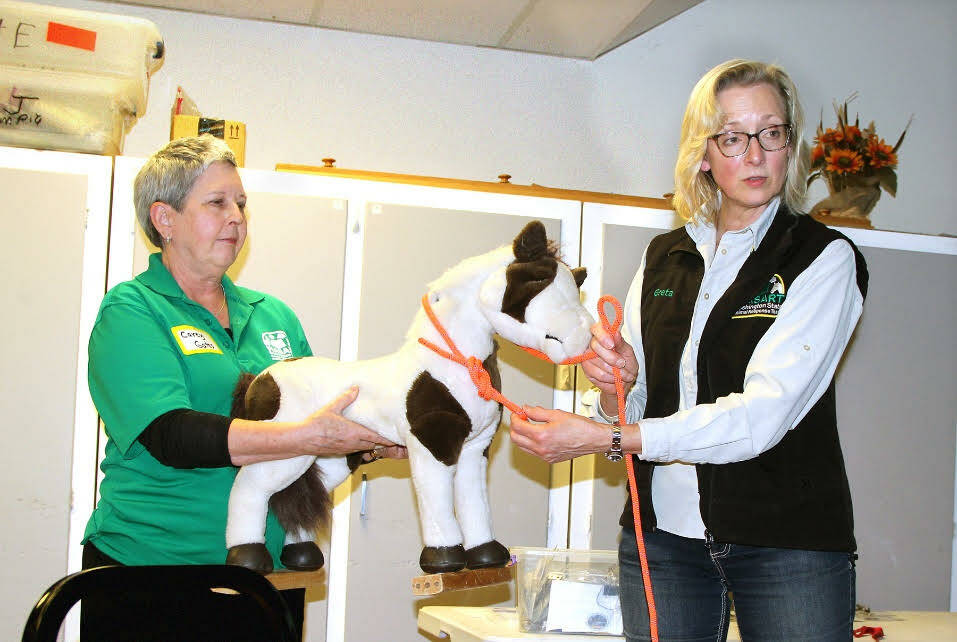
Earlier this month, I accepted Buckhorn Range Back Country Horsemen President Kris Lenke’s invitation to attend a monthly chapter meeting to hear WASART co-founder Greta Cook present “Helping animals and their owners in emergencies.”
I heard about the organization in 2021 when contacted by Kelly Thomas, a Sequimite, former WASART volunteer and longtime member of Clallam Search and Rescue (See my Nov. 28, 2021 column, “HORSEPLAY: Animal rescue group seeks volunteers”).
She joined to learn technical rescues, with “rigging equipment, operators and attendants that can actually go over the cliff to rescue dogs.”
WASART volunteers are trained to help in multiple situations, such as a horse or dog who’s fallen into a ravine or over a cliff, trapped in a well, becomes lame on a mountain trail, stuck in deep mud or needs to be extracted from a horse trailer badly damaged in an accident. They also offer short-term sheltering during disaster evacuations.
WASART’s team must be asked to assist by an owner or an agency, such as the fire department, sheriff’s office or emergency management.
“Community education and training is a core of the work we do,” said Cook, who drove three hours from her home in Longview. “We respond 24/7 to disaster and emergency situations involving domesticated livestock and companion animals.”
During an emergency, she asks people to take a deep breath and then calmly think about the situation before jumping in. Ask yourself: What’s going on? What can I do? Is there anybody around that can help me?
She shared detailed accounts of multiple rescues and techniques used, as well as teaching us animal owners how to prepare for, and perform, these methods ourselves.
“Hopefully, you’ll never need to use it on your own animals, but possibly you could help somebody else using some of these techniques,” said Cook, who has a background in emergency preparedness and livestock through the WSU extension.
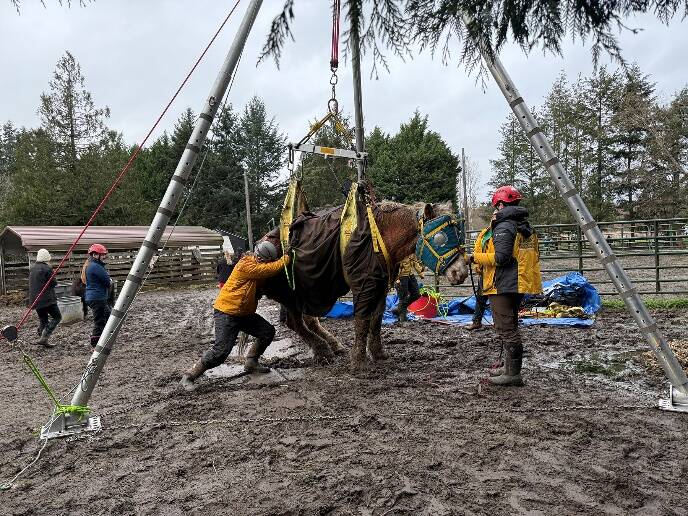
She showed pictures of rescuing Dakota, a retired search and rescue horse that was walking over what looked like “a really solid bridge just outside North Bend when a board broke and one of his legs went completely through to his belly.” WASART’s equipment and expertise was needed to safely extradite him.
By the time WASART arrived, a veterinarian had sedated Dakota and a high-line system utilizing block and tackle was being set up by a search and rescue group.
A block and tackle pulley system, or a force-multiplying system, uses two or more pulleys with a rope or cable threaded between them. It provides tension and can lift or move heavy loads.
“We used our equipment to rig the horse up. Then we raised him up out of the bridge and maneuvered him on to the green,” Cook explained. “It’s our 4- by 9-foot backboard. A little flexible, it’s a great skid that slides well. We got him on there and pulled him off and up.”
The result? Dakota was safely rescued and suffered minimal harm on his leg from the board collapsing.
Training
“Our technical rescue team typically meets twice a month to practice light system and heavy system trainings, using different equipment and supplies,” Cook said. “Our light system is for a 450 pound or lighter load. With our heavy system, we can go up to 2,500 pounds.”
A 22-foot-high aluminum tripod was made specially for the group by an engineer in Vermont who saw they were using 12-foot-long 4-by-4s, lashing them together and making a go of raising, which usually worked, she said. “This is faster and easier. We can use this animal configurations as a tripod, bipod or a monopod.”
Configured as a bipod, they once tipped it over a cliff to raise a horse 30 feet up to safe ground.
A variety of configurations with ropes, lines, straps, pulleys and specialty harnesses are used to rescue animals. Some are designed to hold the animal close to the person as they’re being pulled up the side of a bluff.
Tow straps, or recovery ropes, webbing and round slings are great for creating a rescue type of configuration to assist an animal. One-inch webbing is super handy for all sorts of ways to configure rescue aids, such as a temporary halter and lead rope; use as a pull a strap around a belly to pull the body toward you.
Laying the strap over the back and then both ends between the front legs is a forward assist. It can also be used as a rear drag, but only when they’re down. Never yank or pull on their head or tail. Just guide the head with a halter and lead rope. Use your hand to guide the tail.
Based in Enumclaw, Cook said their limiting factor is the time it takes them to get to the Peninsula. “We do have a few members there. We’re always looking for more.”
When faced with an urgent situation, she said to call 911. They will contact WASART and any other organization that may be able to help. She suggests calling early, pleading, “please don’t wait until dark and after you’ve given up trying to rescue the animal yourself.”
WASART is always looking for new volunteers and places with animals to train people how to work with animals in various situations.
It’s an all-volunteer, donation-supported 501(c)(3). They respond statewide, 24/7. Dial 911 or the WASART emergency line at 425-681-5498.
To donate or to find out more, visit WASART.org
For information on the Buckhorn Range chapter, see its Facebook page or buckhornbchw.org.
________
Karen Griffiths’ column, Peninsula Horseplay, appears the second and fourth Saturday of each month.
If you have a horse event, clinic or seminar you would like listed, email Griffiths at kbg@olympus.net at least two weeks in advance. You can also call her at 360-460-6299.

Best of Olympic Peninsula