
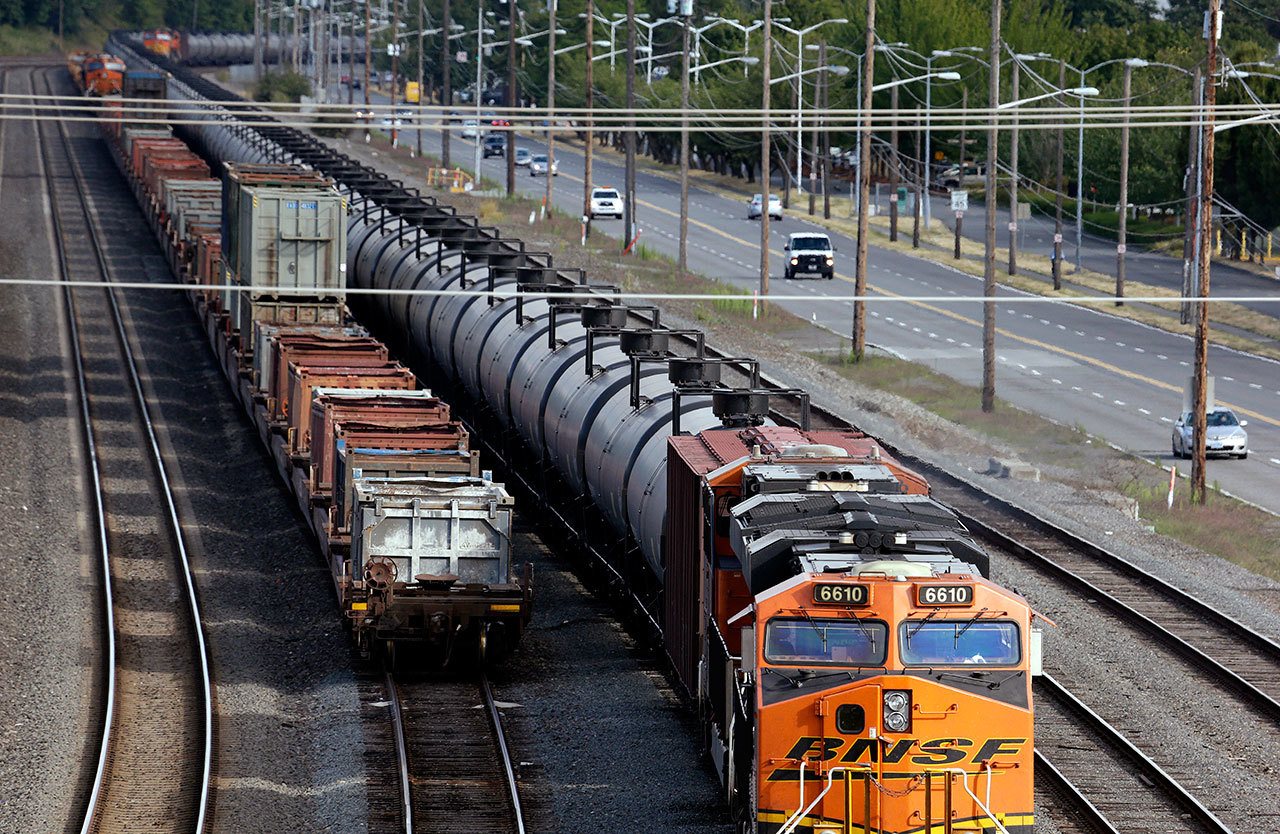
In this July 27, 2015, photo, traffic passes one of two mile-long oil trains parked near the King County Airport in Seattle. (Elaine Thompson/The Associated Press)

In this July 27, 2015, photo, traffic passes one of two mile-long oil trains parked near the King County Airport in Seattle. (Elaine Thompson/The Associated Press)

Bills aim to beef up oil transportation safety

Bills aim to beef up oil transportation safety

  • The Associated Press
  • Thursday, February 9, 2017 1:30am
  • News

By Phuong Le

The Associated Press

SEATTLE — With more crude oil expected to move through Washington state, Democratic lawmakers want to toughen rules around oil transportation and raise more money for spill prevention and response efforts.

Companion bills in the House and Senate aim to reduce the risk of oil spills with provisions that target oil carried by vessels, pipelines and trains. Supporters say the legislation is needed to address the growing risks of oil shipped through state waters.

In November, Canadian Prime Minister Justin Trudeau approved Kinder Morgan’s Trans Mountain pipeline expansion project, which will increase from five to 34 the monthly number of oil tankers and barges plying the shared waters of Washington state and Canada.

The pipeline will carry oil from Alberta to the Vancouver area, where it will be loaded onto barges and tankers for Asian and U.S. markets. Indigenous leaders and environmentalists object to the project over environmental, health and other risks.

“We’re really trying to stay on top of the changing landscape of oil transportation,” said Rep. Jessyn Farrell, D-Seattle, sponsor of House Bill 1611. The companion Senate Bill 5462 is sponsored by Sen. Reuven Carlyle, D-Seattle.

Both measures would require the Department of Ecology to write rules that may require tug escorts and other safety measures for certain vessels such as barges and articulated tug barges through the San Juan Islands and Puget Sound.

Tug escorts are currently required for oil tank ships that transit parts of northern Puget Sound. But vessels such as barges and articulated tug and barges — ships where the tug and barge are combined — aren’t subject to those requirements.

The use of tug escorts for oil-carrying vessels such as articulated tug and barges was identified as the top priority during a recent Salish Sea spills risk workshop hosted by Ecology.

Cliff Webster with The American Waterways Operators testified against SB 5462 at a hearing last Thursday. The state has one of the best oil spill prevention and response programs in the country and there has not been a major cargo spill in waters for years, he said.

But “it only takes one incident to deal a major blow to Puget Sound,” said Rebecca Ponzio with the Washington Environmental Council.

She said it’s a critical year to act, because of the Trans Mountain project and the federal government has lifted a 40-year ban on crude exports, opening the way for oil to be exported through the state’s refineries.

Under the bills, oil refineries proposing to handle crude oil for export update their spill response and prevention plans. Railroads would have to show they have the ability to pay for cleanup and damage caused in the event of a major oil spill — something vessels and pipelines are required to do.

Johan Hellman with BNSF Railway told lawmakers the provision was redundant, unnecessary and conflicts with federal government rules governing railroads. He said the state law passed in 2015 required railroads to submit financial reports to state regulators to demonstrate fiscal solvency. Supporters say it’s needed to ensure that railroads can pay the costs of a major spill.

The state currently levies two taxes for a total of 5 cents on every barrel of oil received by train or vessels to pay for spill response and prevention measures. The bills would extend that tax to pipelines. It would also eliminate a cap on the 4-cent tax that currently takes effect when the account balance hits a certain amount.

Jessica Spiegel, a spokeswoman with the Western States Petroleum Association, said state figures show that only 3 percent of spills are related to the petroleum industry, such as pipelines, trains or fuel barges.

“We believe it’s time to identify the sources of actual spills and place a share of the funding burden on those who are causing the problems,” she said.

Separately, another bill sponsored by Farrell and requested by Ecology, seeks to raise the oil spill administration tax by 2.5 cents a barrel, from 4 cents to 6.5 cents. Ecology says it is facing a $4 million shortfall in the next biennium because it only received a one-time transfer of money for work related to the oil transportation law passed in 2015.

“We’ve been successful in the state because we’ve taken a proactive approach,” Farrell said. “We can’t rest on our laurels.”
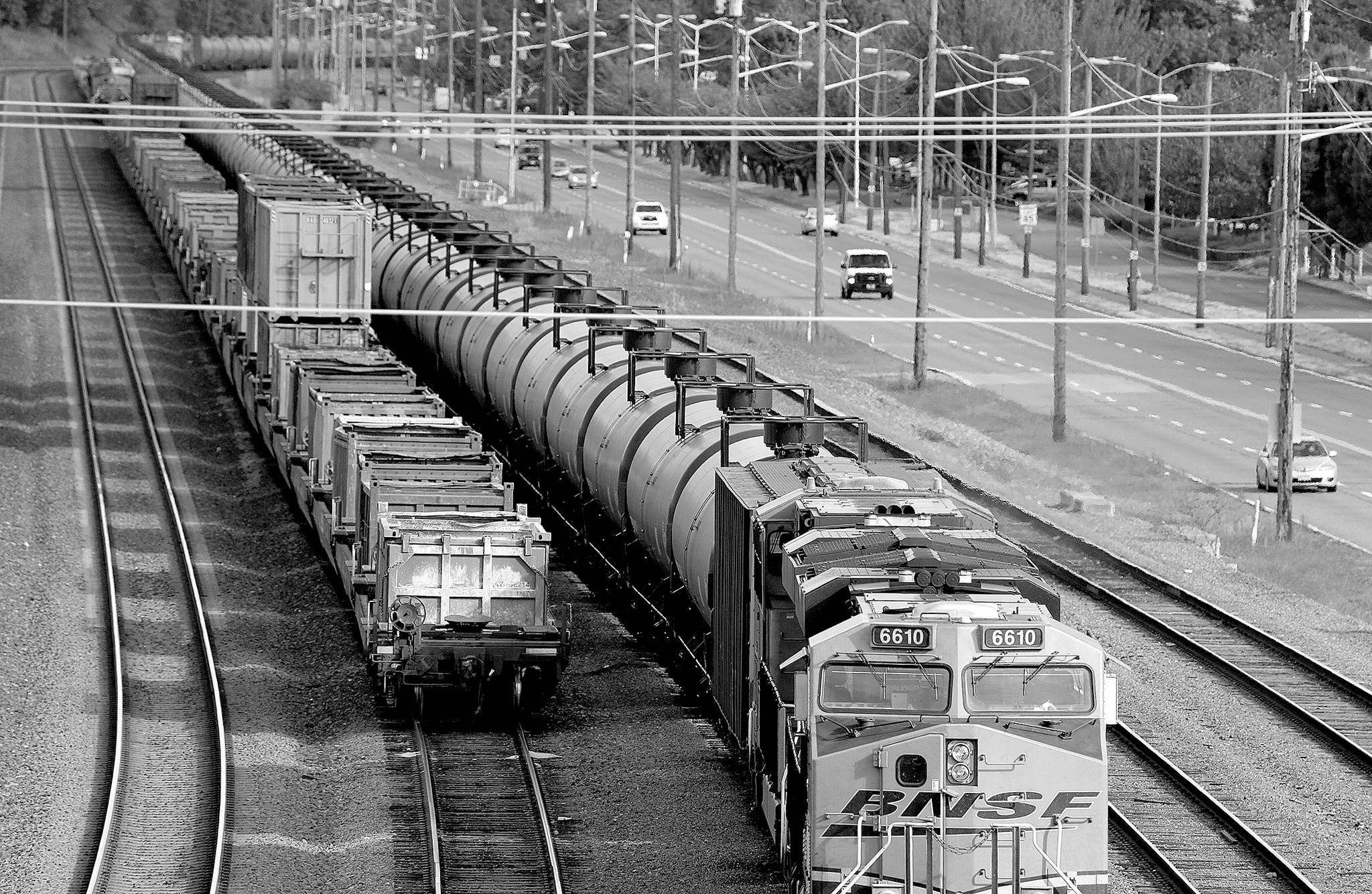
In this July 27, 2015, photo, traffic passes one of two mile-long oil trains parked near the King County Airport in Seattle. (Elaine Thompson/The Associated Press)

In this July 27, 2015, photo, traffic passes one of two mile-long oil trains parked near the King County Airport in Seattle. (Elaine Thompson/The Associated Press)

More in News

Sequim’s 2026 budget is about 11 percent less than this year with fewer capital projects and a new cap on municipal funding. Staffing will increase by 1.1 full-time-equivalent employees following retirements, position changes and new hires. (Matthew Nash/Olympic Peninsula News Group)
Sequim approves $51.6M budget

Utility increases to continue for five years

Santa Claus, the Grinch and career and volunteers with Clallam County Fire District 3, IAFF Local 2933 and the Community Emergency Response Team (CERT) will accept food and toy donations this week as part of Santa’s Toy and Food Fire Brigade in Sequim. The food and toy drive will end on Friday at Sequim Walmart with donations accepted from 9 a.m. to 9 p.m., and Santa arriving to hand out candy canes and take photos from 5 p.m. to 8 p.m. (Matthew Nash/Olympic Peninsula News Group)
Toys, food to highlight Sequim Santa Brigade

Program will culminate Friday with booth at Walmart location

Sequim Museum volunteers Bob Stipe, Scott Stipe and executive director Judy Reandeau Stipe stand with Dan Bujok, VFW district commander, and Ken Bearly, Carlsborg 4760 post commander, at the museum’s Veterans Monument. It’s recently been refurbished and organizers welcome past and present veterans and their family members to apply for a tile to be placed on the east side of the wall. (Matthew Nash/Olympic Peninsula News Group)
Museum seeks veterans to add tiles to monument wall

Rededication ceremony tentatively set for early 2026

Weekly flight operations scheduled

There will be field carrier landing practice operations for aircraft… Continue reading

Denny Bellow, left, waves as he departs the Sequim Food Bank to collect food as part of the 15th annual Cranksgiving event on Nov. 22. Cranksgiving drew a record 84 cyclists and resulted in donations to the Sequim Food Bank of more than $6,400 and more than 2,000 pounds of food, Executive Director Andra Smith said. The event was open to riders of all ages and involves swag and prizes donated by local merchants and national bicycle brands. Over the years, it has brought in more than 10 tons of food and more than $27,000 in donations, with participants purchasing food from along Washington Street. (Monica Berkseth/For Olympic Peninsula News Group)
A record-setting Cranksgiving

Annual event benefiting Sequim Food Bank sees highest number of riders

Aaliyah Clark of Poulsbo (378) and Monica Castleberry of Lacey (21) lead a young runner at the start of the Jamestown S'Klallam Glow Run in Blyn late Saturday afternoon. The race had a record-breaking 900 participants this year. (Michael Dashiell/Jamestown S'Klallam Tribe)
RUN THE PENINSULA: Record-setting crowd at Jamestown Glow Run

A record-setting huge crowd of nearly 900 people ran in… Continue reading

U.S. Rep. Emily Randall.
US Rep. Randall speaks on House floor about insurance

Example of fictional family shows premium increase of more than 1,000 percent

Spending patterns led to pool audit

Office identifies $33K in unsupported payments

Comments oppose plan against Port Townsend zoning changes

Option would increase maximum limit on units per 40,000 square feet

x
Sequim program uses grant for utilities, rent

Community support through Peninsula Home Fund gives $10,000 to organization

Firefighters Tyler Gage and Tatiana Hyldahl check out the light connections on the 1956 fire truck that will travel the streets of Port Angeles during the 41st Operation Candy Cane beginning Monday. Santa and his helpers will pass out candy canes to those who donate food items or cash. The runs will begin at 5:30 p.m. and include the following areas: Monday, west of I street and M street; Tuesday, I and L streets to C street; Wednesday, C Street to Lincoln Street; Thursday, Chase Street to Chambers Street; Friday, Jones Street to Golf Course Road; Dec. 13, above Lauridsen Boulevard. It will be stationary from 5:30 p.m. to 7 p.m. on Dec. 14 at the Port Angeles Grocery Outlet and during the same time on Dec. 15 at Lower Elwha Food and Fuel. (Dave Logan/for Peninsula Daily News)
Operation Candy Cane

Firefighters Tyler Gage and Tatiana Hyldahl check out the light connections on… Continue reading

Online survey launched for Sequim parks access

The city of Sequim has launched an online survey to… Continue reading